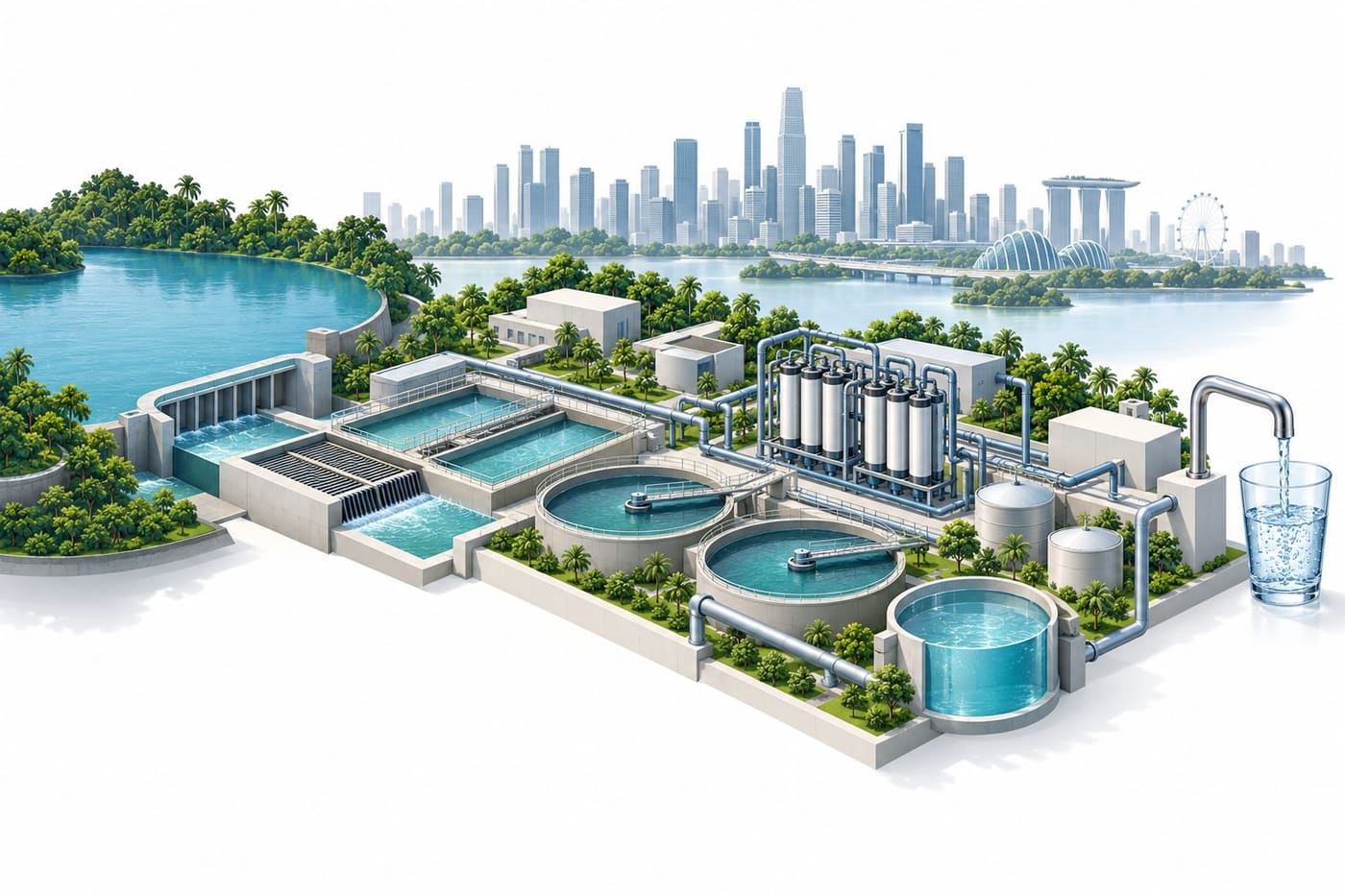
Turning on a tap takes a second. Explaining what happened before the water arrived takes longer, because a water supply is not a single machine. It is a chain of collection, treatment, storage, distribution and checking. Singapore offers a useful example of how different technologies can work within that chain without all doing the same job.
Recent Singapore search interest in tap water provides the starting point for this technology explainer. The purpose is to explain the processes behind the supply, rather than assess a particular household's plumbing or issue an independent water-quality alert. For an actual problem at a property, current instructions from PUB and the responsible building manager take priority over a general article.
The most useful distinction is between the source of water, the treatment applied to it and the evidence used to assess the finished supply. Confusing those three can make a dramatic image of untreated water seem like a test result for drinking water. It is not. Equally, a picture of a modern treatment plant is not a substitute for operational evidence.
Start with the treatment route
PUB's source-to-tap explanation describes reservoir water travelling to waterworks, followed by treatment, storage and distribution. Its process diagram includes screening, coagulation and flocculation, sedimentation, filtration, disinfection and further conditioning. These steps form multiple barriers rather than a single act of filtering. The document also shows the clear-water tank and service reservoirs as parts of the route to customers. [PUB treatment process](https://www.pub.gov.sg/-/media/PUB/PDF/WaterTreatment.pdf)
That sequence helps answer a common question: why not simply install the finest possible filter and finish there? Different stages address different tasks, and the water entering a later stage has already been changed by earlier ones. A treatment route should therefore be understood as a designed sequence, not a collection of interchangeable devices.
For a non-specialist, reading the sequence from left to right is more useful than trying to memorise every technical term. First ask what enters a stage. Then ask what the stage changes, what leaves it and where that output goes next. The same questions can be used to understand a household appliance, an industrial process or a city-scale facility, although their capabilities are very different.
Why particles are sometimes made larger before removal
The US Centers for Disease Control and Prevention explains coagulation as the addition of chemicals that help small particles bind together. Flocculation then involves gentle mixing to form larger groups, or flocs. Sedimentation allows heavier material to settle, while filtration and disinfection address further treatment needs. The CDC also stresses that utilities choose processes according to the starting water quality. [CDC treatment overview](https://www.cdc.gov/drinking-water/about/how-water-treatment-works.html)
The seemingly counterintuitive idea is to make certain material easier to separate before attempting the separation. A useful everyday analogy is gathering scattered paper into a stack before moving it. The analogy illustrates organisation, not the chemistry, and should not be used as a recipe for treating water at home.
This is also why the word “chemical” alone tells a reader very little about whether a treatment is appropriate. A meaningful technical explanation identifies the substance, purpose, controlled conditions and resulting quality. An alarming label or reassuring adjective cannot replace those details. Readers do not need to become plant operators, but they can recognise when an explanation is missing the part that makes it understandable.
Used-water treatment comes before advanced reuse
PUB describes a used-water treatment sequence beginning with removal of debris and grit. Further stages separate settled solids and use biological treatment to break down organic pollutants. Its account also describes membrane bioreactors, which combine biological treatment and membrane separation within an integrated approach. [PUB used-water treatment](https://www.pub.gov.sg/Professionals/Requirements/Used-Water/Treatment)
This distinction matters when discussing recycled water. The input to an advanced reuse process is not adequately described by an image of something poured down a drain. Treatment has already taken place before subsequent purification stages. Leaving those stages out gives readers the wrong picture of the system.
There is another useful distinction between removing material from the water and making material disappear from the world. A process explanation should account for separated solids and other output streams, not just the water that continues forward. When a diagram shows only a clean-water arrow, ask what has been simplified out. Good introductory diagrams simplify complexity; they should not encourage the belief that treatment has no other outputs or operating requirements.
Where NEWater fits
PUB describes NEWater as further-purified treated used water. Its published sequence includes microfiltration or ultrafiltration, reverse osmosis and ultraviolet disinfection, with membrane-bioreactor arrangements able to replace the first filtration stage where applicable. The agency identifies industrial and cooling uses as major applications, supplied through dedicated infrastructure. It also explains that, during dry periods, NEWater can be blended into reservoirs, with reservoir water subsequently treated at waterworks before distribution as tap water. [PUB NEWater](https://www.pub.gov.sg/Public/WaterLoop/OurWaterStory/NEWater)
Two ideas are easily lost in a short headline. First, reuse involves treatment rather than merely recirculating the same water unchanged. Second, the intended use and route matter. Industrial supply and the reservoir-to-waterworks route are not identical descriptions.
For a reader trying to sketch the system, use separate arrows for those destinations. Doing so avoids a misleading drawing in which every output seems to travel directly from the same machine to every kitchen. A good sketch need not show every pipe. It should preserve the distinctions on which the explanation depends.
A membrane is a component, not a complete promise
Membrane names can sound like rankings in which the most advanced-sounding term automatically wins. In practice, readers should ask what role a membrane performs in the specific process being described. A name alone does not establish the condition of an installation, the quality of its input or the quality of its output.
Consider a fictional product brochure that says only “uses advanced membrane technology”. That statement leaves important questions unanswered. What is the intended use? What substances or organisms was performance assessed against? Under which conditions? What maintenance does the manufacturer require? The example is a way of reading technical claims, not a criticism of a particular product or a recommendation to buy one.
The same caution applies to attractive animations. A stream passing through a glowing cylinder can communicate the idea of separation. It cannot establish measured performance. When evaluating an explanation, look for the bridge between the visual model and evidence: specifications, tests, operational context and the limitations explicitly stated by the responsible organisation.
Desalination solves a different starting problem
PUB's desalination overview describes reverse osmosis removing dissolved salts and minerals from seawater. The agency characterises desalination as energy-intensive and gives an indicative energy use of about 3.5 kilowatt-hours per cubic metre for Singapore's current reverse-osmosis approach. It also describes ongoing work to reduce energy requirements. That figure belongs to the agency's stated context; it should not be treated as the exact consumption of every plant or every litre supplied. [PUB desalination](https://www.pub.gov.sg/Public/WaterLoop/OurWaterStory/DesalinatedWater)
An arithmetic example makes the unit easier to understand. At that indicative rate, producing 100 cubic metres would correspond to about 350 kilowatt-hours for the stated process basis. This is simply 100 multiplied by 3.5. It is not a household electricity bill, a tariff calculation or a complete accounting of the entire water system.
Keeping the boundary visible is important. A number can be mathematically correct while its interpretation is wrong. Before comparing two energy figures, check whether both include the same activities. A plant process, distribution network and complete supply chain are different accounting boundaries. Without that clarification, a comparison can appear precise while answering different questions on each side.
Monitoring is part of the technology
PUB's water-quality page describes sampling from reservoirs, treatment facilities and distribution systems, alongside online sensors and laboratory testing. It states that Singapore's tap water is suitable for drinking directly without further filtration and describes its laboratory accreditation. This is the agency's published position on the supplied water, not our independent test of a particular property. [PUB water quality](https://www.pub.gov.sg/Public/WaterLoop/Water-Quality)
Monitoring belongs in the explanation because equipment and evidence are different things. Installing a treatment process establishes what a system is designed to do. Testing and operational oversight help establish what is happening. A reader who asks only which machine is present misses the equally important question of how performance is checked.
This principle extends beyond water. A beautifully designed bridge still needs inspection; a refrigeration system still needs temperature control. The comparison is about the relationship between design and evidence, not a claim that these systems face identical risks. Trust is stronger when the explanation includes how problems would be noticed, rather than asking the public to rely on appearances.
Three questions that prevent common misunderstandings
When reading a water-related headline, separate these questions before deciding what it means:
- What water is being discussed: rainwater, reservoir water, treated used water, finished drinking water or water from a specific fitting?
- What evidence is provided: a photograph, an official explanation, a laboratory result or a report about an individual incident?
- What action is actually advised, by whom, for which location and period?
The questions are useful because they keep a reader from jumping between categories. A photograph can accurately show the contents of a container while saying nothing about a separate supply. An official statement about a national system also should not be rewritten as an inspection certificate for every appliance inside every building.
If sharing an update, retain the date and link to the original organisation. Avoid removing the qualification that makes a statement accurate. “This test found...” and “all water everywhere is...” are very different claims, even if a social-media caption makes the shorter version easier to share.
A simple learning exercise without unsafe experiments
To explain the system to a child or a non-technical audience, draw four large boxes: source, treatment, checking and use. Add the names of the relevant processes underneath rather than starting with a dense engineering diagram. Then ask the learner to explain why a result from one box does not automatically describe every other box.
For example, where would a photograph of rainwater belong? Where would a laboratory report on finished water belong? Where would a household tap complaint belong? There may be more than one connection, and discussing those connections is the point of the exercise.
Do not turn the activity into a demonstration in which homemade filtered water is tasted. A jar becoming clearer is a visual change, not a drinking-water safety assessment. Paper models and official process illustrations can teach the concept without inviting someone to treat an informal classroom experiment as a functioning public utility.
What a useful water-technology story should include
A strong explanation needs more than the newest equipment name. It should identify the problem being solved, the relevant input, the sequence of operations and the way results are evaluated. It should also say what is outside its scope. Otherwise, a reader may leave with confidence but little understanding.
Here is a compact checklist for evaluating a presentation or article:
- Does it distinguish different sources and treatment routes?
- Are numerical claims attached to units, dates and a clear context?
- Does it separate a conceptual illustration from a real facility or measured result?
- Are operating and monitoring responsibilities visible?
- Does it give an appropriate official route for current questions rather than presenting itself as an emergency notice?
These are editorial questions, not an engineering acceptance test. They help a general audience recognise clarity and missing context. A specialist assessing a real installation would need much more information than a public-facing article provides.
The value is in the connected system
Singapore's water technologies are easier to understand when they are presented as connected processes. Reservoir treatment, used-water reclamation, advanced reuse, desalination and quality monitoring address different parts of the task. Combining them into a single vague idea of “purification” hides the decisions that make the story interesting.
For the ordinary reader, the goal is not to memorise a plant layout. It is to understand why the source, treatment route and evidence must be considered together. That understanding makes both reassuring statements and worrying headlines easier to assess without replacing expert guidance with guesswork.
Editorial notes
Sources checked on 25 October 2026. This Technology/Singapore explainer was prompted by the tap-water topic in our country Trends snapshot. It explains established treatment processes; it is not an independent analysis of current haze contamination or a property-specific safety assessment. The official PUB sources linked above provide the primary technical basis. The CDC source supplies general treatment terminology and is not presented as Singapore's regulator.
The cover is an original AI-generated conceptual illustration. It does not depict the actual arrangement of a Singapore treatment facility and must not be used as an engineering drawing. Arithmetic examples and reading exercises are original explanatory material. The separate advertising spaces on this staging page are placeholders and do not endorse a treatment device or water-testing service.