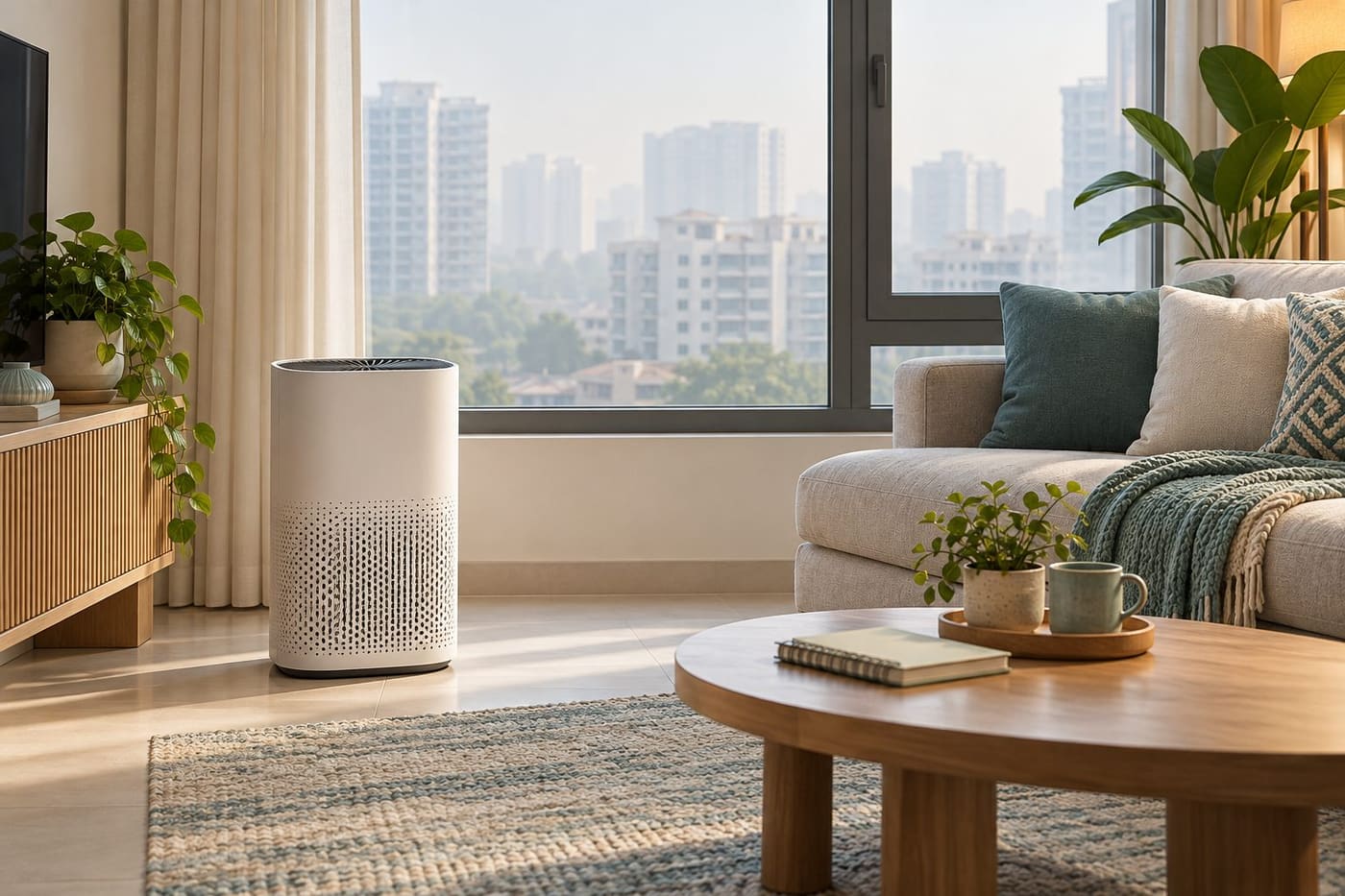
A hazy view from the window can prompt two immediate questions: should the windows stay shut, and would an air purifier help? The useful answer starts with the conditions outside, the room you actually use and the people sharing it. Buying a device is only one part of that decision.
This guide was researched on 25 October 2026, when Singapore searches for haze and indoor air quality included questions about masks, exercise and air cleaners. It explains a practical household planning process using official guidance. It does not report a live pollution reading, certify a home as safe or replace individual medical advice.
Check the right information before changing the plan
Singapore's [Public Service Division guide, dated 29 September 2026](https://www.psd.gov.sg/challenge/articles/6-tips-for-hazy-days/), distinguishes planning ahead with the PSI forecast from using the one-hour PM2.5 reading for an immediate outdoor decision. It also advises using official readings rather than relying on how the sky looks or smells.
That distinction prevents a common mistake: treating a screenshot captured earlier as though it answers a question about the next hour. Open the current official source, check its timestamp and make sure you understand which measure it displays. A number without its time and label is easy to misinterpret, especially when it has been forwarded through several chats.
For a household, a useful note might read: “Checked the official advisory at this time; will check again before the planned outdoor activity.” That is an organisational suggestion, not a medical threshold. It keeps the action connected to current information rather than allowing yesterday's plan to become today's assumption.
Use the [NEA haze portal](https://www.haze.gov.sg/home) for current information. This article deliberately avoids freezing a changing air-quality value into a headline that could remain online after conditions change.
Make the household plan personal without inventing medical rules
The [Ministry of Health's haze guidance, updated 21 October 2026](https://www.moh.gov.sg/others/haze/), explains that effects depend on health status, exposure duration, air quality and the intensity of outdoor activity. Its advice distinguishes groups, including people with chronic heart or lung conditions. People who feel unwell should seek medical advice rather than assuming a general household plan covers their situation.
Start your practical discussion by asking who will be home, which activities are planned and whether anyone already has a clinician's instructions. Keep prescribed medication available as directed. Do not change treatment or invent a new rule from a social-media post about the haze.
The goal is a shared plan with room for different needs. A person working indoors, someone leaving for a short errand and someone planning strenuous outdoor activity are not facing identical circumstances. Use the official advisory for the relevant situation; a single instruction in a family chat should not silently replace that distinction.
Closing windows is a response to conditions
NEA's [practical indoor-air guidance](https://www.haze.gov.sg/docs/default-source/faq/detailed-practical-tips-for-manging-iaq-during-haze.pdf?sfvrsn=2) describes closing doors and windows when outdoor air deteriorates, then reopening them when outdoor conditions improve. It also notes that an enclosed space can accumulate heat, carbon dioxide and other pollutants. The purpose is to manage changing conditions, not to keep a room sealed indefinitely.
This document dates from 2014; it remains useful for that specific explanation, while current health decisions should follow the latest advisory. Its discussion is not a reason to alter shared building ventilation or block a safety vent. If the arrangement in your home is unclear, ask the building manager or an appropriate professional before changing equipment.
Our practical suggestion is to give the window decision an owner and a review point. In a shared flat, one person may close the windows while another opens them without knowing why. A short explanation of the current plan prevents that confusion. The review point matters just as much: someone should check when conditions have improved rather than leaving the original action in place by default.
Reduce what the room itself produces
The Public Service Division guide recommends avoiding indoor smoking and using damp wiping or mopping instead of stirring settled dust back into the air. These are modest household measures; they do not remove the outdoor haze or prove that all indoor pollutants have gone.
Think through the room before adding more equipment. Is the proposed air-cleaner position beside a cluttered shelf? Are household members treating a pleasant scent as evidence of clean air? Does everyone know that the plan includes ordinary upkeep, rather than expecting one appliance to cancel everything else happening indoors?
A useful preparation task is to clear the intended space and identify the actual problem you want to address. “Reduce fine particles in the bedroom during a haze episode” is a more specific goal than “make the flat healthy.” The narrower description helps you evaluate a product claim without accepting a promise that extends to every pollutant and every room.
What an air cleaner can and cannot do
The [US Environmental Protection Agency's household overview](https://www.epa.gov/indoor-air-quality-iaq/air-cleaners-and-air-filters-home) describes filtration as a supplement to reducing pollution sources and ventilating with clean outdoor air. It distinguishes a portable unit serving a room or area from a central system, and cautions that air-cleaning equipment cannot remove every pollutant.
That is general technical background, not a replacement for Singapore's haze advisory. It supports a limited expectation: an appropriate device may help with the pollution it is designed to address. It does not support an assurance that buying a purifier makes every activity suitable or eliminates the need to respond to symptoms.
For shopping purposes, write the intended use at the top of your comparison sheet. Then put each advertised claim beside that use. A statement about particle filtration, a statement about electricity consumption and a statement about room coverage answer different questions. One should not be allowed to stand in for the others.
Match the rating to the actual room
NEA's [current air-pollution FAQ](https://www.nea.gov.sg/our-services/pollution-control/air-pollution/faqs) recommends efficient particle filtration, such as HEPA, and sizing a portable cleaner to its space. It gives an ordinary sizing estimate of smoke CADR in cubic metres per hour at least equal to room volume in cubic metres multiplied by five. It specifies a different estimate for certain harder-to-ventilate or higher-risk settings, so the general calculation should not be applied indiscriminately.
Here is an illustrative calculation, not a measurement of your home. A rectangular room measuring 4 metres by 3 metres with a 2.6-metre ceiling has a volume of 31.2 cubic metres. Applying the ordinary five-times estimate gives 156 cubic metres per hour of smoke CADR. These numbers demonstrate the method only; they do not certify a particular model or installation.
Keep the units beside the calculation. Floor area and room volume are different quantities. Likewise, a product specification expressed in one airflow unit should not be compared numerically with another unit without conversion. If a seller supplies only a broad room-size slogan, request the underlying specification and the conditions it assumes.
Compare products without turning the article into a shopping list
Once you have a room and a relevant rating, compare practical ownership details. Record the exact model, the filter it requires, the replacement-filter price and whether the supplier can provide that filter. Keep these as questions to verify at purchase time; this article has not checked current stock, prices or a particular retailer.
Ask what operating setting the advertised performance refers to. The [EPA's consumer guide](https://www.epa.gov/indoor-air-quality-iaq/guide-air-cleaners-home) notes that CADR is typically measured at the highest speed and that noise can affect whether people keep using a unit. It also advises avoiding products that intentionally generate ozone and keeping airflow unobstructed.
The comparison therefore needs more than a large number on a box. A household may prefer a unit it can operate consistently in the intended room, with clear instructions and an available replacement filter. This is a practical buying criterion, not a recommendation for a brand or a claim that the quietest device is necessarily the right one.
Set up the room before switching on
Use the manufacturer's instructions for placement, clearance and electrical requirements. Do not choose a position solely because the device disappears neatly behind furniture. The aim is a workable location that household members can maintain without moving it somewhere unsuitable whenever they use the room.
Walk through the everyday routine. Can someone reach the controls? Will a curtain cover the unit? Is the cable crossing a route used at night? Where will the manual and filter information be kept? These are setup questions you can answer before a haze episode becomes the reason for a rushed purchase.
For a shared household, label the plan rather than modifying the machine. A private note can identify the intended room, the agreed operating arrangement and the person who will check the manual when maintenance is due. It should not claim that an indicator light certifies the room's safety.
Do not confuse cooling with filtration
A cool room can feel more comfortable, but comfort is not a complete measurement of indoor air quality. The EPA consumer guide explains that many window and wall-mounted air-conditioning units are principally designed for temperature control, with limited filtration rather than removal of fine particles from room air.
Check the actual equipment instead of assuming that every air conditioner performs the same job as a dedicated particle cleaner. Equally, do not assume a portable cleaner supplies fresh outdoor air. Those are different functions, and the household plan may need to account for both.
A useful question for a building manager or technician is specific: “What does this system filter, and how is outside air supplied?” That gives them something answerable. Asking whether the room is “fully protected” invites a broad reassurance that may conceal the distinctions you need to understand.
Keep maintenance realistic
A purchase plan that omits upkeep is incomplete. Find the manufacturer's maintenance instructions for the exact unit and filter. Do not wash a component unless its instructions say it is washable, and do not invent a replacement interval based on an unrelated model discussed online.
Record the installation date and the model of the replacement filter in a place you can find again. This is especially useful if the packaging is discarded or another household member later takes over the task. A short note is enough; the purpose is to avoid rediscovering the same information every time.
If replacement parts appear unavailable, resolve that before assuming the product will be practical for the household. Ask the seller about compatible parts and verify the answer against the manufacturer's information. A cheaper initial price may be less useful if the required maintenance cannot be carried out reliably.
A fictional shared-flat example
Imagine three adults sharing a flat. One works from home in a bedroom, one uses the living room in the evening, and one is away for most of the day. They have one portable cleaner and have not agreed where it should go. This is a planning example, not a claim that a particular arrangement is suitable for every household.
Their first useful step is to identify the room the device is meant to serve and check its specification against that room. Moving it back and forth without a plan does not establish that it has provided equivalent cleaning everywhere. They also need an agreed window-review routine based on current outdoor information.
Next, they assign the simple tasks: one person checks the official advisory before a planned outdoor activity, another locates the maintenance instructions, and all three know why the device should remain clear of obstructions. None of these steps proves a health outcome. Together, they turn a vague intention into actions that can actually be followed and reviewed.
Keep masks and medical decisions in the right place
A household air-quality article should not invent a universal mask rule. MOH's current guidance discusses when N95 or equivalent masks may help outdoors, the importance of fit and circumstances in which medical advice is needed before use. Consult that guidance for the person and activity concerned rather than treating a mask as permission to ignore the advisory.
If someone feels unwell, do not keep experimenting with appliance settings instead of seeking appropriate care. A device display cannot diagnose symptoms or override a clinician's advice. This article does not provide medical clearance for exercise, work or prolonged outdoor exposure.
The practical role of a household plan is to make information and responsibilities easier to find. It should support an appropriate decision, not replace the professional advice required by an individual situation.
A short checklist to keep beside the plan
Before making changes, check the current official information and the needs of the people involved. Then identify one concrete room or activity to address. That keeps preparation manageable and makes it easier to notice what remains unresolved.
- Confirm the timestamp and type of air-quality information.
- Identify the room and measure it if comparing cleaner capacity.
- Check the exact device instructions, filter and operating conditions.
- Agree who reviews the window and activity plan when conditions change.
- Keep maintenance information accessible and seek medical advice when needed.
These steps are not a promise of pollution-free air. They are a way to avoid preventable confusion: an outdated screenshot, an underspecified purchase, a blocked appliance or a household rule that nobody remembers to review.
A useful plan is one you can revise
Singapore haze preparation works best when the household response remains connected to current conditions. Use the official advisory, manage the indoor environment thoughtfully and judge an air cleaner by its intended function and room requirements. Keep medical questions with the appropriate professional.
The result should be a clear, revisable routine rather than a pile of products or a permanent rule to seal every window. You know what information you checked, what the equipment is meant to do and what still requires attention. That is a practical foundation for managing the next hazy day without overstating what any one measure can achieve.
Editorial note: Researched on 25 October 2026 using Singapore NEA, MOH and Public Service Division guidance, with US EPA technical background. This AI-assisted guide includes original planning examples and a hypothetical room calculation, not a product test, medical assessment or live air-quality bulletin. The generated illustration shows a fictional apartment, not current haze conditions. Limited web phrase checks are not comprehensive plagiarism certification.