Summary: A useful inflight watchlist is short enough to use and varied enough to suit your mood. Here is how to explore KrisWorld’s film and television catalogue, check language and accessibility requirements, and avoid turning a long flight into an unfinished viewing marathon.
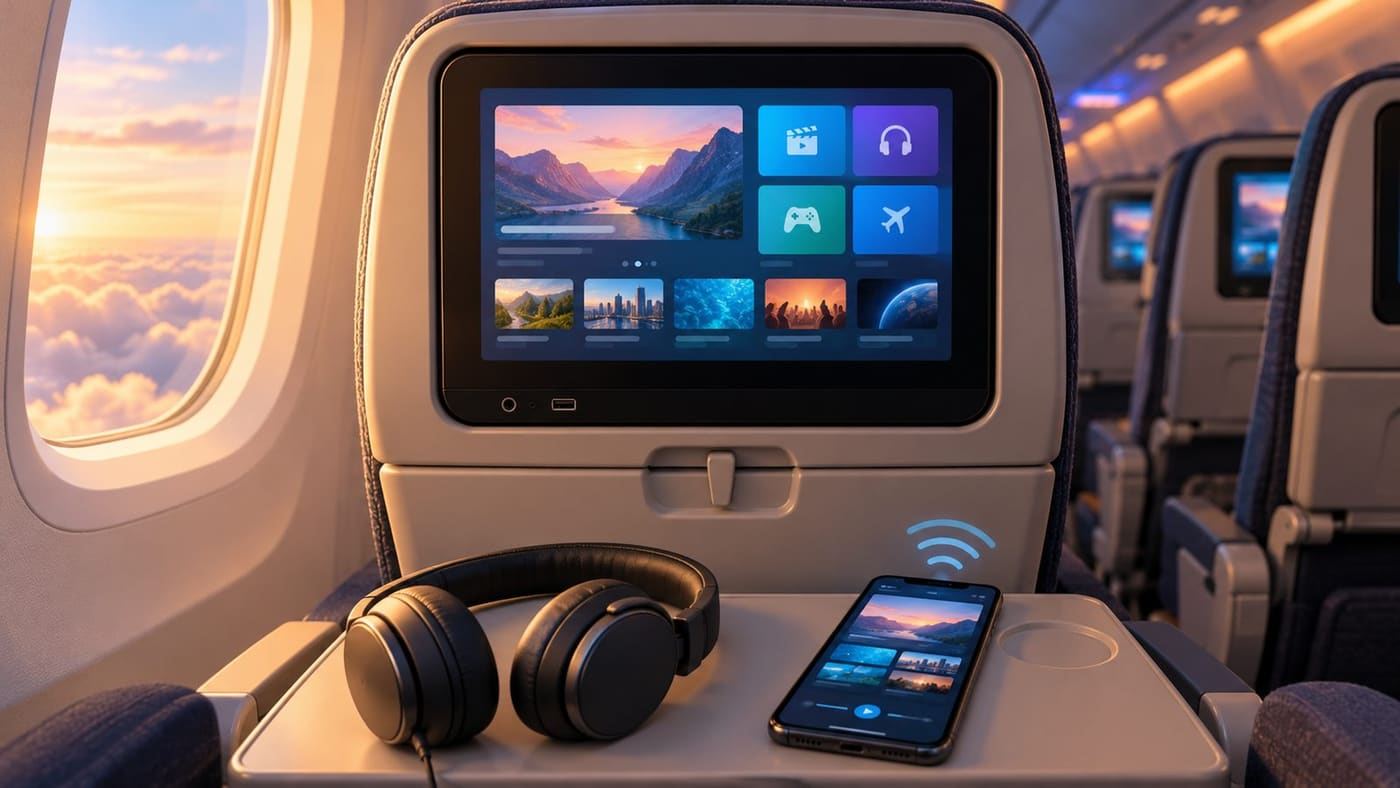
Research checked: 26 October 2026, Asia/Dhaka. Catalogue examples are a dated snapshot, not a promise of availability on a particular flight. This is an original viewing-planning guide, not a review claiming that the author watched these programmes on board. The image is an original generated conceptual cabin scene, not a Singapore Airlines product photograph.
Start with the catalogue that exists today
The [official KrisWorld movie catalogue](https://krisworld.singaporeair.com/movies.html) currently lists titles including Toy Story 5, Disclosure Day and The Sheep Detectives. Its browsing categories include regional cinema, family viewing, films leaving soon, audio description and closed captions. These are useful starting points for discovery; a category label is not a guarantee that every listed title meets your individual requirements.
The [television catalogue](https://krisworld.singaporeair.com/tvshows.html) separately lists programmes including The Studio, The New Look and Widow’s Bay, alongside documentary, comedy, anime, regional-language and family categories. A series appearing in the catalogue does not establish that every season or episode is available. Check the actual programme entry and the onboard selection before deciding where to begin.
That practical distinction is more useful than a list of supposed must-watch titles. A passenger who needs a particular subtitle language, has already seen the opening episodes of a series or wants something suitable for a child has a different problem from someone simply looking for a new film. The right shortlist begins with those requirements, not with the most prominent promotional tile.
Choose one main programme and two alternatives
Try a three-part shortlist: one main choice, one short choice and one familiar alternative. The main choice is something you would be pleased to give sustained attention. The short choice can fill a smaller window. The familiar alternative is for the moment when your appetite for an unfamiliar story disappears. None of the three has to be the newest release.
For example, a traveller might choose a film as the main option, a self-contained television episode as the shorter option and an album as the familiar alternative. Another might prefer a documentary, a comedy and a book. These are sample structures, not claims about the availability of specific programmes or recommendations based on a personal onboard experience.
The advantage is that each item answers a different situation. Ten ambitious films all requiring two uninterrupted hours offer less practical variety than three different forms of entertainment. A shortlist should reduce the number of decisions you face after boarding, not recreate the entire catalogue in another place.
Keep a note of why each item appealed to you. A phrase such as interested in the setting or want a complete story is enough. When you return to the list later, that reason may be more helpful than a star rating copied from an unrelated review. It also gives you permission to change your mind when the reason no longer fits your mood.
Estimate usable viewing time, not just flight length
A scheduled flight duration is not a commitment to watch throughout the journey. You may want to eat, rest, talk, read or simply look away from a screen. Leave space for those choices instead of treating every available minute as a gap that entertainment must fill. Follow crew instructions whenever a programme needs to be paused.
Here is an illustrative calculation, not an airline timetable. Suppose you decide to use a three-hour window for entertainment. A 110-minute film and a 25-minute episode total 135 minutes, leaving 45 minutes within that self-chosen window. Three 55-minute episodes total 165 minutes, leaving only 15. The second plan may still suit you, but it provides fewer natural stopping opportunities.
Now suppose your available window shrinks to 90 minutes. Neither plan works unchanged. A shorter programme becomes a better first choice than starting a long film with an expectation that you must finish it. The numbers are not a rule for how people should travel; they demonstrate why programme duration matters independently of the number of attractive titles in a catalogue.
A useful watchlist therefore records runtime when it is available and identifies a reasonable stopping point. Do not invent a runtime from the length of a trailer or assume all episodes in a series are identical. If the programme entry does not answer the question, leave room for uncertainty rather than building an exact plan on a guess.
Check language at the title level
A regional cinema category helps you discover films but does not settle which audio or subtitle options a particular version offers. A film’s country of origin, spoken language and available subtitle tracks are different pieces of information. If language access is essential, open the entry and inspect the options actually listed.
For a bilingual travelling pair, this may change the shortlist. One person might be comfortable listening in the original language while the other needs subtitles. Their shared choice should accommodate both requirements. Selecting a title because its poster looks familiar does not resolve that issue, and a translated title is not proof of a translated audio track.
Before committing to a long programme, check the options on the system you are using. If the required language is unavailable, move to your alternative early. This is a planning suggestion, not a statement that a particular language is absent from KrisWorld. The catalogue and onboard entry, rather than this article, should provide the current title-specific information.
The same care helps language learners. Decide whether you want to follow the story comfortably or practise listening. Those are different activities. A familiar film may be easier to revisit in another language because you already know the plot, but that is a personal learning choice, not evidence that any entertainment service guarantees a particular educational result.
Treat accessibility as a requirement, not an afterthought
The movie catalogue includes Audio Description and Closed Captions categories. Use them as entry points, then check the individual title and the options available during playback. A general category cannot tell you whether the programme you want offers the combination you need on your particular journey.
Write the requirement explicitly in your shortlist. For example, needs captions is more useful than easy to follow. A companion helping you browse can then evaluate the right thing. If a feature is essential and the available information is unclear, ask the airline before travel and prepare an accessible alternative you can use independently.
Do not let a prominent title displace a functional requirement. An acclaimed film without the support you need may be a worse choice for this journey than a less familiar programme that you can enjoy comfortably. This is not a judgment of the film’s artistic quality. It recognises that access is part of the viewing experience rather than an optional extra to consider after choosing.
This article does not certify the accessibility of KrisWorld, its controls or every item in its catalogue. We have not conducted a usability test with passengers. The practical recommendation is to verify the specific requirement and avoid converting a catalogue label into a broader guarantee that has not been established.
Choose television by episode, not only by series
A television series can be an excellent fit for a journey when the available episodes match where you are in the story. Begin by checking season and episode information. If you last watched episode four at home, a selection beginning with episode seven is a different proposition from a complete first season.
For a continuing drama, gaps may make the story difficult to follow. For an anthology or a self-contained programme, an individual episode may work independently. Do not assume which structure applies from a genre label alone. Read the synopsis without seeking unnecessary spoilers, then decide whether that episode works as a standalone choice.
A short note helps across a return journey: title, season, episode and where you stopped. The note is useful even if an account feature remembers your position, because it gives you a reference you control. It does not preserve access to the programme itself. A saved position and continued catalogue availability are different things.
If you are choosing something new, avoid making the whole flight dependent on liking the first episode. Give yourself an alternative with a different pace or tone. A programme that does not suit you after twenty minutes has not created an obligation to watch the rest simply because it was first on your list.
Build a family list with choices, not a single verdict
For a family, choose a small set of candidates together before departure. Adults can review the programme information and suitability, while children can express which options interest them. A family or animation label alone should not replace that review; people differ in what themes, intensity and humour they find comfortable.
An illustrative list might contain one new story, one familiar favourite and one non-screen activity. The value is flexibility, not the assumption that entertainment will occupy a child for a specified number of hours. Keep the plan adjustable and avoid promising a particular title before you have confirmed it is available.
If two children choose different programmes, the goal need not be a single winner. Independent viewing may be appropriate where the seating and supervision arrangements allow it. If the family wants to watch together, check the practical setup and agree on the choice rather than assuming a shared playback function exists.
Talk about stopping points as well as starting choices. Ending after an episode or a chapter may be easier to understand than an unexpected interruption in the middle of a scene. That is a general planning idea, not behavioural or medical advice, and it should yield to the practical needs of the journey and the crew’s instructions.
Use favourites without confusing them with downloads
The airline’s SilverKris publication described the April 2026 KrisWorld.com launch and its favourites feature. Its instructions connect the watchlist experience with adding a KrisFlyer number to the booking and signing in on the onboard entertainment system. That is an account-linked planning feature, not evidence that pressing a heart downloads a film to your own device.
The official myKrisWorld page also describes playlists and bookmarks, with an exclusion for Boeing 737-800 NG aircraft. Its account guidance says to include KrisFlyer details in the booking. These are the operator’s stated conditions; follow current instructions on the actual service if the interface changes. The sources were available through search-indexed text during this review, while direct retrieval failed.
A plain note remains a useful backup to any account-linked list. Record a few titles and your priorities, without storing passwords in that note. If you choose to download entertainment through a separate lawful service, check its own offline rules and test playback before travelling. Do not infer those rights or capabilities from the existence of a KrisWorld catalogue entry.
Leave room for discovery and for doing nothing
A prepared shortlist does not have to close off discovery. One practical approach is to choose a main programme in advance and leave a second slot open. Once on board, you can explore a regional cinema category or a documentary you would not normally seek out, while retaining a familiar fallback.
The distinction between preparation and prescription matters. Preparation removes friction: you know what you need and have a few workable options. Prescription would turn the journey into a sequence you feel compelled to complete. If you would rather read, listen to music or rest, the unused watchlist has not failed.
It is also reasonable to stop a film you are not enjoying. A long catalogue offers alternatives, but endlessly browsing them can become its own distraction. Give yourself a modest selection window, make a choice and reassess only if it does not suit you. The purpose is enjoyment, not extracting a maximum number of viewing minutes from a ticket.
A short checklist before you board
- Choose a main programme, a shorter option and a familiar alternative.
- Check runtime, season and episode information where relevant.
- Verify the specific language, caption or audio-description requirement.
- Review family suitability rather than relying only on a category name.
- Keep a simple title list if account-linked favourites are unavailable.
- Remember that saving a favourite does not establish offline playback rights.
- Leave time for rest and other activities, and follow crew instructions.
For screen and headphone differences, see our separate [KrisWorld technology guide](https://monetizearticle.com/article/singapore-airlines-a350-refresh-what-passengers-can-expect-and-when-02f7ce). This article addresses what and how to choose from the catalogue, rather than repeating the hardware specification table.
Conclusion
A good inflight watchlist is a small collection of suitable choices. Start with the current catalogue, apply your language and accessibility requirements, and fit programmes to the time and attention you actually want to give them. Keep alternatives for changes in availability or mood.
The catalogue is an invitation to explore, not a requirement to finish as much content as possible. One film you can comfortably enjoy may be a better result than three programmes started without the time, language options or interest to finish them.
Sources and research notes
- [KrisWorld movies](https://krisworld.singaporeair.com/movies.html) and [television](https://krisworld.singaporeair.com/tvshows.html), directly checked 26 October 2026. Named titles and category examples are a snapshot, not flight-specific availability.
- [SilverKris, personalised KrisWorld.com watchlists, 18 April 2026](https://silverkris.singaporeair.com/exclusives/airline/in-flight-entertainment/personalise-in-flight-entertainment-new-krisworld-com/), indexed official text checked; direct request returned403.
- [Singapore Airlines, myKrisWorld](https://www.singaporeair.com/en_UK/lk/flying-withus/entertainment/myKrisWorld/), indexed official conditions checked; direct retrieval was unavailable.
The examples, timing exercise and selection framework are original editorial analysis. No programme review, firsthand flight experience, comprehensive plagiarism clearance or guarantee of availability is claimed. Editor: Alex Morgan. Illustration: original AI-generated conceptual aircraft interior.