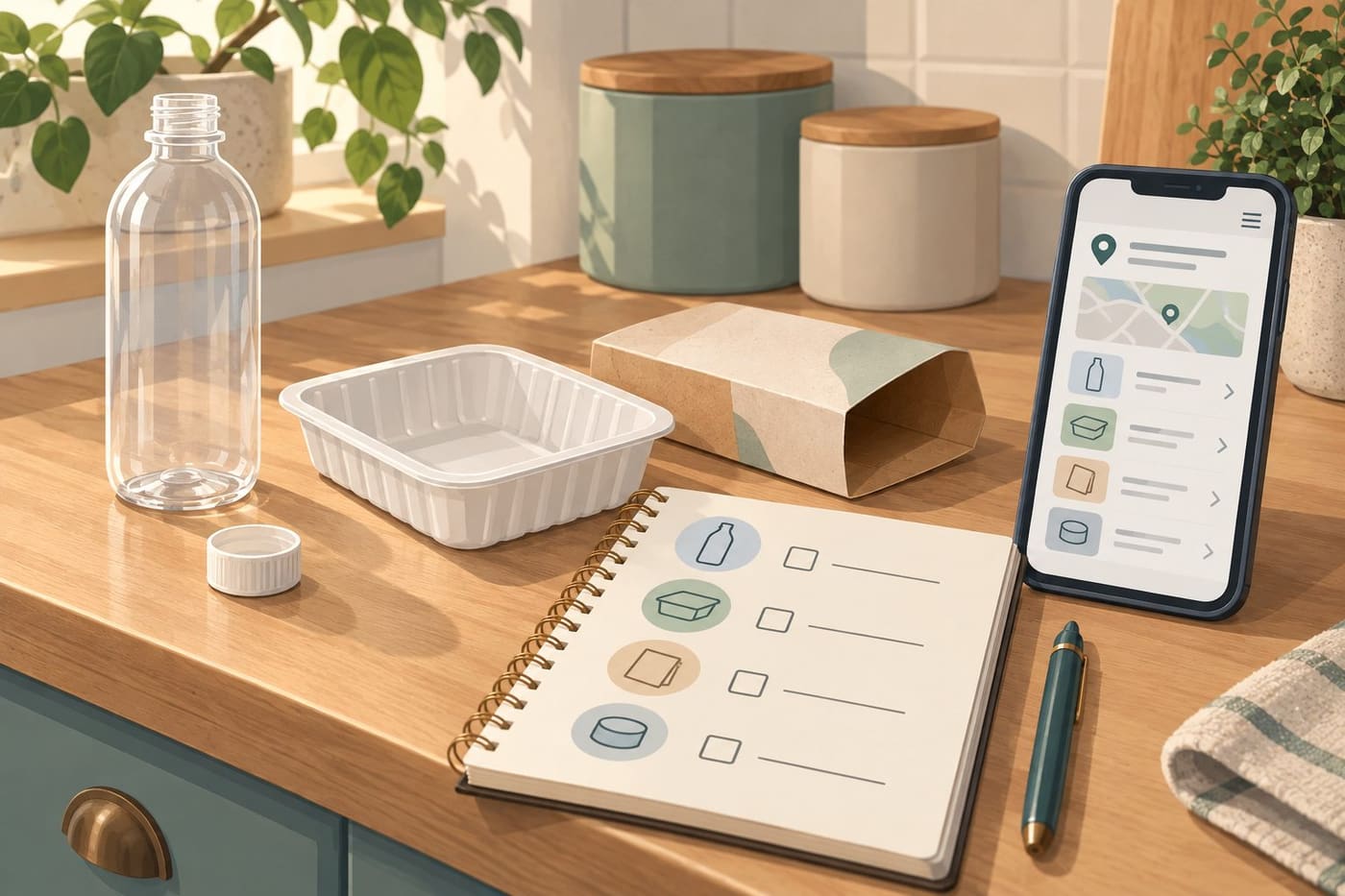
A triangle on a container looks reassuring. So does a leafy design or a short claim about recyclable packaging. But the decision at the kitchen bin is more specific: does the collection serving this address accept this item, in this form, through this route? A material description and a local collection instruction are different kinds of information. Reading them together is more useful than asking the symbol to answer every question.
This guide explains how to separate material codes, packaging instructions, recycled content and collection routes. The primary references were checked on 31 October 2026 and are labelled by their US or UK context. Examples are invented to illustrate a checking method. No particular household's collection has been verified, and no item is declared suitable for every recycling bin in every country.
A material code does not book a place in your bin
The US Environmental Protection Agency explains in its [recycling questions page](https://www.epa.gov/recycle/frequent-questions-recycling) that a plastic resin code does not guarantee local recyclability. A collector may accept some products and not others. The practical implication is to check the actual programme rather than convert a familiar number into a universal instruction. The local service is part of the decision, not an inconvenient detail after the symbol has supposedly settled it.
Imagine a fictional household with an empty bottle and a rigid tray. Both carry a material marking, but the household has not checked whether its collector accepts both forms. It would be premature to decide that the same number requires the same destination. The useful next question names the items: bottles of this kind and trays of this kind. Material identity is relevant information, but it does not by itself establish the service's accepted list.
Fairfax County's [plastic guidance](https://www.fairfaxcounty.gov/publicworks/recycling-trash/plastic) offers a local-government example. It distinguishes the resin identification code from practical acceptance and directs residents to their collector's instructions. Its local accepted items are not instructions for someone living elsewhere. The value of the example is the relationship between the material and the actual recovery system, not a list to export unchanged to another city.
Keep that distinction when sharing advice with a neighbour or relative. A photograph of a code may help identify the question, but it does not establish which service collects their waste. Their building, workplace or municipality may use a different arrangement from yours. Name the collector and relevant programme when passing on an answer, and check that the answer concerns the actual item rather than merely a similar-looking material.
Read the instruction at component level
A package can contain several parts: a container, lid, sleeve and film seal, for example. A statement about one part may not apply to all the others. Look for the component named by the instruction, then keep the instructions distinct while checking the collection route. Do not force or dismantle an item in an unsafe way to make it match an imagined recycling category.
The UK's [Recycle Now symbol guide](https://www.recyclenow.com/how-to-recycle/recycling-symbols) explains on-pack labels and routes such as home collection or a specified collection point. It also notes that the absence of a recycling label does not automatically rule out recycling. These are UK label explanations. They help a reader understand why words beside a symbol matter, while the actual local programme still needs checking.
For an original hypothetical example, consider a plain tray with a paper sleeve and a thin lid. Suppose the household's confirmed instructions accept the tray but direct the film elsewhere. The household should preserve that distinction in its sorting note. The word packaging on a broad marketing claim is less useful than the specific component instruction. This scenario does not claim that every tray, sleeve or film belongs in the same route.
The same care applies when an item changes. A new package may resemble the old one but have different components or instructions. Check it again rather than assume that the familiar product name guarantees identical packaging. A quick household note can identify the current version with an ordinary description. It need not become an archive of every purchase; it just needs to avoid turning yesterday's answer into a permanent rule for a different item.
Separate recycled content from future recyclability
A statement about what went into making a package is not automatically a statement about where that package can go next. Recycled content concerns material used in production. A recyclability instruction concerns a potential route after use. Those claims can coexist, but one does not logically supply the other. Read the actual wording instead of treating every environmental phrase as a general endorsement of the whole product.
The UK's Competition and Markets Authority discusses clarity about the scope of environmental claims in its [2021 Green Claims Code guidance](https://www.gov.uk/government/publications/green-claims-code-making-environmental-claims/environmental-claims-on-goods-and-services). In particular, a claim needs to be clear about whether it concerns a whole product, part of it or its packaging. This article uses that communication principle; it does not certify a business's legal compliance or describe the document as a complete account of current advertising law.
Try reading an invented label sentence aloud in two parts: what is claimed, and which thing the claim describes. If the claim concerns the sleeve, write sleeve in the note. If a percentage is given for a named component, do not spread it over the entire product without evidence. A number can look precise while answering a much narrower question than the shopper assumes it answers.
This is also a useful way to discuss an unclear claim. Ask for clarification about the component and the intended route, rather than declaring fraud from one photograph. The point is to improve the connection between wording and action. An attractive green design cannot establish that a collector will accept a package, just as an absence of green graphics does not establish that a suitable collection route is unavailable.
Home collection, a drop-off point and composting are separate routes
An item may need a route other than the ordinary home recycling bin. The US EPA's [common-recyclables guidance](https://www.epa.gov/recycle/how-do-i-recycle-common-recyclables) distinguishes material streams and repeatedly directs readers to their local programme. It also explains that compostable plastics are not intended to join conventional plastic recycling. A compostability claim should therefore not be converted into permission to mix the item into the ordinary plastics stream.
Home composting and an industrial composting process are different settings as well. For a real item, confirm what its claim means and whether the intended service accepts it. A facility's ability to process a material does not prove that your collection sends it there. Likewise, a general statement that something breaks down does not tell you the conditions, timing or locally available disposal route.
In an invented household note, a bag could be marked as requiring a particular collection point. The useful next step is to confirm that the point still operates and accepts that exact type of bag. Finding an old directory entry is not the same as confirming a current destination. Do not leave material beside an unavailable bin or at a shop that has not agreed to receive it. Follow the responsible service's instructions for unresolved items.
Keep dangerous or unusual waste outside an ordinary packaging experiment. Batteries, chemicals, sharps, electrical items and damaged materials may need specific handling. Use the relevant authority or provider guidance; this article is not a disposal procedure for hazardous items. A household sorting plan should make those questions visible rather than squeeze everything into whichever container happens to be nearest.
Ask a question the collector can answer
When the accepted list is unclear, describe the actual item and service. A useful question might identify an empty food tray, its material marking, its separate film lid and the address's collection programme. Avoid sending unnecessary personal information. The aim is to make the item recognizable enough for a relevant answer, not to publish a household's full address or purchase history in a public discussion.
For an original fictional exchange, imagine that a resident asks whether a small rigid tub is accepted, while the first answer discusses bottles. The resident still needs a tub-specific answer. A reply that is related to plastic in general has not necessarily resolved the question. This is a practical communication check: compare the noun in the question with the noun in the answer before marking the task complete.
If the collector provides preparation instructions, keep them with the destination. Emptying, cleaning, separating parts or handling lids can be programme-specific. Do not substitute a remembered rule from a different collection scheme. Also avoid washing or processing an item unnecessarily just because a generic online list sounds more demanding than the actual guidance. The relevant instructions belong to the item and route being used.
A small note can contain four details: item description, accepted route, required preparation and the source with a check date. This format is an optional original aid, not an official reporting system. It is especially useful for a repeated household item that previously caused confusion. If the source changes its instructions, revise the note rather than maintaining a local rule that no longer matches the service.
Make uncertainty a question, not a hopeful deposit
Putting an unconfirmed item into a recycling bin does not make it accepted. The collector may have to remove inappropriate material, and some items can interfere with processing. The EPA's general guidance explains why local acceptance matters. The practical alternative is to resolve the uncertainty through the actual service rather than assume that someone downstream will find a suitable route for every object placed in the bin.
For a household example, imagine a shared kitchen with a small card listing the few recurring packaging items that everyone has checked. An unusual package does not need to become a permanent resident on the counter. It needs an identified question and an appropriate next action under local guidance. The plan should not encourage unsafe storage, piles that obstruct access or transferring unknown waste into unlabelled containers.
Avoid turning a sorting mistake into a judgment about a person's character. If a housemate used an outdated instruction, correct the shared information and explain the current route. A general request to recycle better may not tell them what to do differently. The useful correction names the item, the instruction and where the revised information came from. No measured behaviour change is claimed for this suggested approach.
Where several people share the work, agree who checks an unresolved item and how the answer reaches the others. A screenshot sent to one person can remain invisible to the person emptying the bin. A simple updated note at the relevant place may be more useful, provided it remains accurate and readable. The goal is reliable everyday action, not an elaborate record that nobody consults.
A recycling route is not a complete environmental verdict
An accepted collection route answers an important practical question. It does not, by itself, measure a product's total environmental impact or establish that buying more of it is beneficial. Claims about emissions, resource use or comparative sustainability need their own evidence and scope. This guide does not calculate a footprint, rank materials globally or assign a saving to an individual household's unmeasured actions.
Keep prevention and reuse in the conversation where they suit the actual need. For example, avoiding an unnecessary package is a different decision from finding a destination for one already in the home. Reusing something appropriately is different again. No single symbol can compare every alternative across every circumstance. A clear discussion names the decision and the evidence available instead of using recyclable as a substitute for all environmental reasoning.
For food scraps and the space and care involved in composting, see our [home-composting planning guide](https://monetizearticle.com/article/home-composting-plan-the-scraps-the-space-and-the-care-bbab88). Local arrangements determine whether composting is an available route for a particular item. Food scraps, conventional plastic and certified compostable packaging should not be assumed to share the same destination merely because they appear together after a meal.
Conclusion
Use a label to identify the question, then confirm the answer with the collection serving the actual location. Separate the material code from acceptance, the component from the whole package, and recycled content from the item's next destination. Keep preparation instructions and special routes attached to the item. A small amount of precise checking is more useful than asking a familiar symbol to provide a worldwide promise it cannot make.
Sources and research note
US EPA, Fairfax County, Recycle Now and UK CMA pages linked above were checked on 31 October 2026. Local US and UK guidance is explicitly identified and is not exported as a worldwide accepted-items list. Only relevant material-code, component-scope and collection-route concepts are used. No real household's collector was contacted, no packaging claim certified, and no recycling outcome or environmental saving measured. All household notes and exchanges are invented examples. The original AI-generated conceptual image does not reproduce an official certification or establish a local sorting rule.