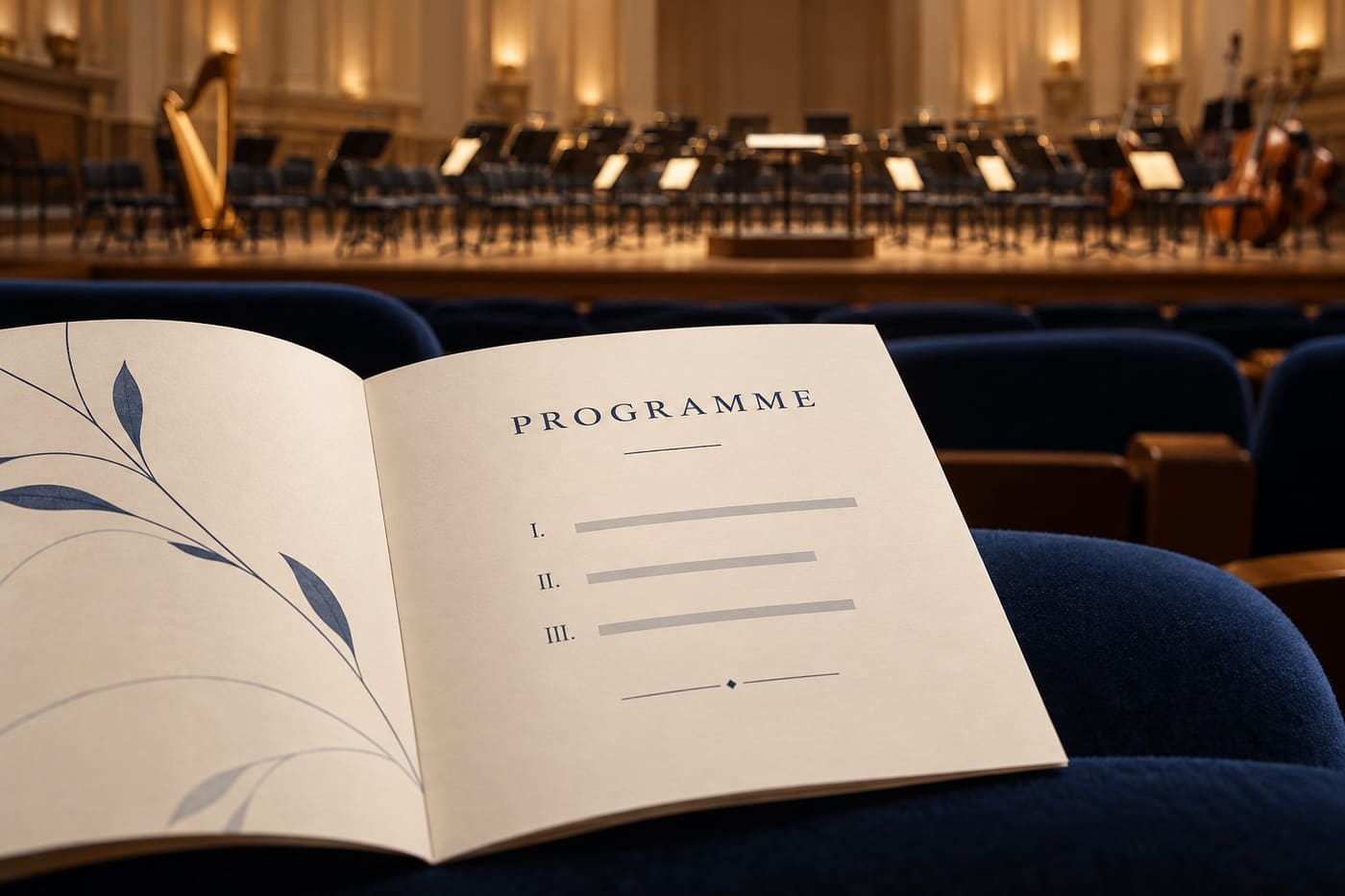
The lights have not dimmed yet. You open the concert programme and find a page containing composers' names, dates in brackets, several unfamiliar titles and a list of performers. It can look like a document written for people who already know the music. In practice, you need only a few of its signposts to begin following the evening.
A programme is a map of the performance, not a test you must pass. Start with the correct concert listing, identify the larger works and the sections within them, then choose one detail that interests you. You can leave the rest for another reading.
This guide focuses on reading a classical orchestral or chamber-concert programme. Different events organise their information differently. The original sample programme below is invented for explanation; it is not an announcement, review or description of a real performance.
Find the page for your concert first
Check the date, venue and event title before reading the music list. A season brochure may contain many evenings, and even a concert booklet can cover more than one performance. The cover alone may not identify the page you need.
For a real example of that format, the [Singapore Symphony Orchestra's first-timer guidance](https://www.sso.org.sg/whats-on/plan-your-visit/first-timers) explains that it combines several concerts in some programme booklets. It directs readers towards the relevant event pages for digital versions. That is a useful reminder to match the listing, rather than assume every page describes tonight's music.
Once you have the right page, find the programme order and any interval marking. Put a finger beside the first work and trace down to the last. You now have a broad outline of the evening, even if you cannot pronounce every title.
Check a current organiser notice if it mentions a change. An older downloaded programme can be helpful background without necessarily being the latest account of a replacement artist or work. Keep the current notice alongside the older information so the two do not become confused.
Separate the work from the movements inside it
A long piece can contain several sections called movements. The [Hamilton Philharmonic Orchestra's beginner guide](https://www.hpo.org/orchestra-101/) compares movements to chapters and explains that a pause may separate them, although some continue directly into the next. A movement ending is therefore not automatically the end of the complete work.
In print, movements may appear indented beneath the work's main title. Roman numerals, shorter headings or tempo indications can help show their order. Look at the spacing and typography as well as the words: a small indented line may belong to the heading above rather than represent a separate item on the programme.
Here is a deliberately invented example:
- Harbour Suite — composer: Mira Vale
- I. Arrival
- II. Lanterns
- III. Departure
- Interval
- Concerto for Clarinet and Ensemble — composer: Rowan Ellis
- I. Opening
- II. Still Water
- III. Homeward
In this sample there are two main works, each containing three movements, with an interval between the works. It is not a six-work programme. The invented titles make the structure visible without requiring knowledge of a particular score.
Read the title as an identifier
A programme title may include an instrument, a number, a key or a catalogue reference. You do not need to decode every element before listening, but keeping the full printed title helps you find the same work later. A search for a composer alone may lead to many different pieces.
[Bard Conservatory's programme-format guidance](https://blogs.bard.edu/conservatory-wiki/preparing-printed-programs-bard-conservatory/) describes listings that bring together a formal title, composer information and identifiers, with movements following underneath. It also discusses translating otherwise unfamiliar movement titles. This is a programme-preparation guide, not a rule requiring every organiser to use identical typography.
For your own note, copy the title carefully enough to distinguish it. If the programme specifies an arrangement or selected movements, preserve that detail. Otherwise, you may later compare a different version or a complete work with an extract and wonder why the order does not match.
Treat numbers and dates as clues to identity, not a ranking system. A higher number does not tell you whether you will enjoy the piece more. Nor does an unfamiliar title mean that you need to complete a history course before the performance begins.
Keep the composer and performers in different roles
The person named beside a work is not necessarily the person standing at the front of the stage. Look for role labels such as composer, conductor, soloist or ensemble. Their placement can help separate who created the music from who is performing it on this occasion.
In the invented programme, Mira Vale is the composer of Harbour Suite. The fictional clarinet concerto might be played by a featured soloist with the ensemble. If you write “I liked Rowan Ellis's playing” without checking whether Ellis performed, you may attribute your observation to the wrong person.
Use cautious descriptions until the roles are clear: “I enjoyed the clarinet solo in the second work” is an observation you can make without guessing an identity. Later, use the programme to connect the observation with the listed performer.
An artist biography can supply context, but you do not need to memorise every award or previous engagement. Find the person's role in this concert first. That small distinction makes subsequent reading and conversation more accurate without turning the evening into an exercise in collecting credentials.
Use the notes to choose a listening question
Programme notes can explain a work's background or suggest features worth noticing. Read them selectively. If you have a few minutes, look for a short paragraph on the music you are about to hear rather than trying to absorb every biography and historical detail.
The [London Symphony Orchestra's Barbican visitor information](https://www.lso.co.uk/your-visit/what-to-expect/what-to-expect-barbican/) describes its programmes as a way to learn about the music and performers and explains its printed and online availability. That is one orchestra's arrangement; check the organiser for the event you intend to attend rather than assuming every venue distributes programmes in the same way.
Choose one listening question for each work. You might ask whether a short musical idea returns, whether a quiet section changes the balance of attention, or how the solo instrument interacts with the group. These are suggested personal approaches, not claims about what a particular composer intended.
A note can open a door without prescribing your reaction. If it describes a passage as playful and you hear something uneasy, you can retain that difference as a question. You do not need to rewrite your experience to match an adjective on the page.
Follow an invented listener through the programme
Imagine a fictional listener, Leena, attending the invented Harbour Suite programme. Before the music starts, she marks the three movements in the first work and notices that the interval comes afterwards. She chooses to listen for changes between the movements rather than identify every instrument.
After the first movement, there is a pause. Leena looks at the programme and sees that two movements remain. She waits and continues listening. The programme has helped her locate the pause without telling her what to feel about the music.
During the interval, she writes one brief sentence: “The quiet middle section held my attention more than the opening.” That is a report of her imagined response, not a technical verdict. She leaves a second question for later: “Was the sound I noticed the clarinet or another instrument?”
After the fictional concerto, she checks the soloist's name and keeps it with the work's complete title. Her note is now useful for finding the music again. This example is an original listening scenario, not a reported audience interview or a claim that this method improves measured musical ability.
Let pauses and applause make sense in context
Many orchestral concert guides describe a convention of applauding after a complete work rather than between its movements. Hamilton's guide suggests using the programme and the conductor's acknowledgement if you are unsure. That convention explains why a quiet gap may not be followed immediately by applause.
The [Chamber Orchestra of New York's FAQ](https://chamberorchestraofnewyork.org/faq/) similarly discusses waiting until the whole work is complete, while acknowledging that audiences sometimes applaud between movements. These are audience guides for particular concert traditions, not a reason to judge someone harshly for responding differently.
For a newcomer, the simplest approach is to follow the event's introduction and the visible cues around you. If the performer invites participation or the concert is presented in another format, follow that context. Do not impose the expectations of a formal orchestral evening on every type of live music.
Avoid turning every silence into a search for permission. Once you understand which movements belong together, you can spend more attention on listening. A small uncertainty about applause does not invalidate the experience, and there is no need to apologise to your companions for not already knowing the structure.
Keep estimated duration separate from the interval
When a programme gives durations, read what each estimate refers to. Is it attached to one work, one half or the full event? Does the event information separately mention an interval? Do not add or subtract time without first establishing those labels.
For an original arithmetic example, an invented listing might show a 20-minute work before an interval and a 35-minute work afterwards. The listed music totals 55 minutes. That calculation alone does not establish when the audience will leave, because it does not specify the interval length or other parts of the event.
Use the current organiser's running-time information for practical travel decisions. A movement list is not a promise about the precise time a door will open. Similarly, an unlisted extra piece should not be assumed when calculating the journey home.
If your main concern is finding a suitable event, seat or accessible route, our [first theatre visit guide](https://monetizearticle.com/article/your-first-theatre-visit-choose-the-performance-seat-and-journey-that-work-for-you-e06e6d) offers a related planning approach. Its practical questions can be useful, while the actual concert venue's arrangements still need checking separately.
Read digital notes before the performance where possible
A programme on a phone can be convenient to read in advance. Open the correct event page, confirm the listing and enlarge unfamiliar names while there is time to do so. Save the relevant reference in a way you can find again without scrolling through a crowded set of unrelated pages.
During the performance, follow the venue's device instructions and avoid distracting others with a bright screen. You do not need to track every movement on a display in order to listen. A short preparation note can be enough, and a printed programme may be an option where the organiser provides one.
If you cannot read the available format comfortably, check what alternatives or assistance the organiser offers. Do not assume that a PDF is accessible simply because it opens on your device, or that every concert provides the same format. Ask about your actual reading need and the particular event.
Programme availability is also separate from recording permission. A digital booklet does not grant permission to film a performance or reproduce a recording. Check the event's rules rather than inferring those rights from access to its written notes.
Make a small record after the concert
Keep the full title, the ensemble and any featured performer you want to remember. Add one concrete observation and one question. The observation could concern a passage that caught your attention; the question could identify something you would like to hear again.
Distinguish the programme's statement from your own impression. “The notes described a returning idea” and “I noticed a phrase return near the end” are different kinds of evidence. If you did not recognise the return, leave that honest rather than borrowing the note as though it were your experience.
When comparing impressions with a friend, begin with the moment each person remembers. You may have followed different details without either person listening incorrectly. The programme can help you name the work and movement, while the conversation can remain open to different responses.
Conclusion: use enough of the map to enjoy the journey
Begin with the right concert page, separate the works from their movements and identify the performers' roles. Read enough background to find a question that interests you. Then allow the music to hold your attention without requiring the programme to explain every moment in advance.
Afterwards, a complete title and a short personal note give you a reliable starting point for another listen. The booklet becomes more useful through that connection with the performance, rather than through how much of it you managed to memorise.
Sources and research note
Research checked 31 October 2026. The linked primary guides from Hamilton Philharmonic Orchestra, Singapore Symphony Orchestra, London Symphony Orchestra, Chamber Orchestra of New York and Bard Conservatory support the programme-structure, availability and audience-convention explanations. These established guides are not evidence that a particular event is scheduled today. Venue practices and current programme notices take precedence for an actual visit.
The sample works, composers, listener, durations and responses are invented explanatory examples. No actual concert attendance, performer interview or listening experiment is claimed. The original builtin AI-generated conceptual illustration depicts a generic programme in an anonymous hall, not a real event or copied score. Limited exact-title and phrase searches returned related or unrelated material without an exact matching article observed; this does not establish an exhaustive similarity result or guarantee human authorship.