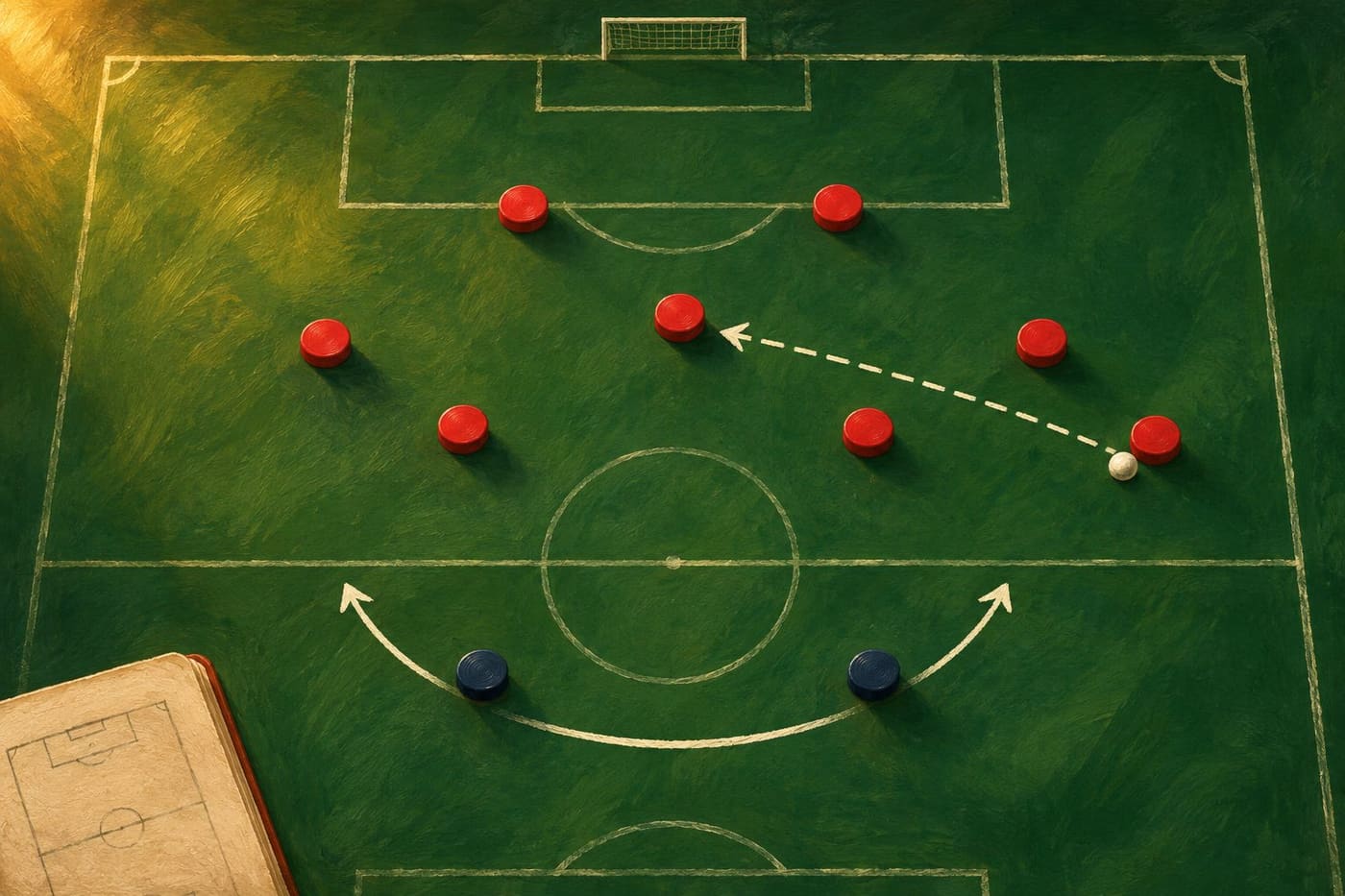
PSV lost 2-1 at home to Club Brugge on 4 November 2026, a result that raised a more interesting question than whether the home side attacked enough. Peter Bosz's explanation focused on how a team protects itself while it still has the ball. His concern about rest defence offers a useful way to understand why pressure at one end can coexist with danger at the other.
The result is confirmed in UEFA's league-phase results. The tactical explanation below separates the club's match record, the coach's assessment and illustrative examples. The examples explain a football principle; they are not reconstructed tracking data from the match.
The three goals and the changing score
PSV's match-centre timeline records Nicolò Tresoldi scoring for Club Brugge in the 25th minute, Kodai Sano equalising in the 54th and Carlos Forbs restoring the visitors' lead in the 65th. The first goal came from a corner, according to the club's live account.
That sequence matters. PSV were behind, recovered to level terms and then had to chase again. Treating the whole evening as one unchanging tactical situation would miss how the score altered the decisions each side faced.
The same match centre lists possession at 62 percent to 38 and shots on target at nine to three in PSV's favour. Those are the club's published match statistics, not an independent expected-goals model. They describe substantial home involvement without explaining the location, pressure or difficulty of every attempt. PSV's record also notes Joaquin Seys clearing a Ruben van Bommel header from the line shortly before the winning goal.
What Bosz identified after the defeat
In PSV's published post-match press conference, Bosz identified two problems: chances went unused, and the defensive organisation was insufficient, particularly for the second goal conceded. His central point was that the protective structure must be arranged during possession rather than improvised once possession disappears.
He also described periods of high pressing and quick regains, while acknowledging that the chances created still needed finishing. Sven Mijnans likewise expressed frustration about missed opportunities. These are participants' assessments, attributed to the club's report, rather than a neutral tactical audit.
The useful implication is that chance creation and protection against counters can be evaluated separately. A team can improve its finishing and still need to change how players cover space behind an attack. Conversely, better cover does not automatically solve a failure to convert chances. Neither issue cancels the other.
What rest defence means
The term can sound as though some players stop working. Its meaning is almost the opposite: players away from the immediate attack have responsibilities before the next defensive action begins.
A FIFA Technical Study Group discussion, published during the 2025 Club World Cup, describes offensive balance, also called rest defence, as defensive organisation while a side has possession in the opposition half. It links that structure both to limiting danger after turnovers and to sustaining attacks.
For a viewer, the practical question is where the players outside the immediate attacking combination are standing. Are they prepared to challenge a first outlet, protect the route towards goal and collect a loose clearance? The answer can change with every pass. A formation label on a pre-match graphic cannot answer those questions for an entire game.
An invented example: the attack on the right
Imagine an entirely fictional team attacking down its right flank. Its winger has the ball near the touchline, a teammate overlaps and two forwards occupy the penalty area. A midfielder moves towards the edge of the box to receive a cutback. Several players now offer useful attacking options.
Behind them, two defenders and another midfielder face a choice. They could stand flat, close to halfway, each watching the ball. That arrangement might look numerically adequate in a still image. Yet an opponent standing between them could receive a clearance facing forward, while a second runner attacks the space outside.
Alternatively, the midfielder could position to challenge the first forward pass, with a defender behind providing cover and another adjusting towards the exposed channel. The same number of players may offer a different kind of protection. The difference lies in angles, distances and responsibilities, rather than simply counting bodies.
This example does not prove that either arrangement appeared in Eindhoven. It shows why an instruction to leave more players back is incomplete. A coach still needs to decide which space those players cover, how their positions relate to the ball and what each does if the first challenge fails.
The first pass after a turnover is a useful viewing clue
A replay often draws attention to the final sprint or tackle. To understand a transition, start earlier. Pause at the moment possession changes and identify the opponent's first realistic pass. Is the receiver facing their own goal under pressure, facing sideways, or able to turn and run towards open space?
Then follow the nearest covering player. Moving towards the ball may be useful if it prevents the receiver turning. It may be costly if it opens a direct route behind. A defender who appears to retreat can be buying time for teammates to recover; a defender who charges forward can be helping or exposing the structure, depending on the surrounding positions.
These are questions to ask of footage, not verdicts to attach without seeing it. A cropped highlight may exclude the player who made the original covering decision. If the camera cannot show the relevant space, the honest conclusion is that the angle leaves the question unresolved.
Counterpressing and covering space are related tasks
In a second fictional sequence, a forward loses the ball just outside the penalty area. Three teammates are close enough to challenge immediately. If one reaches the receiver before a controlled forward pass, the attack may resume near goal. That is the attraction of trying to regain possession quickly.
But imagine all three rush towards the same receiver while an opponent becomes available outside them. The first challenge can look energetic while the next pass removes several players at once. A teammate positioned to cover the outlet could matter more than a fourth player joining the same chase.
The viewer should therefore distinguish the intensity of a challenge from the organisation around it. Running hard is visible. Protecting a passing lane can be less dramatic, especially when it persuades an opponent to turn back rather than producing a tackle. Judging only the most conspicuous action can miss that contribution.
Why possession does not measure protection
A possession share is a description of time with the ball under the provider's measurement. It does not indicate how safely every possession ends. Two fictional teams could each have sixty percent possession and face very different transition risks.
One might circulate slowly with several opponents behind the ball, then lose it near a touchline with cover already nearby. Another might commit many players ahead of a difficult central pass, lose it with its remaining players far apart and allow an opponent to attack immediately. The shared possession percentage would conceal different situations.
Likewise, total shots on target do not supply the whole story of a match. They cannot alone establish which goalkeeper had the more difficult saves or how much pressure surrounded a particular effort. A reader can acknowledge an advantage in the published figures while leaving those additional questions open.
A counterattacking threat can exist before the regain
The opposition also prepares while it does not have possession. A FIFA analysis of France's rest attack, published on 28 May 2026, explains that idea through France's use of Kylian Mbappé at the 2022 World Cup. It describes an advanced outlet positioned before a regain to help the next attack start quickly.
That historical example is not evidence that Club Brugge used France's system. It provides a helpful counterpart to rest defence: both sides can be preparing for the same possible change of possession. A viewer watching only the ball may miss the attacking outlet and the player assigned to control it.
For the team in possession, the challenge is relational. An unmarked opponent who remains high can influence how many teammates feel able to advance. An opponent who drops deeper can change the available space again. The relevant picture includes both teams, rather than treating defensive cover as a shape chosen in isolation.
The score changes the trade-off without determining it
An equaliser can produce an understandable urge to attack again immediately. In an invented match, a team that has just made the score level might find its opponent retreating and the crowd urging another wave forward. There may be a real opportunity to exploit that moment.
The decision still involves alternatives. An additional runner could create an overload, while a more patient pass might allow the protective players to move into position. Neither option is universally correct. The value depends on the space, opponent, timing and quality of the available action.
This is why a late concession should not automatically become a claim that attacking ambition itself was mistaken. The more precise question is whether the attack had appropriate support and cover for the risks it took. Ambition and organisation are decisions that interact, rather than opposing football identities.
What the league-phase record establishes
UEFA's team-by-team page lists PSV drawing 1-1 with Shakhtar Donetsk, losing 1-0 at Leipzig, winning 1-0 at Porto and then losing 2-1 to Club Brugge. Reading those four results together gives one win, one draw and two defeats, with three goals scored and four conceded. Those totals are arithmetic from the listed results, not a claim about a live table position.
The same fixture list schedules PSV away to Real Madrid on 24 November, at home to Atlético de Madrid on 9 December, away to Viking on 20 January and at home to Stuttgart on 27 January. Future fixtures are scheduled events, not forecasts of results or a guarantee of qualification.
For analysis, that distinction keeps the immediate problem manageable. The next useful evidence would be how PSV organise and finish subsequent attacks. A dramatic prediction about the entire campaign cannot substitute for observing those changes when matches are actually played.
A compact method for watching the next transition
Choose one possession sequence rather than trying to diagnose a team from an entire evening at once. Note where the ball is, which opponents remain available ahead and which players stand between those opponents and the defending goal. Then watch what changes when the ball moves to the other side.
At the turnover, follow the first receiver and the nearest covering player. After the sequence, ask whether the danger came from a lost individual duel, an uncovered route, a difficult pass under pressure, or several decisions together. A single label may not explain all of it.
This method can make a replay more informative without pretending that a home viewer has access to the coaching staff's instructions. The purpose is to identify observable relationships and unanswered questions. It is not to assign blame to a player whose role or available information is unknown.
Why this match appeared in Dutch search trends
At retrieval on 5 November 2026, Google Trends' Netherlands Trending Now page displayed 'psv - club brugge' first under the past-24-hours window, all categories and search-volume-descending sort. Its displayed volume band was 100K+, the increase 1,000 percent and the status Active. No substitute topic was selected.
That is evidence of search interest in the selected window. It does not measure agreement with a tactical explanation or demonstrate that one football approach is superior. The result and comments were checked separately in primary sources.
Readers can find more reporting in our Sports section. The lasting lesson from Bosz's assessment is a question worth carrying into the next game: when the ball is still under control, who is already preparing for the moment it might not be?
Sources consulted 5 November 2026. This article uses official match records and attributed coaching comments, with explicitly fictional tactical examples. It does not claim attendance, access to private instructions or a complete video and tracking-data audit.