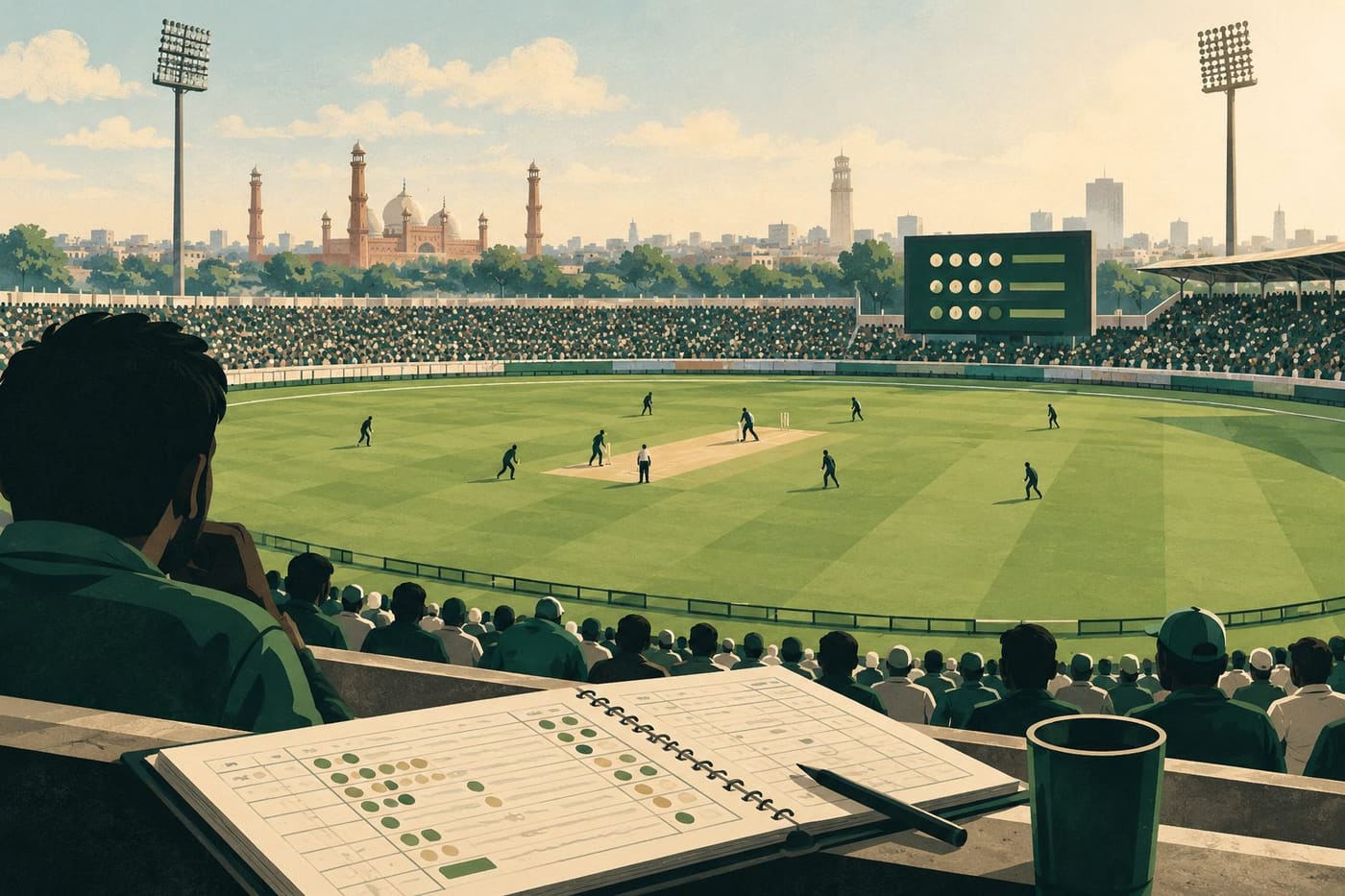
Pakistan beat England by one wicket at Gaddafi Stadium on 25 October 2026. The PCB’s completed-match report gives England 241 all out in 46.4 overs and Pakistan 243 for nine in 47.1. Shadab Khan finished unbeaten on 113, with the last-wicket partnership adding 89. Those compact facts establish the outcome. The rest of this guide explains how to read the figures without mistaking a low required rate, an old scorecard or an unfamiliar over notation for the whole story.
The completed result replaces the preview
This article has been updated from a fixture guide. It is no longer a preview of a match yet to take place. The official PCB report was available in indexed text; direct retrieval returned 403. Radio Pakistan’s completed-result report corroborates the one-wicket win and the innings totals and overs. A PCB scorecard retrieved during research still displayed an early England innings snapshot, so it was not treated as a final card.
There are inconsistencies within the PCB report: its opening calls 241 the target despite England’s total being 241, and its Dawson figures differ between narrative and summary. We use the consistent team totals and result, avoid the conflicting individual bowling figure, and distinguish the first-innings total from the ordinary winning target of 242. The final 243 is the reported score, not a typographical substitution for the target.
Why winning by one wicket does not mean winning by one run
The result describes the resources left to the successful chasing side, rather than the difference between the two totals. Pakistan had lost nine wickets when it passed England’s score. The two-run difference between the final totals should therefore not be relabelled a two-run victory. A result statement and an arithmetic difference are different information.
For a new viewer, write the three relevant figures on separate lines: first-innings total, winning target and final chasing score. In this case they are 241, 242 and 243. Keeping those labels visible avoids the common habit of using total and target interchangeably. The final score can pass the minimum needed rather than stop exactly on it, subject to the scoring laws governing the winning action.
The example also explains why a chase can look close in one sense and comfortable in another. There can be deliveries remaining while only one wicket remains. Time available and batting resources are separate constraints. Neither should be ignored simply because the other appears favourable.
How an ODI innings works
An ODI is a limited-overs international. Under the standard format, each side has an innings of up to 50 overs, unless the match is shortened or otherwise adjusted under playing conditions. An over is six valid deliveries. Wides and no-balls are not counted as valid balls in the over, so the bowler must deliver replacements; they also add runs to the batting side.
The batting team tries to score as many runs as it can before using its allotted overs or losing all ten wickets. The second side then tries to pass the first-innings total. If it reaches the target, it wins; if it ends short, the first side wins. A tie is possible if the scores finish level, and a rain-affected match may use a revised target under the competition’s rules.
This simple structure helps make a live score readable. Suppose a scoreboard says 142 for 3 after 28 overs. That means the batting side has 142 runs, has lost three wickets and has faced 28 completed overs. It has not yet used the full 50-over allocation. The number of wickets in hand is seven, and the side has 22 overs remaining if the innings continues uninterrupted.
Do not confuse overs with balls. A display of 28.4 means 28 completed overs plus four valid deliveries in the next over, not 28.4 decimal overs. The team has faced 172 legal balls, not 28.4 overs multiplied as a decimal. In a rain-shortened match, the permitted overs can be fewer than 50, which changes the meaning of the “overs remaining” calculation.
Reading the scorecard beyond the headline
A useful scorecard answers several questions at once:
- Runs and wickets: How much has the batting team scored, and how many batters have been dismissed?
- Overs: How many legal deliveries have been bowled, and what allocation remains?
- Run rate: How quickly the batting side has scored so far. It is usually runs divided by overs faced, but some score displays show the current rate and a required rate separately.
- Batter figures: Runs scored and balls faced. A player’s strike rate is runs per 100 balls; it is a descriptive statistic, not a forecast.
- Bowler figures: Overs, maidens, runs conceded and wickets. Economy rate describes runs conceded per over; it does not by itself measure every aspect of a spell.
- Extras: Runs credited through wides, no-balls, byes, leg-byes and penalties. The scorecard explains why total runs do not always equal batter totals plus bowler figures.
- Partnerships: Runs added by a pair of batters. A partnership can steady an innings after wickets or accelerate a chase, but it should be read alongside the overs and target.
The first-innings run rate is the team’s runs divided by overs faced after converting any partial over into a fraction of six valid balls. During a chase, the required rate is the runs still needed divided by overs remaining. For example, if a side needs 120 from 20 overs, the required rate is six runs per over. That arithmetic does not mean the side will score at that pace: wickets, bowling changes, field restrictions, boundaries and pitch conditions all affect what happens next.
Why wickets and remaining overs must be read together
Two teams can have the same score and face very different situations. A side at 200 for 2 after 40 overs has eight wickets available for the final ten overs. A side at 200 for 8 has two. The same total therefore carries different possibilities for acceleration and different risks of being bowled out.
The reverse is true in a chase. A team may have a manageable required rate but few wickets left. It may need to preserve a partnership rather than attempt a boundary from every delivery. A team with many wickets in hand may be able to take more calculated risks, but no scoreboard formula guarantees the result.
When following a match, note the sequence behind the current total. A sudden cluster of wickets can change the balance without changing the target. A slow phase may reflect accurate bowling, difficult conditions or a deliberate effort to rebuild. Unless the official match report or evidence supports a specific explanation, avoid turning an observation into an unsupported claim about tactics or player intent.
What changes when rain or interruptions arrive
Weather can interrupt an ODI. The competition’s playing conditions then determine whether the match resumes, how many overs are available and how a result can be calculated. In many limited-overs competitions, the Duckworth–Lewis–Stern (DLS) method is used to adjust targets in interrupted matches. The method accounts for overs and wickets remaining; it is not simply a proportional reduction in the original target.
The displayed target can therefore change after an interruption. When that happens, use the live match centre’s revised target and overs allocation. Do not calculate a new target from an old screenshot or assume the second side still needs the original total. A temporary rain delay is not, by itself, proof that a match is abandoned or that either team has won.
If an official result is decided under a weather method, distinguish the method from the score that would have been needed in a full-length chase. News headlines often compress this context. The official scorecard should show the result and any revised target; the match report can explain the sequence.
Work through the late-chase arithmetic
The PCB report places Pakistan at 154 for nine after 33.5 overs. In a full 50-over allocation, that notation represents 203 valid deliveries used and 97 remaining. Against a winning target of 242, another 88 runs would be needed from that point. The required rate is therefore 88 divided by 97, multiplied by six: approximately 5.44 runs per over. These are our calculations from the reported position, not an official win-probability model.
That rate alone misses the defining risk: there was no spare wicket after the final partnership. An identical required rate with several wickets in hand would describe a materially different situation. A rate is useful for the pace of the chase, but it does not measure the chance of losing the remaining wicket or the difficulty of the available scoring opportunities.
The reported finishing point, 47.1 overs, represents 283 valid deliveries. Subtract the earlier 203 and the difference is 80. Subtract 154 from the final 243 and the difference is 89. The two calculations align with the report’s description of the final stand. They are a consistency check, not proof that every detail of a separate live score feed is correct.
If you reproduce the calculation, avoid entering 47.1 minus 33.5 into a decimal calculator and reading the answer as cricket overs. Convert both values to balls first. It is the simplest way to prevent a notation error from becoming a false analysis of the scoring speed.
A partnership total is not one batter’s score
A stand describes runs added while two batters are together. It should not be credited entirely to the better-known batter or confused with that player’s final innings total. Extras can also contribute to the team’s progress. A complete scorecard is needed to divide the partnership accurately among the participants and extras.
For a fictional example, a pair might add 40 while one batter scores 25, the other 12 and extras supply three. Calling it a 40-run contribution by either individual would be wrong. Likewise, a batter’s final unbeaten score may include runs made before the partnership began. The labels matter even when all the numbers are individually accurate.
In discussing Lahore, it is enough to distinguish Shadab’s reported final innings from the final pair’s reported stand. This guide does not invent a ball-by-ball distribution of strike or a private tactical instruction. A plausible explanation of how a pair might manage a chase is not evidence of what was said or planned in this one.
Check the source’s match state, not only its badge
An official source can still be displaying an old snapshot. During this review, the PCB result report and the accessible scorecard were at different stages of the same match. The completed report was appropriate for the result; the early scorecard was evidence only of the earlier position it displayed. Treating the two as equally current would create a contradiction that careful timestamp and status checks can resolve.
When using a score page, look for a final-result line, both innings and a completed match status. If those are absent, do not turn the last visible number into a final total. A search engine can also retain an earlier snippet after the underlying event has finished. Open the source where possible and state a retrieval limitation when it cannot be checked directly.
For a reader following from Singapore, the practical routine is simple: identify the match date and venue, confirm the status, read runs and wickets with overs, then use a completed report for context. A historical fixture time is useful for identifying the game, but it should not remain the lead information after the result is known.
What this result says about the series
The ECB’s published schedule places the remaining league fixtures on 27 and 29 October, followed by a final on 31 October. Those dates describe the planned programme. Any qualification or tie-break claim should be checked against the competition’s current standings and rules rather than inferred only from this match’s margin.
A one-wicket win is still a completed win; the drama does not itself tell a reader how a competition awards points or resolves equal positions. This guide does not calculate net run rate from an incomplete table or assert a qualification outcome without the relevant standings. The useful distinction is between understanding the match result and establishing all its tournament consequences.
Conclusion
Lahore’s final line is clear: Pakistan won by one wicket. Understanding it requires several separate readings—England’s total, Pakistan’s target, the final score, the valid deliveries and the wicket situation. Converting overs correctly and checking whether a source is actually final make the figures much more useful. The arithmetic explains the position; it does not turn a remarkable recovery into a predictable outcome after the fact.
Sources and research note
Research checked 26 October 2026. [PCB’s completed-match report](https://www.pcb.com.pk/news-detail/shadab-s-record-breaking-unbeaten-century-gives-pakistan-stunning-one-wicket-win-over-england.html) was checked in indexed official text; direct access returned 403. [Radio Pakistan’s result report](https://radio.gov.pk/25-10-2026/tri-nation-odi-series-pakistan-beat-england-by-1-wicket) corroborates the result. [ECB’s schedule](https://www.ecb.co.uk/news/4562387/pakistan-to-host-sri-lanka-and-england-in-odi-triseries) supplies planned remaining dates. The [ICC October 2026 ODI conditions](https://images.icc-cricket.com/image/upload/prd/bxkzkcyvfn6tvi70zh0w.pdf) and [ICC DLS information](https://www.icc-cricket.com/about/cricket/rules-and-regulations/duckworth-lewis-stern) support the short rules explanation. Score arithmetic and hypothetical examples are original analysis. Source inconsistencies are disclosed above rather than silently harmonised. Limited phrase searches are not a comprehensive plagiarism scan. The original generated cricket-ground and scorebook illustration is conceptual, not a real match moment. The existing Singapore trend supplied the topic lead; no new independent trend is claimed.