The October full moon falls on 26 October 2026, according to NASA's lunar calendar. For someone in Ireland deciding whether to step outside, that date is the starting point rather than a complete observing plan. Your view also depends on local cloud, an open line of sight and the time you can comfortably spend outdoors.
The useful question is not whether you can catch one perfect second. It is whether you can find a clear interval, look carefully and understand what you are seeing. This guide separates the verified calendar information from practical suggestions for planning a short observation, taking a modest photograph and checking the claims that often accompany a trending Moon story.
The date to put in your diary
NASA's October 2026 skywatching article places the full moon on Monday, 26 October. Its Daily Moon Guide also lists that date. These are the sources for the calendar claim here; this article is not reporting an observation made on the night itself.
Do not confuse the date of a lunar phase with the time the Moon rises at your address. A phase calendar and a local rise-and-set table answer different questions. When planning an outing, use a table set to your own town and the correct local date. Check the time-zone label rather than assuming that a time copied from an American headline applies in Ireland.
This guide deliberately does not give a single nationwide moonrise time. A precise-looking number would be unhelpful if it belonged to another location or date. Write down the location and time zone alongside any timing you use, particularly when arranging to meet someone or travelling beyond your neighbourhood.
What the name Hunter's Moon tells you
NASA describes October's full moon as the Hunter's Moon in some traditions, connecting the name with seasonal hunting after fields had been harvested. The name provides cultural context. It does not promise a special colour, an unusually large appearance or a particular weather condition.
Treat the name as an invitation to look, not as a specification for what your photograph must contain. A pale Moon above a suburban roof is still a worthwhile observation. You have not missed the event because the scene does not resemble an orange, oversized moon in a dramatic social-media image.
It is also sensible to distinguish a traditional name from an astronomical measurement. A caption can accurately identify the October full moon without making extra claims about size or rarity. If a headline adds a stronger label, follow its source and ask what definition supports it before repeating it.
Choose a viewing place before choosing equipment
Start with a familiar place where you can stand comfortably and return safely. A garden, an accessible public path or a clear view from near home may be more practical than a long trip to a supposedly perfect location. Check access arrangements before making an evening journey, and respect closures, private property and other people's homes.
Think about the view at standing height. A location that looks open on a map may have trees, buildings or a wall in the direction you need. Visit in daylight if it is unfamiliar. Work out where you will stand, where your equipment will go and how you will leave without relying entirely on a phone screen.
For a family outing, choose convenience over drama. A short visit with a warm layer and an easy route home is often a better plan than an ambitious late-night expedition. Do not choose a roadside stopping point, an exposed edge or a remote route merely because it could produce a striking composition.
Make a flexible weather plan
Check a current local forecast near your intended observing time. A general article about the October full moon cannot tell you whether clouds will clear over your street. Look at the forecast's issue time as well as its symbols, and refresh your plan if conditions change.
Choose a main viewing window and a simple alternative. That might mean trying from home first and checking again later, rather than driving elsewhere after one disappointing glimpse. Decide in advance when you will stop waiting. A clear limit makes the outing easier to enjoy and prevents a small plan from becoming an exhausting search.
Keep expectations separate from forecasts. A favourable forecast is not a booking for a clear sky, while a brief gap can still provide a satisfying view on a mixed evening. If weather prevents observation, record that honestly. There is no need to manufacture a success story or use an unrelated photograph to suggest that you saw something you did not.
Begin with a few minutes of ordinary looking
Before opening a camera app, spend a little time looking at the whole scene. Notice the Moon's position relative to a roof, a tree or the horizon. Then look at the visible pattern of brighter and darker areas. Ask yourself what you can actually distinguish, rather than searching immediately for named features.
A small notebook can be more useful than a complicated equipment list. Record the date, approximate time, location, cloud conditions and what caught your attention. If you observe again, those notes give you something real to compare. They also help you write an accurate caption later instead of reconstructing the details from memory.
For beginners, make the objective manageable: identify the Moon, describe the scene and notice one detail you had previously overlooked. You do not need to name every visible feature. Curiosity works better when the task is small enough to complete without feeling like an examination.
Use a lunar guide as a reference, not a script
NASA's Daily Moon Guide offers an interactive reference with viewing modes for unaided eyes, binoculars and telescopes. Select the relevant date and viewing mode, and read the guide's time-system information. It can give you a starting point for comparing what is visible with a labelled representation.
The point is not to force your view to match every detail on a screen. Your equipment, the conditions and your familiarity with the view all affect what you can identify confidently. If a feature is uncertain, leave it uncertain in your notes. An honest question is more useful than an impressive name attached to the wrong patch.
Try using the reference twice: once before going out to establish a modest goal, and once afterwards to investigate your notes. That keeps the outing from becoming an exercise in staring at a phone. It also creates a useful distinction between what you noticed independently and what you learned from the reference afterwards.
What a full moon means
NASA's explanation of lunar phases describes how the changing view of the Moon's sunlit portion produces the familiar phase cycle. At full moon, the face directed towards Earth appears illuminated. The phase is about the geometry of sunlight and our view, not the Moon switching on its own light.
This distinction helps when reading seasonal headlines. The calendar identifies a phase; it does not prescribe the appearance of every scene from every observing location. A photograph combines that phase with framing, equipment, exposure and the conditions in front of the camera.
You can make this a simple learning exercise with children or friends. Ask everyone to describe what they see before sharing a reference image. Compare the descriptions, then look up the phase explanation together. The aim is to turn a familiar bright object into a question worth exploring, without pretending that one evening supplies a complete astronomy lesson.
Take a photograph that records your experience
Decide what you want the picture to show. A photograph of the Moon as a small element in a landscape serves a different purpose from a close view of its surface. With a phone, a clear composition that includes the surroundings can be more satisfying than repeatedly enlarging a tiny bright object on the screen.
Begin with a steady position and a simple frame. Make one image, inspect it and change one thing at a time. If your camera allows exposure adjustment, try a small change and compare the result instead of assuming that the brightest image is the best. Equipment varies, so treat this as an experiment rather than a universal settings recipe.
Avoid spending the entire outing reviewing files. Set aside a few minutes for photographs and then put the device away. If the result is modest, keep the accurate caption. A small Moon above your own neighbourhood has documentary value that a dramatic but unrelated image cannot replace.
Keep editing and captions honest
When sharing a photograph, state where and when it was made if you are comfortable revealing that information. You can use a broad location rather than a home address. Keep the original file so that later edits do not become your only record of the scene.
If you combine separate exposures, move objects or substantially reconstruct the sky, describe the result as a composite or illustration. Such work can be creative and attractive; the problem is presenting it as an untouched record of one moment. The same principle applies to generated artwork accompanying an astronomy article.
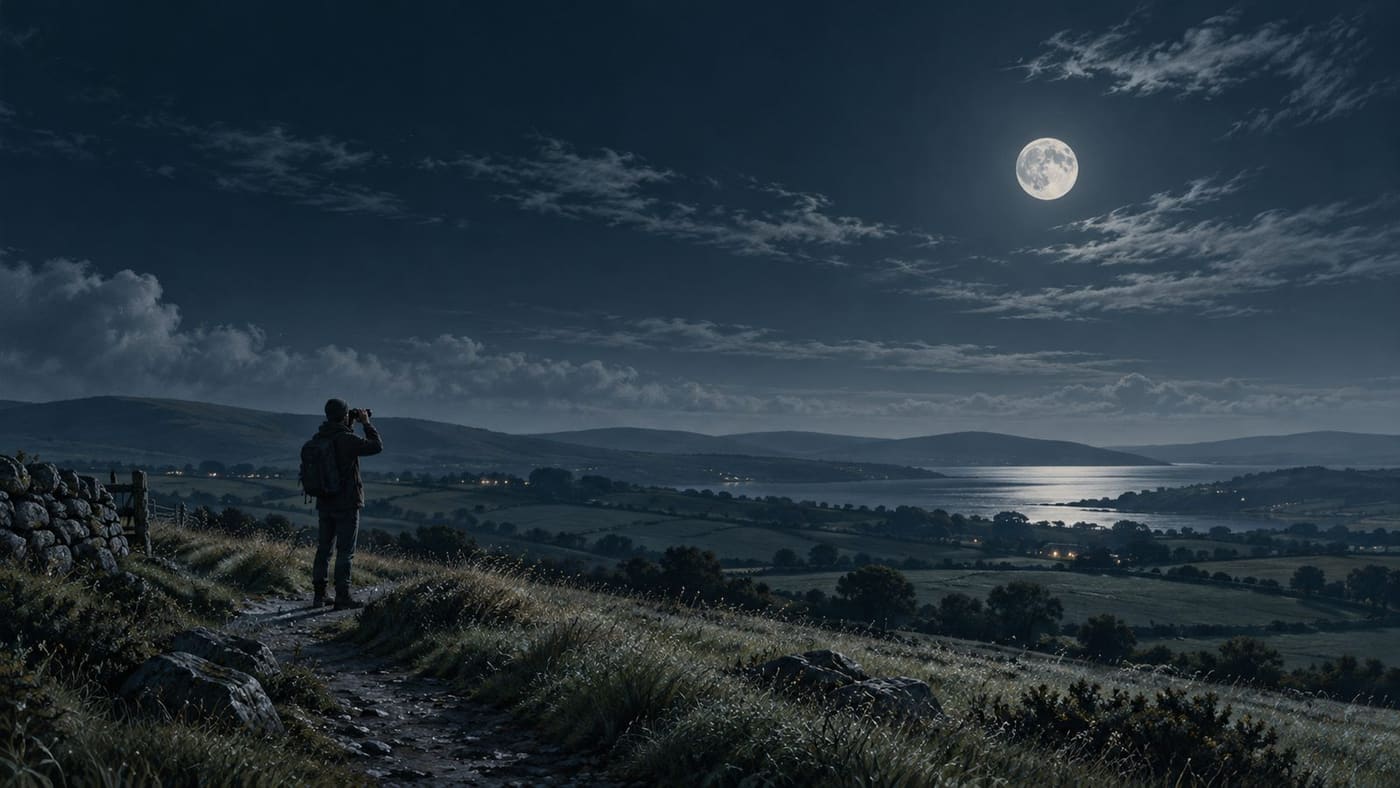
The cover for this guide is an AI-generated editorial illustration, not a photograph of the October 2026 event or a verified Irish observing location. It sets a visual mood. The astronomical claims come from the linked reference material, not from details in the picture. Keeping those roles separate makes both the art and the explanation more trustworthy.
Read trending Moon stories with three questions
First, what is the original source for the date or numerical claim? Follow a calendar or official explanation rather than relying on a repeated caption. Second, which location and time zone does the claim describe? Third, is the accompanying image a current observation, an older photograph or an illustration?
These questions are especially useful when different headlines seem to disagree. Two pages may be describing different local dates, or one may be discussing a convenient viewing evening rather than the exact phase. Compare the underlying information before deciding that either must be wrong.
Do the same with promotional language. Words such as spectacular or unmissable express enthusiasm, not a viewing forecast. You can enjoy an event without accepting every superlative attached to it. For this guide, the supported central claim is straightforward: NASA lists the October 2026 full moon on 26 October.
A compact plan for your evening
- Check the date and a local rise-and-set reference for your chosen place.
- Read a recent local weather forecast and any relevant public warnings.
- Choose an accessible, familiar location and an easy route home.
- Bring only equipment you already know how to use, plus suitable clothing.
- Make a few observations before taking photographs.
- Record the time, broad location and actual conditions in a short note.
- Keep captions accurate, including any substantial editing or illustration.
You can prepare this plan in a few minutes. Its value is not the number of items but the decisions it removes later. When you know where you will stand and what you want to notice, you can spend more of the evening looking and less of it searching for instructions.
If you miss the evening
Missing a clear view is not a reason to abandon the interest. Keep the date in your notes, record the weather and choose another evening for a short observation. Use an up-to-date lunar guide to understand the phase on that later date rather than describing it as the full-moon night.
There is a useful editorial lesson here too. A viewing guide should remain honest when conditions do not cooperate. It should help someone make a good decision, including the decision to stay indoors, rather than pressure them to produce a photograph that proves they joined a trend.
When revisiting an article after its event date, check whether its timings and language still apply. A guide written before 26 October is preparation, not a report on what observers actually saw. Later coverage should add independently checked observations and clearly distinguish them from the earlier advice.
The worthwhile part is the observation
The October full moon offers a simple reason to pause and look at the sky. For an observer in Ireland, a sensible plan begins with the verified date, a local timing reference and a realistic weather check. Everything else can stay uncomplicated.
Choose a place you can reach comfortably, notice a few details and keep an honest record. You may return with a photograph, a question about a lunar feature or just a clearer sense of the view above your neighbourhood. None of those outcomes requires an exaggerated claim. A carefully observed ordinary scene is enough.
Sources and editorial context
NASA, October 2026 skywatching and Hunter's Moon date: https://www.nasa.gov/blogs/watch-the-skies/2026/10/05/disappearing-planets-dragon-fireballs-hunters-moon-fill-octobers-spooky-skies/
NASA, Daily Moon Guide and 2026 lunar calendar: https://science.nasa.gov/moon/daily-moon-guide/
NASA, explanation of lunar phases: https://science.nasa.gov/moon/moon-phases/
Researched on 25 October 2026. The observation plan and photography exercises are editorial suggestions, not reports of field testing. This is a trend-led explanatory guide, with AI-assisted drafting and an AI-generated cover illustration, prepared for editorial review. No specific local weather or exact nationwide moonrise time is asserted.