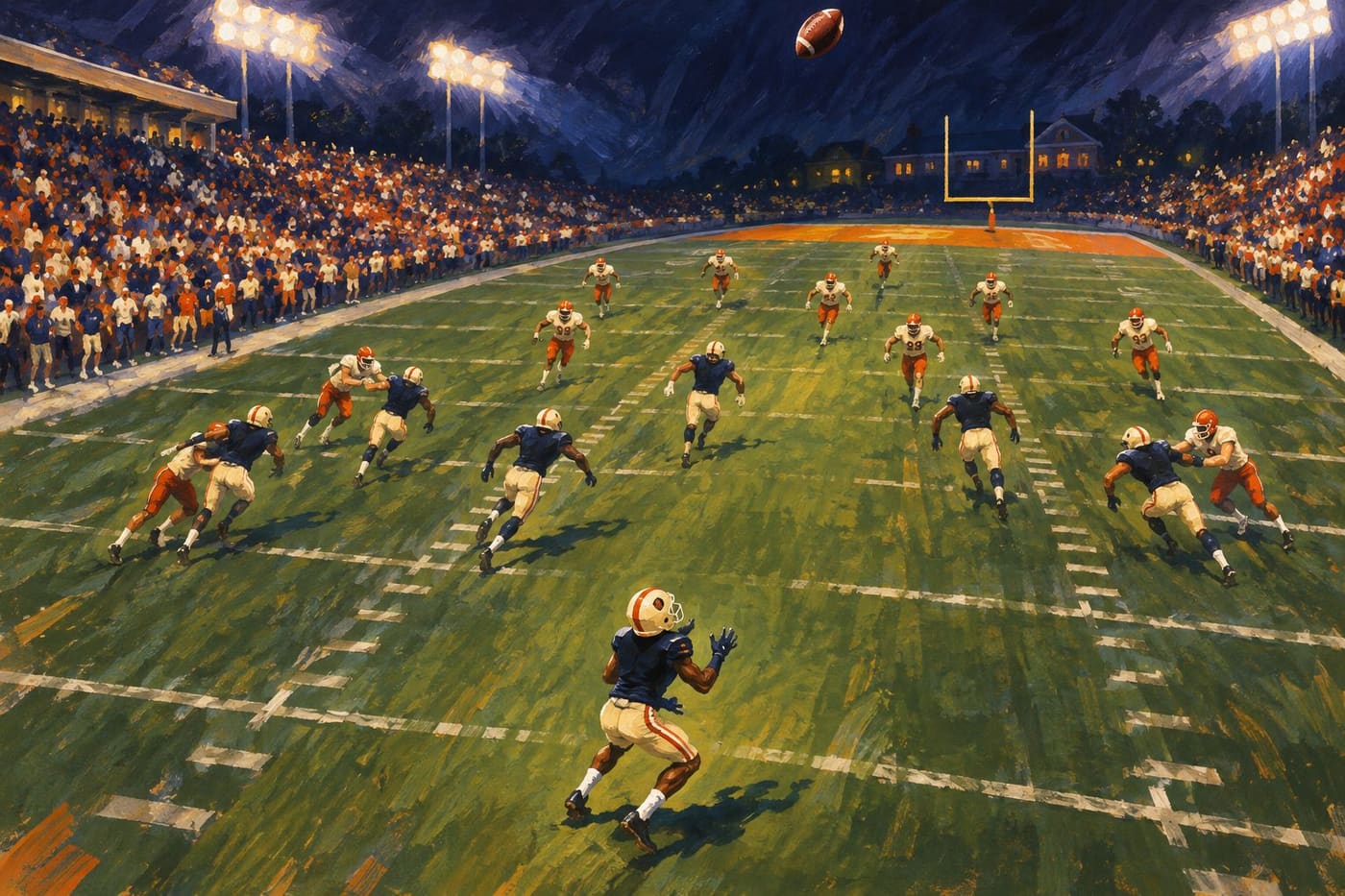
Notre Dame beat Miami 31–24 on 7 November 2026 at Notre Dame Stadium. The Irish led 17–3 at halftime and reached 24–3 after a long punt return set up a short touchdown drive. Miami got within seven twice, but Notre Dame held on through the Hurricanes' last two possessions. The margin was one touchdown at the finish, while the game itself included a goal-line stand, a shift in field position and a turnover that gave Notre Dame the chance to rebuild its cushion. Notre Dame recap and Miami recap.
The difference between getting close and getting seven
Notre Dame took the opening possession 50 yards in 12 plays. Spencer Porath's 44-yard field goal gave the Irish the lead, but Miami had kept them out of the end zone. In the second quarter, Notre Dame scored a different way. CJ Carr found Jordan Faison from 27 yards out to complete a four-play touchdown drive. The first drive used more time and more plays, yet the second put more points on the board. That distinction is worth keeping in mind when comparing possession time with scoring. Miami recap.
Miami's response also covered ground without producing a touchdown. Darian Mensah connected with Cooper Barkate and Vandrevius Jacobs on gains that helped get Miami into Notre Dame territory. Penalties helped move the ball to first and goal at the Irish one. From that position Miami tried to run the ball, and Notre Dame kept it out of the end zone. Jake Weinberg made a 19-yard field goal to make it 10–3. The home team's account highlights the stops at the goal line, while Miami's account shows the gains that brought the Hurricanes there. Both details matter. Miami had moved effectively through much of the field, then ran into a different problem in the final yard. Notre Dame recap and official box score.
A first down on the one gives the offense several opportunities, but it also brings the defenders close to the ball and leaves almost no space behind them. For someone reviewing the game, the useful comparison is between the open-field gains on Miami's way there and the repeated attempts in the compressed area near the goal line. A drive chart only records three points at the end. The play log shows why those three points can be read as a defensive success for Notre Dame even though Miami had scored.
A late first-half drive changed the halftime margin
Notre Dame led by seven after the field goal. It added a touchdown shortly before halftime when Carr found Micah Gilbert from 18 yards out. Miami's recap records the drive as eight plays, 81 yards and 1:39. Notre Dame's account singles out Aneyas Williams for blocking in pass protection and also picking up a first down with a reception. Those actions help explain how a possession with little time available reached scoring range. The highlight that ends in Gilbert's catch can be understood better if you watch the plays that allowed Carr time and moved the ball downfield. Notre Dame recap.
The drive changed the problem Miami faced at halftime. A seven-point gap could be erased by one touchdown and an extra point. At 17–3, one such possession would still leave the Hurricanes behind. The difference is important even before considering the third quarter. Notre Dame's defense had allowed a long scoring drive to reach the one and had yielded three points. Its offense then put seven on the board before the break. On a scoreboard those drives appear as a field goal and touchdown. In the order they happened, the combined result was a 14-point halftime lead.
The punt return set up a two-play touchdown drive
After a Miami possession ended in a punt early in the second half, Faison returned the kick 56 yards to the Miami 30. The official scoring record then shows a short Notre Dame possession ending with Carr's second touchdown pass to Gilbert. The score went to 24–3. The receiving touchdown gets the points in the box score, while the return explains why the offense needed to cover only 30 yards. To trace the start of the scoring opportunity, go back one possession and watch the punt. Notre Dame recap and official box score.
This is a useful contrast with the touchdown before halftime. The earlier drive covered 81 yards through the offense. The next score came after special teams supplied the favorable starting point. A chart that lists both drives as touchdowns can hide that difference. When comparing scoring drives, write down the starting yard line, the result of the preceding possession and the number of plays. Those details explain how the two touchdowns emerged even before considering the receiving routes or the quality of the throws.
Miami cut the deficit to one score twice
The Hurricanes answered 24–3 with touchdown passes on consecutive possessions. Mensah found Elija Lofton from 12 yards out, then connected with Barkate on another 12-yard touchdown. The second brought Miami to 24–17. Miami's defense forced Notre Dame to give the ball back, creating an opportunity to tie the game. The comeback had reached a different stage by then. It was no longer a question of whether Miami could reduce a large deficit. The next successful touchdown drive with the usual extra point could bring the teams level. Miami recap.
Luke Talich intercepted Mensah near midfield on that next possession. Notre Dame converted the turnover into a touchdown drive capped by a one-yard run from Nolan James Jr. It put the Irish ahead 31–17. The interception and the ensuing touchdown belong together in the sequence, though each was made by a different unit. The defense ended a Miami drive that could have tied the game, and the offense used the new possession to restore the two-score gap. Notre Dame recap.
Miami still had time to answer. With 9:53 remaining, Mensah found Barkate for a one-yard touchdown, making it 31–24 after the extra point. Miami's recap says Notre Dame stopped its final two possessions. The home report credits Talich with a pass breakup that denied a possible touchdown as well as the interception. The two defensive plays should be tracked separately. One led to a new Notre Dame possession. The other helped keep Miami from scoring while the margin was seven. If you are looking for the end of the rally, the final two drives are as important as the scoring play that started it. Miami recap and Notre Dame recap.
What the passing figures tell you
Notre Dame records Carr at 29 completions on 40 attempts for 319 yards and three touchdowns. Gilbert caught nine passes for 98 yards and two of the touchdowns. Faison caught the other touchdown and also made the long return. Keeping the receiving and return contributions separate makes it possible to see Faison's role in two different phases. The return did not count as a reception, but it helped create the short field from which one of Carr's touchdown drives began. Notre Dame recap and official box score.
Mensah threw three touchdown passes as Miami outscored Notre Dame 21–14 after halftime. The Irish had already established a 14-point lead before the interval, so the seven-point advantage for Miami over the second half reduced the final margin to seven. This provides a way to reconcile a strong Miami second half with a Notre Dame win. Miami made up half the halftime gap, including twice getting close enough for a touchdown drive to tie the game. Notre Dame protected the remaining margin. Miami recap.
Why different ranking numbers appear
The teams' reports put the meeting in the context of pregame rankings. Miami's recap describes Notre Dame as fourth in the AP Top 25 and 11th in the initial College Football Playoff rankings. A display that uses 11 for Notre Dame and a headline that uses four can both describe the same team on the same night. Check the name of the ranking before interpreting the number. The official result is 31–24 whichever ranking a scoreboard uses. Notre Dame's recap gives both teams a record of 8–1 after the game. Miami recap and Notre Dame recap.
For a separate example of reading scoring phases in a college football result, see our Oregon–Ohio State report. For this game, the result and date come first. Any claim about a later poll or playoff ranking needs its own dated release. The Saturday game record establishes who won and how the lead changed, while a subsequent ranking would reflect the assessment made by that ranking's authors.
What the search snapshot captured
The United States Google Trends view captured on 8 November listed “miami fl vs notre dame” first by search volume across the preceding 24 hours. The query showed 1M+ and was marked Active. Related terms included Notre Dame football and Notre Dame game. The capture describes interest in the search term at that time. It does not measure attendance or viewership. If you are looking for the result from the query, the official box score confirms it. If you are looking for the key moments, begin with the goal-line stand and compare it with the punt return and the interception. Each affected the next scoring opportunity in a different way. Google Trends United States.
The quickest way to reconstruct the game is to follow five scores in order: 10–3 after Miami's field goal, 17–3 at halftime, 24–3 after the return and two-play drive, 24–17 after Miami's first two touchdowns, and 31–24 after the teams exchanged fourth-quarter scores. Then look beyond that last change on the scoreboard to the possessions that followed. The game remained within seven, and the last defensive stops are what made the final margin hold.
Use the play log to compare the two chances to tie
Start the comparison when Miami's second touchdown made it 24–17. The Hurricanes had just scored on consecutive drives. After their defense forced a punt, they had the ball back with a chance to erase the remaining gap. In the official play log, locate that possession and follow the changes in field position until Talich's interception. Then mark the start of the Notre Dame drive that followed it. That sequence shows the effect of the turnover in two steps: Miami lost an opportunity to score, and Notre Dame gained a possession that ended in seven points. Official box score and play log.
The second chance to tie arrived after Barkate's fourth-quarter touchdown. At 31–24, the margin was the same seven points, but there was less time left and Miami had already used its earlier chance. Read the two final Miami possessions separately. For each, check how it began and what ended it. If you watch a short highlights package, use the play log to locate the attempted end-zone pass and the point at which the ball went back to Notre Dame. A pass that reaches the end zone does not appear in the scoring summary unless it is completed for a touchdown. It can still be the most consequential play of a possession.
It is also worth tracking when the defense was able to force the other offense off the field. Miami's stop after reaching 24–17 was essential to giving its offense a chance to tie. Notre Dame's closing stops performed the opposite function, keeping Miami from using its second opportunity to level the score. This is why the most important plays in the rally span both teams' offenses and defenses. The quarterback touchdowns supply the visible changes on the scoreboard. The stops determine who had the ball and how many opportunities remained.
Finally, use the same source when comparing numbers within a drive. A pass may be described by its gain in the play log and by the total distance covered by the possession in a recap. The figures measure different things. Note whether you are recording one play, the distance of the drive or the points it produced. In this game, keeping those columns separate makes it easier to see the value of the early punt return, the short touchdown it set up and the late possessions that ended with the score unchanged.
Sources consulted 8 November 2026, Bangladesh time.