The immediate question for people searching for Mein Schiff 3 is whether their own holiday is affected. The answer depends on which departure they booked. A cancellation announcement for the current voyage should not be expanded into an announcement about every future sailing, and a repair requirement is not a published date for returning to service.
In its update dated 26 October 2026 at 11:00, [TUI Cruises confirmed that the current Canary Islands voyage was cancelled](https://www.meinschiff.com/de/aktuelle-informationen). It said shipyard repairs were necessary and that the effect on later voyages was still being assessed. Guests with subsequent bookings were to receive information once the company could make a reliable assessment.
This guide separates that confirmed operational information from the decisions a traveller may need to make. It also explains how to keep useful records without turning incomplete news into assumptions about compensation, responsibility or a new departure date. The practical examples below are editorial suggestions, not instructions issued by the cruise company or individual legal advice.
The confirmed incident, in a short account
[Bremen Police’s 26 October statement](https://www.presseportal.de/blaulicht/pm/35235/6377541) describes a cruise ship departing Bremerhaven with tug assistance on 25 October when a gust pushed it towards two moored container ships. Police reported damage to all three vessels, including the cruise ship’s lifeboats, associated cranes and exterior. They reported no injuries or water entering the ships and said departure restrictions had been imposed on all three. Their investigation was continuing.
That account is more useful than trying to infer the whole event from one photograph. It identifies an official source, a date and the status of the investigation. It does not provide a final allocation of responsibility, a repair invoice or a timetable for future passenger operations. Those are separate questions requiring separate evidence.
The distinction matters when an incident develops quickly. A report can be accurate when published and later become incomplete. Readers should check whether an update actually replaces an earlier statement or simply adds a different piece of information. A company’s travel update and a police account may serve different purposes without necessarily contradicting each other.
First identify the booking that needs a decision
Before contacting anyone, put the ship name, departure date and booking reference together. An enquiry saying only “my Mein Schiff holiday” leaves the person answering it to establish which voyage is involved. A precise enquiry is easier to match to a current notice and less likely to produce a general answer that does not resolve the traveller’s concern.
Make a short list of the arrangements attached to that booking. The cruise, a flight, a hotel night and a rail ticket may appear in different confirmations. Record who sold each part and which reference belongs to it. This is an organisational step; it does not determine which business is legally responsible for a particular cost.
Useful information to have ready includes:
- The exact sailing date and the names of the booked travellers.
- The cruise booking reference and the contact details already on the booking.
- The latest direct message from the operator or booking agent.
- Separate transport and accommodation confirmations, if there are any.
- Any practical assistance that must be arranged before travelling.
Avoid posting these records publicly to ask strangers for help. A screenshot that looks harmless may contain a reference number, an address or details about other passengers. Public discussion can help identify questions, but the booking-specific answer belongs in a private exchange with the relevant company or adviser.
Current-voyage passengers and later guests have different questions
For someone booked on the cancelled voyage, the useful next enquiry concerns the instructions attached to that cancellation: what to do now, where to find written arrangements and whom to contact if a practical problem remains unresolved. Ask for clarification of an unclear instruction before substituting a plan found in a social-media comment.
For a later departure, the starting question is narrower: has the operator issued a notice covering this particular date? The absence of a new notice does not establish that everything will proceed exactly as originally booked. Equally, uncertainty does not establish that the sailing has been cancelled. A cautious plan should preserve both possibilities until better information arrives.
If a separate hotel or transport booking has a decision deadline approaching, tell the cruise company or agent the deadline when asking for an update. For example, a traveller might explain that a hotel can be changed until a particular time and ask whether any confirmed information about the sailing is available. That is more actionable than asking for a prediction about repairs.
The company may still be unable to give a definitive answer. In that case, record the response and examine the terms of the separate booking rather than treating an estimate as a promise. The objective is to understand the decision in front of you, including what remains unknown, before committing to another expense.
Keep a small decision log
A useful log can fit on one page. Give each entry a date, the source of the information, what it says about your booking and the next action. Keep the actual message alongside the summary. A summary is convenient, but the original wording matters when a qualification or deadline has been left out inadvertently.
For example, an entry might read: “Monday afternoon: agent acknowledged my enquiry; no sailing-specific change confirmed; requested an update before my separate hotel deadline.” This fictional entry does not assert that any particular agent has made such a promise. It illustrates how to distinguish an acknowledgement from a substantive answer.
Use separate entries for confirmed instructions and your own decisions. If you choose to change a hotel, note why and keep the confirmation. Do not rewrite the earlier history after new information arrives. A chronological record makes it easier to see what was known at the time, which is especially useful when several family members are coordinating arrangements.
The log need not become an elaborate spreadsheet. Too many columns can create another administrative task during a stressful disruption. Four clear fields and a folder of original documents are usually easier to maintain than a large collection of screenshots with no dates or explanation.
Treat reimbursement questions as questions, not assumptions
This article does not establish an individual entitlement to a refund, compensation or reimbursement of additional expenses. Those questions can depend on the booking, applicable rules, the circumstances and the response offered. A headline announcing a cancelled voyage cannot substitute for examining the actual arrangements.
When asking about an expense, identify it precisely. “Will you cover my extra travel?” is less clear than explaining which journey, who booked it, the amount involved and why it became necessary. Keep receipts and written responses. A receipt supports what was paid; it does not by itself prove that another party must repay it.
Before accepting an alternative arrangement, read what it includes and what it leaves out. Check the dates, transport connections, accommodation and any response deadline. If the wording has consequences you do not understand, obtain appropriate independent advice. Do not rely on another passenger’s outcome as a guarantee that your differently structured booking will be treated identically.
Be particularly careful when comparing an immediate practical solution with a later financial claim. Getting home, changing a hotel and resolving the final account are related but separate tasks. A useful enquiry makes clear which task needs an urgent answer and which supporting documents can follow once the immediate arrangements are settled.
Why a repair announcement cannot supply a return date
Readers naturally want a date they can put in a calendar. However, a statement that work is necessary contains less information than a statement that the work is complete and a named sailing is confirmed. Filling the gap with a guess creates false certainty precisely when passengers need dependable information.
For planning purposes, look for a notice that names the affected departure rather than a broad claim that the ship will be ready “soon.” Ask whether the information is a confirmed instruction, a provisional expectation or simply a description of work underway. These labels have different practical value even when they appear in the same conversation.
This is not an invitation to speculate about the extent of damage from images. The position of a visible mark, the angle of a photograph and the condition of one component cannot give a reader a complete technical assessment. This guide does not attempt one. It focuses on what a traveller can verify and what decision can reasonably follow from that information.
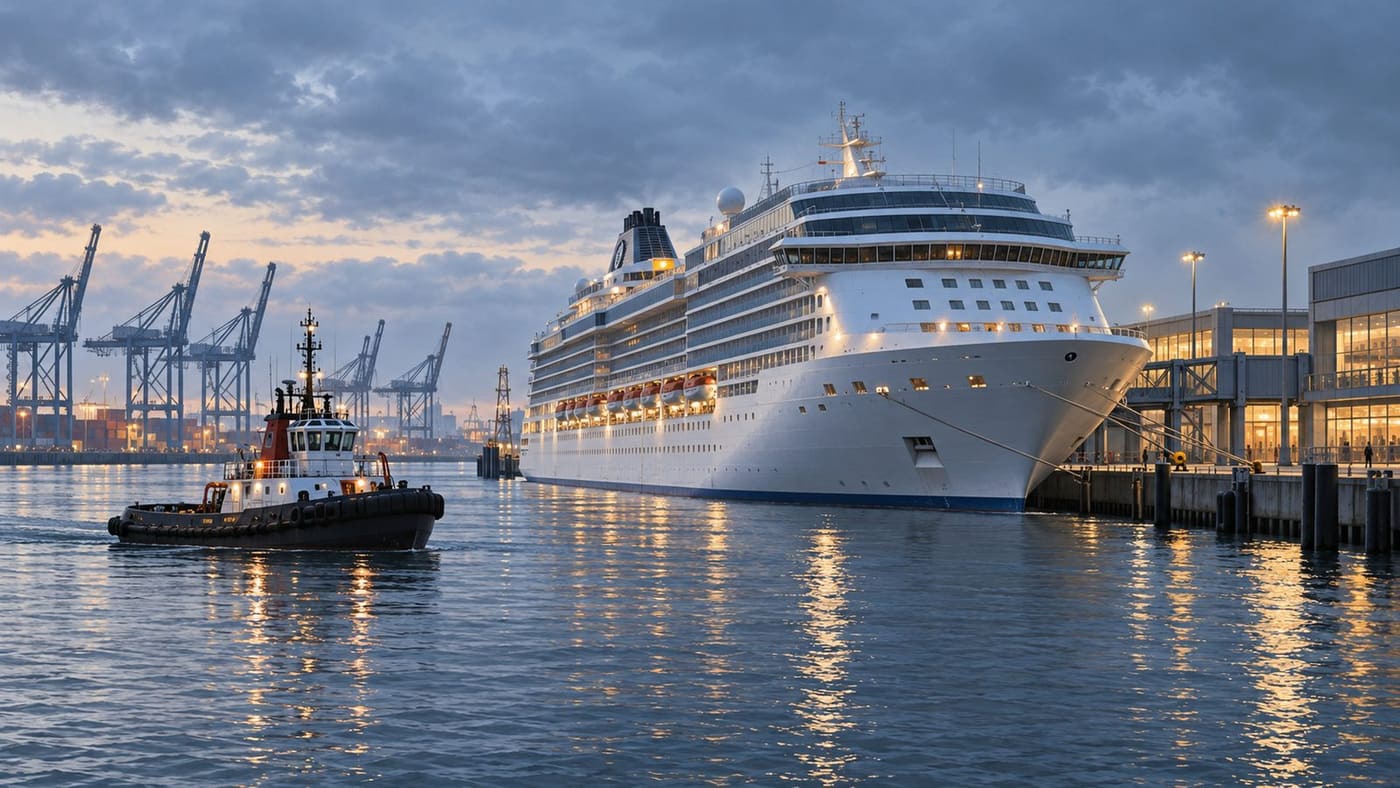
Similarly, an illustration accompanying a news explainer is not documentary evidence. The image used here is an original generated concept of a cruise ship in a harbour. It does not reconstruct the collision, identify damaged components or show the actual position of the vessels during the incident.
Investigation and travel information answer different needs
An operational notice helps guests understand a voyage. An investigation examines the event. Neither should be treated as a substitute for the other. An announcement that a holiday will not proceed does not, on its own, establish who is legally at fault; a developing investigation does not necessarily answer a passenger’s immediate question about tomorrow’s transport.
The [International Maritime Organization’s casualty-investigation framework](https://www.imo.org/en/ourwork/iiis/pages/applicable-imo-instruments.aspx) provides background on marine safety investigations. The [Casualty Investigation Code](https://wwwcdn.imo.org/localresources/en/OurWork/MSAS/Documents/Res.MSC.255%2884%29CasualtyIinvestigationCode.pdf) distinguishes the safety objective from assigning blame or liability. That general distinction is not a claim that a particular investigation has been opened under that framework in this case.
For readers, the practical lesson is to label the kind of statement being discussed. A preliminary account, a safety finding, a legal decision and a customer-service offer are not interchangeable. Keeping those categories separate prevents a factual update from acquiring a conclusion its source never made.
It is reasonable to ask hard questions about a serious disruption. It is also reasonable to wait for evidence before answering them. Avoid attaching blame to a named individual based only on an edited clip or a confident comment. A careful account can explain what is known while leaving unresolved matters unresolved.
A fictional example of two different travellers
Imagine two friends reading the same cancellation headline. One has a booking on the affected voyage and needs instructions for returning home. The other has a later departure and a separately booked overnight hotel. They should not necessarily take the same action, because the headline relates directly to only one of those booking dates.
The first traveller gathers the cancellation message and asks the designated contact to clarify the immediate travel arrangements. The second checks for a notice naming the later sailing, reads the hotel’s change deadline and asks the booking agent what confirmed information is available before that deadline. Neither needs to guess the repair schedule to formulate a useful question.
If both receive incomplete answers, each can record the missing information explicitly. “No return-transport instruction yet” and “no confirmed effect on my later departure yet” describe different gaps. Naming the gap makes the next enquiry clearer and helps relatives understand why one person is making arrangements while another is waiting for a specific update.
This example is deliberately simple. It does not predict how the operator will handle an individual booking or recommend cancelling a future trip. It shows how matching information to a particular decision can reduce confusion without pretending that all uncertainty has been removed.
Conclusion
Check the date of your own sailing, use the latest direct notice and keep a concise record of decisions and expenses. Ask precise questions about the arrangements you need to make. Until a statement names a later departure, do not turn news about the current voyage into a blanket conclusion about future trips. Verified information is most useful when it is matched to the booking and decision it actually concerns.
Sources and research note
Research date: 26 October 2026, Asia/Dhaka. TUI Cruises’ current-information notice dated 26 October at 11:00 and Bremen Police’s statement dated 26 October at 08:20 were checked directly. Links appear beside the short factual summaries. The IMO material supplies general background only. Google Trends discovery used Germany, past 24 hours, all categories, search volume descending at 22:49 Asia/Dhaka: “mein schiff 3” ranked first with 200K+, 1,000% growth and Active status. Search interest is not a safety assessment. The generated harbour illustration is conceptual, not an incident photograph. Practical examples are fictional and no individual financial or legal outcome is promised.