Ireland's yellow weather warnings are attracting searches on 26 October, but a search phrase is not a reliable description of the warning currently in force. A reader searching for wind and rain together may find a headline, screenshot or search extract that no longer matches the official page. The useful response is to check the latest warning itself, then connect its location and timing to the journey or activity being considered.
At this article's research check on 26 October 2026, Met Éireann's current warnings page displayed a yellow wind warning for eleven counties, valid from 17:00 to 23:59 that Monday. An earlier retrieved search extract also mentioned a rain warning; the canonical page subsequently retrieved did not display that rain warning. This article therefore does not present the earlier rain entry as a confirmed current alert. Open the live official page before making a decision.
That distinction matters for anyone arranging a collection, travelling to work, meeting a ferry or deciding whether an outdoor event is practical. The following guide separates the verified warning snapshot from general preparation and illustrative examples. It cannot establish whether a particular road, property or service is safe at the moment you use it.
The verified warning snapshot
The [Met Éireann warnings page](https://www.met.ie/warnings-today.html) listed Carlow, Clare, Cork, Donegal, Galway, Kerry, Kilkenny, Mayo, Waterford, Wexford and Wicklow for the Monday evening wind warning. It described strong, gusty south to southwest winds and potential effects including displaced objects, difficult travel, fallen branches and coastal waves. The stated validity was 17:00–23:59 on 26 October, in the warning's Irish local-time context.
These are time-limited details, not a standing forecast. The page can change after publication. A warning's expiry also does not certify that every obstruction or service disruption has been cleared. For decisions after that window, retrieve the next day's information and the relevant local service update instead of treating this article as a live bulletin.
Read four fields before sharing a warning
A useful reading order is location, hazard, validity and update time. Start with the county or area, then identify whether the alert concerns wind, rain or another hazard. Next, read when it starts and finishes. Finally, check whether the information has been updated since the screenshot or headline you received.
Those fields answer different questions. The county identifies the area covered by the alert. The hazard explains what the forecaster is warning about. The validity window identifies the relevant period. The issue or update time helps distinguish versions. Reading only one of them can produce an apparently sensible but incomplete conclusion.
For example, imagine receiving a warning image in a family message group on Monday afternoon. The image may have been saved on Sunday, and its caption may simply say “tonight.” Before forwarding it, replace that relative description with the actual date and link to the official page. The recipient should not have to work out whose tonight the message means.
An effective short message would identify the affected area, the relevant period and the official link. Avoid adding a prediction that every school, workplace or transport service will close. Those operational decisions need their own confirmation.
Yellow requires a local decision
Met Éireann's [warning explanation](https://www.met.ie/weather-warnings) describes yellow conditions as potentially dangerous on a localised scale. It also explains that impacts depend on factors such as location, previous conditions, timing and the activity involved. The colour alone therefore cannot answer whether your individual plan is appropriate.
A sheltered indoor appointment and an exposed outdoor setup are different decisions, even when both are in the same county. The practical question is what the proposed activity exposes people to and whether that exposure can reasonably be avoided. A person does not need to wait for a more severe colour before reconsidering an optional plan.
Equally, a yellow warning is not evidence that every location has already suffered damage. A forecast warning describes a risk; an observed incident report describes something that has happened. Keep those categories separate when discussing conditions with colleagues, customers or relatives. Do not attach an old photograph to a new alert and imply that it shows today's situation.
Plan the whole journey, including the return
Before leaving, look beyond the weather outside your own door. A journey has an origin, a route, a destination and a return period. A plan that appears manageable at departure may overlap with the warning later. Write those parts down if several people are coordinating transport, rather than relying on a vague agreement to “see how it looks.”
Consider an illustrative family arrangement: one adult leaves before the warning begins, while another is expected to collect someone later in the evening. The first successful journey does not settle the second decision. They should separately check the later conditions, the collection arrangements and any update from the venue. This is a planning example, not a report of a particular disruption.
Ask the service or venue the question it can actually answer. A train operator can confirm its service information; an event organiser can confirm its arrangements; a local authority can publish local access notices. A general forecast cannot substitute for those operational updates, and an operational update cannot guarantee conditions along every part of your route.
Useful questions include:
- Is this journey necessary during the affected period?
- Has the destination confirmed that the appointment or event is proceeding?
- Is there a reasonable alternative time or remote arrangement?
- Who needs to know if the plan changes?
- What official source will be checked immediately before departure?
Road information and driving decisions
[An Garda Síochána's adverse-weather guidance](https://www.garda.ie/en/roads-policing/road-safety/adverse-weather-conditions.html) advises considering whether a journey is necessary in extreme conditions, checking the intended route and allowing extra time. Its wind guidance includes reducing speed, increasing following distance and remaining alert to debris and the effects of wind on exposed roads and other road users.
Treat that as general guidance, not a personalised clearance to travel. A familiar journey can still require a new decision when an official warning or local closure affects it. If an appointment can be rearranged, resolve that with the person expecting you before leaving; being late is not a reason to ignore a closure or rush through deteriorating conditions.
Navigation software may help identify a route, but a suggested line on a screen is not evidence that the route is open. When an official closure conflicts with a navigation suggestion, follow the closure. A detour should not become an improvised attempt to get around a barrier through an unfamiliar lane.
The same communication principle applies to employers and clients. Explain the specific uncertainty: a route notice, a service cancellation or a warning affecting the travel period. That is more useful than saying merely that the weather is bad, and it makes alternative arrangements easier to agree without exaggerating what is known.
Rain searches do not establish a current rain warning
The search cluster that prompted this article included both wind and rain. However, the later official page retrieval and the earlier search extract differed. Rather than combining them into a larger alert, this article keeps that discrepancy visible. A search engine can retain text from a page version that is no longer the version a reader sees.
For anyone specifically concerned about rain, open the live warning page and select the relevant date and county. If there is no matching warning displayed, do not infer that flooding is impossible. Conversely, do not claim an active rain warning solely because an older headline includes the phrase. Local conditions and official local notices still require attention.
The government's [flooding advice](https://www.gov.ie/en/department-of-defence/publications/flooding-advice/) says not to walk or drive through floodwater and warns that contamination and concealed hazards may be present. A road that looks shallow from a distance is not a reliable assessment of what lies beneath the water. Avoid attempting to investigate it personally to settle an argument about whether a route is passable.
Power information: use the current service
If electricity is affected, distinguish a weather warning from a confirmed outage affecting a particular address. They are different records. A neighbour's message may be helpful as a prompt to check, but it does not establish the expected restoration time for another property.
[ESB Networks' PowerCheck guidance](https://www.esbnetworks.ie/services/power-outages/check-my-power-status/powercheck-guidelines) directs users to its browser-based service and says the older downloadable PowerCheck app is no longer maintained. It also states that fallen electricity wires are dangerous: do not approach or touch them. Report them to ESB Networks on 1800 372 999, or use 999 or 112 for an emergency as indicated in its guidance.
Do not turn a group message into a request for someone to inspect damaged electrical equipment. The useful information to pass on is the location and the official reporting route, without encouraging anyone to get closer for a photograph. An outage estimate is also not a promise that every dependent arrangement will immediately return to normal at that time.
Organisers should publish decisions people can use
For an outdoor gathering, a practical update needs more than a weather symbol. Participants need to know whether the event is proceeding, changing location or being postponed, and where to find the next update. The organiser should distinguish an actual decision from an assessment that is still underway.
An illustrative notice might say that the organiser is reviewing the evening arrangements, that a decision will be posted through the usual official channel and that attendees should check before travelling. It should not claim that the event is safe merely because the warning is yellow. Site-specific decisions belong to the responsible organisers and relevant professionals.
Consistency matters when several channels are involved. If a website says postponed but an old social post still says doors open at seven, people may act on the wrong message. Updating the main event page and directing other channels to it is more useful than publishing several slightly different explanations.
Keep cancellation, travel and refund information distinct. A weather warning does not by itself establish every customer's contractual entitlement. Give the actual booking terms or contact route rather than inventing a universal refund rule. That helps attendees solve the practical problem without confusing a safety decision with a financial promise.
A compact household information plan
The most useful preparation may be deciding who will check which source. One person can follow the official warning page while another confirms a transport or appointment update. They can then share the findings with dates and links, rather than repeatedly forwarding the same screenshot.
This need not become a complicated monitoring exercise. Agree one clear decision point before travel and another if the official information materially changes. Continuous scrolling through unverified posts can create more uncertainty without improving the decision. A short list of authoritative sources is easier to interpret than a large stream of competing claims.
For someone helping an older relative or a person with access needs, ask what practical arrangement requires confirmation. It might be a collection time, a service visit or a way to receive an update. Avoid assuming that a public message reaches everyone or that every person can quickly change an existing arrangement. Specific communication is more useful than a general instruction to be careful.
How to recognise an outdated update
Look for missing dates, cropped validity windows, a warning image without its source or a caption that uses only “today” and “tomorrow.” Those are reasons to verify, not proof that the message is deliberately false. Someone may have shared a genuine notice after its useful period had passed.
When correcting such a message, provide the newer source and explain the precise difference. For example, say that the current page displays a different county list or that the screenshot's validity period has ended. Avoid making a broader claim about all weather conditions unless the official source actually supports it.
The same discipline applies to this article. Its factual snapshot is dated, its sources are linked and the rain-warning discrepancy is disclosed. Later readers should use it as a guide to interpreting information, not as a replacement for the current forecast or emergency instructions.
Conclusion: make one informed decision at a time
The practical value of a yellow weather warning is the opportunity to reconsider an activity before conditions affect it. Read the actual location and validity window, check the service or route relevant to your plan and communicate any change clearly. Separate a forecast from a confirmed incident and a transport update from a general claim about an entire county.
For this Monday's search interest, the verified snapshot supports reporting the wind warning described above. It does not justify presenting an earlier rain extract as a current alert. That careful distinction is what makes a weather article useful after a headline has caught your attention: it shows what is confirmed, what needs another check and where to obtain that check.
Sources and research note
Researched 26 October 2026. Primary sources linked above: Met Éireann's current warnings and warning explanation; An Garda Síochána's adverse-weather guidance; the Department of Defence flooding advice; and ESB Networks' PowerCheck guidance. Live warnings can change after publication. No road closure, outage total, school closure or individual transport cancellation is asserted here.
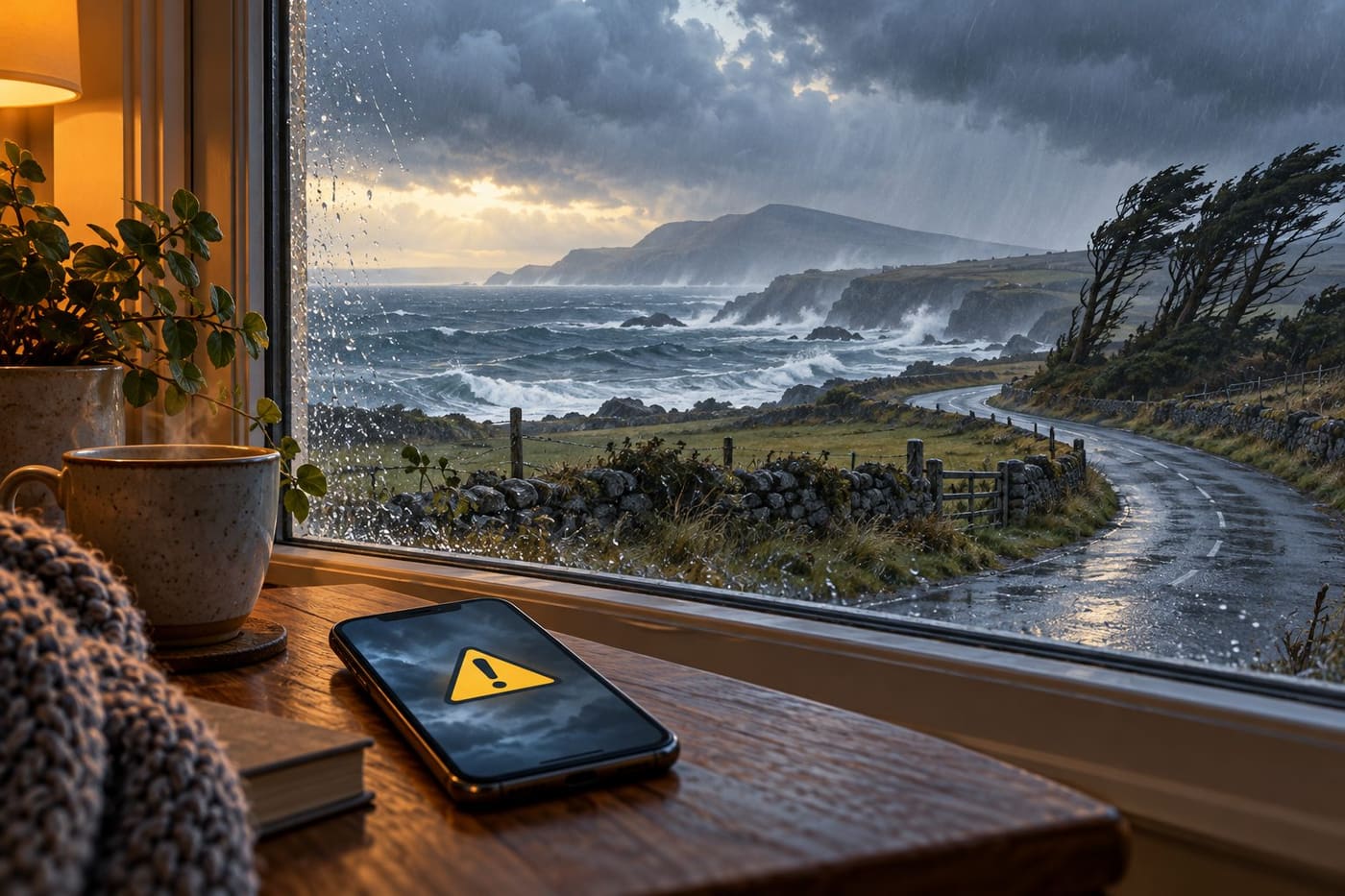
Google Trends Ireland, past 24 hours, sorted by search volume, showed the active “irish yellow wind rain warning” cluster at 2K+ searches in the research snapshot. Higher entries were ended, already covered or lacked usable primary confirmation. Search volume explains topic discovery, not the severity of the weather. Examples are illustrative. The original generated conceptual image depicts general Irish coastal weather preparation; it is not a photograph or reconstruction of an actual incident.