A newly named dinosaur can become news without a newly excavated skeleton. Invictibellatrix amberina is a useful example: the scientific announcement concerns a new interpretation of an existing museum specimen. The interesting question is how that interpretation connects a small piece of physical evidence to a much larger account of an animal and its relatives.
UCL announced the identification on 14 October 2026. Its researchers describe a roughly 120-million-year-old fragment from the back of a skull, originating on the Isle of Wight and acquired by the Natural History Museum in 1924. Their analysis places the dinosaur among megaraptorans and identifies it as the first known European member of that group. Those are the central reported findings, rather than evidence of a complete dinosaur newly uncovered this month. [UCL announcement](https://www.ucl.ac.uk/news/2026/oct/uk-dinosaur-fossil-identified-new-long-clawed-predator).
Research note: reviewed 26 October 2026. Dutch Google Trends discovery for “fossiel” led to recent coverage of this British research. Search interest in the Netherlands does not make the specimen Dutch, and October coverage should not be confused with the date of excavation. The journal article could not be retrieved during this review; this account uses the institutions' announcements, the researchers' explanatory article and accessible background methods literature. It does not independently reproduce the study's analysis.
Keep the specimen, reconstruction and interpretation separate
There are three different objects in a dinosaur story: the material preserved, a representation of that material, and the conclusions drawn from studying it. A photograph of a fossil, a digital reconstruction and an artist's whole-animal illustration can appear together. Their evidential roles are different.
For this case, the preserved material described in the announcement is a skull fragment. A picture showing an entire predator should therefore prompt a practical question: which parts of this picture came from that fragment, and which were supplied through comparison or artistic interpretation? That question is useful even when the illustration is scientifically informed and produced with researchers' advice.
The same distinction applies to language. “The specimen preserves a feature” describes an observation. “The animal probably had a feature” expresses an inference. “An illustration depicts a feature” describes an image. Moving casually between those sentences can make a reasonable scientific interpretation sound like a direct observation that nobody actually made.
For a reader making notes, a three-column page works well:
- Material: identify what survives and where it is held.
- Analysis: identify the technique or comparison used to examine it.
- Interpretation: identify the conclusion, including any uncertainty attached to it.
This is a reading aid, not a substitute for specialist examination. It helps prevent a striking reconstruction from silently becoming the evidence for its own accuracy.
What changed after the fossil entered a collection?
In their 20 October explanatory article, researchers Cassius Morrison and Charlie Scherer describe Paul Barrett examining the collection in 2020 and recognising the importance of the braincase. Museum records connected it with a beach near Sudmoor Point on the Isle of Wight. That account supplies a recent research sequence; it does not establish that nobody had ever looked at the object before. [Researchers' explanation](https://www.ucl.ac.uk/news/2026/oct/analysis-new-long-clawed-british-dinosaur-first-its-kind-europe).
The distinction matters for a headline such as “lost for a century”. Lost can mean physically missing, insufficiently identified, overlooked for a particular question, or simply unfamiliar to the public. These are not interchangeable claims. Here, the useful story is the reassessment of material already held in a collection.
A collection date also answers a different question from a geological age. The former concerns the history of the specimen as an object in human custody. The latter concerns its ancient setting. A publication date records when findings were communicated. Combining the three into a single “discovery date” removes information instead of simplifying it.
Consider an imaginary classroom timeline with four empty boxes: ancient animal, collection acquisition, modern investigation and publication. Place each documented date in the relevant box. Leave an unsupported excavation date blank. A blank is more accurate than filling it with the acquisition year because the numbers happen to be nearby in an article.
This approach also makes later corrections easier. If a museum record adds a detail about acquisition, it can update that part of the account without altering an unrelated scientific claim about the animal's relationships.
What CT scanning contributes
The UCL announcement reports that the team used computed tomography to construct three-dimensional models and compared the specimen with other meat-eating dinosaurs. It highlights a combination of features, including the form of the spinal-cord opening and a crest, in the argument for a new species. The importance is the anatomical comparison, not merely that a computer produced an impressive image.
Background methods literature explains that CT represents a three-dimensional structure through a sequence of digital sections. A digital endocast represents an internal space. In a skull, that space is related to the brain and surrounding tissues; it is not preserved brain tissue itself. The relationship between cavity shape and brain shape can vary. [Balanoff and colleagues' methods review](https://pmc.ncbi.nlm.nih.gov/articles/PMC4948053/).
For a nonspecialist, a useful question about a scan is therefore “what boundary is being represented?” A coloured region on a screen might be a selected cavity, a portion of bone or another structure. Colour alone cannot tell the viewer which it is. A clear caption and explanation are necessary.
Imagine being shown a smooth digital shape with no label. You could describe its visible outline, but you could not responsibly label it a dinosaur's intelligence, hunting strategy or personality. Those claims would require an additional argument. A polished visual does not remove that requirement.
Nor does a digital model eliminate the need to explain judgement. The general methods review discusses comparability and sources of variation in making endocasts. That is background context, not an allegation that this particular study used poor methods. Without inspecting the full paper and its supporting material, this article cannot assess the study's individual processing decisions.
Naming a species and placing it in a family tree
Two questions often become compressed into the phrase “new dinosaur”: whether a specimen warrants a distinct species, and where that species belongs among related animals. A reader should look for an explanation of both rather than treating the name itself as the complete scientific result.
The researchers' public account describes anatomical comparison followed by a computer-based assessment of relationships. For this article, that remains a reported analysis. It is not possible to audit its character scoring, alternative trees or sensitivity tests from the announcement alone.
An evolutionary tree is a hypothesis about relationships, rather than a ladder ranking animals from inferior to superior. T. Ryan Gregory's educational review explains the importance of interpreting such trees as branching histories. That general principle helps with the wording of dinosaur coverage: a relative is not automatically a direct ancestor, and a branch's position is not a score for evolutionary success. [Understanding Evolutionary Trees](https://link.springer.com/article/10.1007/s12052-008-0035-x).
When reading the Invictibellatrix story, ask what “first” modifies. First known European member is a statement about the evidence available to researchers. It should not be expanded into “the first individual ever to arrive in Europe”. The second sentence would claim much more than the first.
Similarly, a new name is not evidence that every earlier classification was careless. A fair assessment would need the earlier identification, the information then available and the new analysis. Those details are outside the direct verification completed here, so this account does not invent a history of previous mistakes.
Why body size deserves careful wording
The public descriptions do not provide one consistent whole-body length. The 14 October announcement gives an estimate of three to four metres based on relatives; the researchers' 20 October explanation says about five metres. Both concern inference from incomplete material, not a measurement along an intact skeleton.
This article does not average the numbers or choose the larger one for a stronger headline. An average would look like a fresh estimate without a scientific basis. Instead, the disagreement is disclosed and the animal's exact length is left unresolved here.
The practical lesson extends beyond this single number. If a report contains a precise-looking value, ask what was actually measured. Was it the surviving fragment, a reconstructed dimension, or an estimate transferred from relatives? A number can be useful while still belonging to the third category.
The same care should apply to feathers, claws and behaviour in a whole-animal reconstruction. A reader should seek the supporting evidence for each feature rather than assume that all were preserved together. This does not require dismissing reconstruction. It requires keeping its basis visible.
For a school presentation, a defensible caption would say that the animal's appearance is reconstructed and that the preserved specimen is incomplete. Avoid presenting a dramatic scene as if it were a photograph of an observed encounter. No colourful comparison is necessary to explain why a fragment can be scientifically informative.
A European occurrence and a wider geographical hypothesis
The researchers interpret the European finding as evidence relevant to how megaraptorans spread between regions. Their explanation discusses a proposed route involving Asia, Europe and Africa toward southern continents. They also acknowledge unresolved questions about the group's earliest evolution.
A fossil occurrence and a migration route should remain separate entries in a reader's notes. The occurrence concerns a specimen assigned to a group in a particular ancient setting. A route is a broader historical interpretation connecting evidence across places and times. A point on a map does not by itself record every movement between the surrounding points.
One way to evaluate the communication is to ask which sentence would remain if the proposed route changed. The specimen's significance might remain substantial even if later work revised a larger geographical model. Making that distinction avoids the mistaken choice between accepting every part of a narrative unchanged and rejecting the entire discovery.
An illustrative map should also be labelled appropriately. A line drawn between regions may communicate a hypothesis clearly, but viewers should not mistake it for a tracked journey. Arrows can convey more certainty than the accompanying prose intends.
For this reason, this article does not offer an original migration map or claim to resolve ancient geography. The accessible sources establish what the researchers propose; they do not give this review the basis to test all of the model's assumptions.
How to check another report about this dinosaur
Start with the report's central claim and trace its attribution. Is it describing the institutional announcement, quoting the researchers, interpreting the paper independently or simply reproducing another headline? Several pages repeating a statement do not necessarily represent several independent examinations of the fossil.
Then check the date and the object. An October news article about a museum specimen is not evidence of an October excavation. A rendering of a complete animal is not evidence of a complete skeleton. A reference to brain research is not evidence that soft brain tissue survived.
Finally, ask whether uncertainty has been preserved. The size discrepancy described above is a concrete example of something a careful summary should acknowledge rather than silently resolve. Where a source says “probably”, removing that word can change the claim.
A short review checklist is enough:
- Can the announcement or research reference be located?
- Is the preserved material identified clearly?
- Are acquisition, investigation and publication dates distinguished?
- Are reconstructed dimensions labelled as estimates?
- Are geographical and evolutionary conclusions attributed?
- Does the illustration explain what it represents?
These questions will not qualify a reader to name a species. They can, however, distinguish an accountable explanation from a headline that relies entirely on scale, danger or surprise.
Conclusion: a useful finding without a complete reconstruction
Invictibellatrix is interesting because researchers connect an existing skull fragment with a new taxonomic and evolutionary interpretation. Understanding that connection is more rewarding than treating the animal as a collection of dramatic measurements.
The accessible evidence supports reporting the announced identification and explaining the methods at a general level. It also leaves clear limits: the full study was unavailable for direct review, whole-body size differs between public descriptions, and wider historical conclusions remain interpretations to assess through research. Keeping those limits visible allows the finding to be discussed without pretending that one fragment preserves every detail of a living animal.
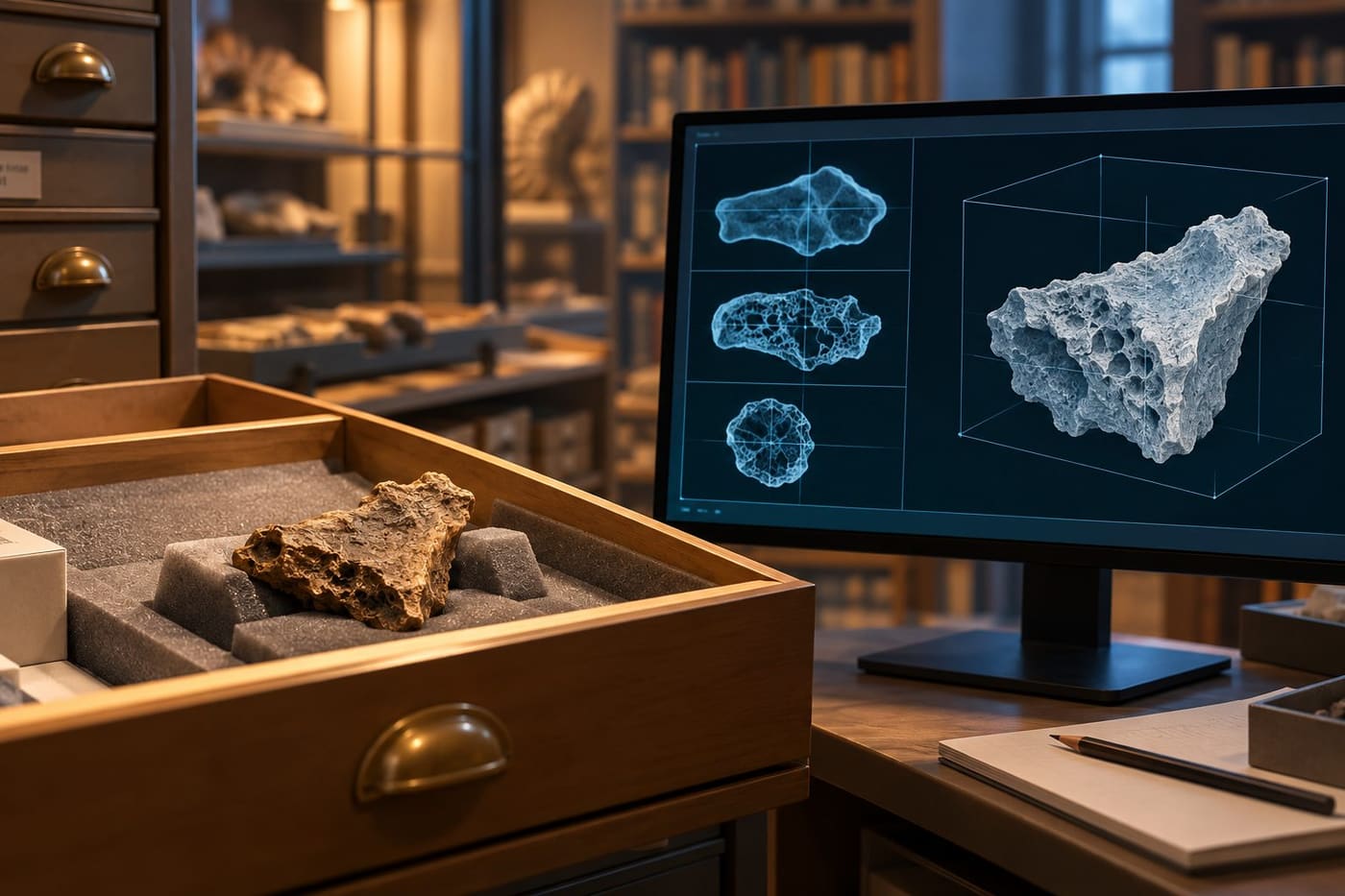
Image note: original generated conceptual illustration of a museum drawer and abstract scan display. It does not depict the actual specimen, its verified anatomy or a real museum workstation.
Sources and research note
Reviewed 26 October 2026: the linked UCL announcement, researchers' explanation, accessible endocast methods review and evolutionary-tree review. The [Royal Society Open Science study reference](https://doi.org/10.1098/rsos.260937) returned an access error during this review; no claim is made to have inspected its full methods or supplementary data. Google Trends was used for topic discovery, not as evidence for palaeontological conclusions.