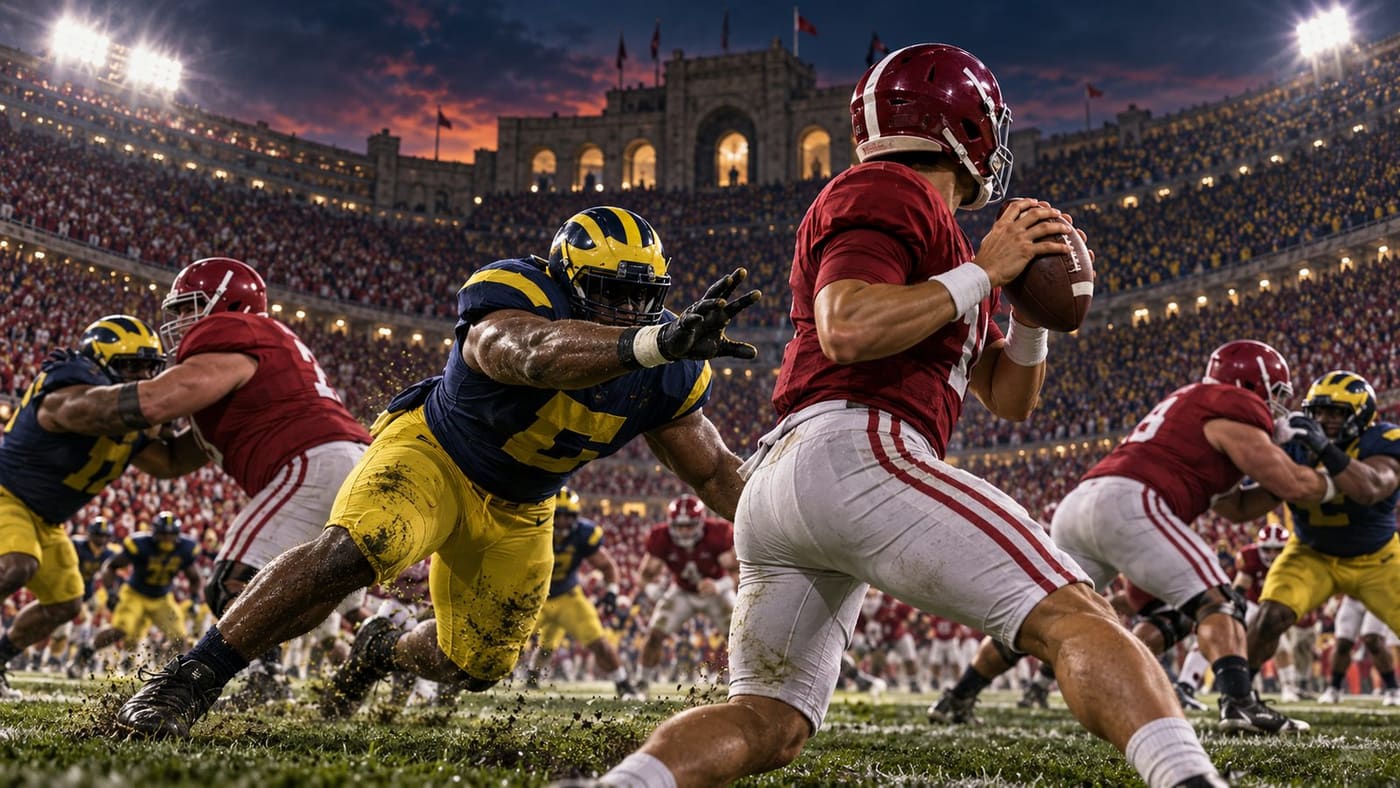
Indiana beat Michigan 13–6 in overtime at Michigan Stadium on 24 October 2026, despite finishing with 212 total yards to Michigan’s 224. The 12-yard difference was small; the difference in what each side did with its opportunities was not. Indiana scored twice from short fields created by takeaways, held Michigan to two field goals, and then used a 21-yard completion and a four-yard quarterback run to win in overtime.
The final score can make the contest look like a simple defensive stalemate. The official box score shows something more specific: Michigan had more first downs, more total plays, more passing yards and more possession time; Indiana had more rushing yards, fewer total yards allowed, and two takeaways that led to field goals. Michigan tied the game with no time left in regulation, then could not score in overtime after Indiana took the lead. This analysis separates those facts from interpretation and explains why the 13–6 result was not just a matter of one late run.
The final score and the game’s shape
- Final: Indiana 13, Michigan 6, after overtime.
- Quarter scoring: Indiana led 3–0 after the first quarter and 6–0 at halftime; Michigan made it 6–3 in the third and tied it 6–6 with a field goal at the end of regulation.
- Overtime: Indiana scored a touchdown on its first possession; Michigan failed to continue its final drive on fourth down.
- Total offense: Indiana had 212 yards; Michigan had 224.
- Passing: Indiana 81 yards; Michigan 167.
- Rushing: Indiana 131 yards; Michigan 57.
- Turnovers: Indiana lost one; Michigan lost two.
Those numbers show that Michigan moved the ball more often but did not convert its advantage into a win. Indiana’s offensive production was modest, yet the Hoosiers protected a lead long enough for one successful overtime possession to decide the game.
Indiana took an early lead through field position and defense
Indiana’s first points came from a 22-yard field goal after Indiana recovered a Michigan fumble, giving the Hoosiers possession near the Wolverine 28-yard line. Later, an Indiana interception set up another scoring chance, and Nico Radicic converted from 34 yards. The two kicks created a 6–0 halftime lead.
These were not long touchdown drives. The official Indiana recap says the defense created the opportunities, including an Isaiah Jones fumble recovery and an Amare Ferrell interception. When an offense has only a short field, a field goal is still valuable, but the scoreboard does not tell the whole story of how those points were generated. Indiana’s defense supplied the starting positions; the offense converted them into a narrow lead.
Michigan’s first half was quiet by points, but the score alone should not be confused with a total absence of movement. The Wolverines reached field-goal range before halftime, but a long attempt missed after a sack pushed the drive back. Indiana’s defense made that scoring opportunity harder rather than allowing a straightforward kick. The consequence was that the Hoosiers went to the locker room with every point still valuable.
The defensive numbers behind the result
Indiana’s official recap credited the defense with four sacks and 10 tackles for loss. It also reported that Michigan was held to 224 yards, including only 57 on the ground. The Big Ten box score lists Michigan with 74 plays compared with Indiana’s 53, and possession time of 33:44 against 26:16. Michigan had the ball longer and ran more plays, but it did not produce the same number of points.
That contrast helps explain how a defense can shape a game without dominating every possession. Michigan held the ball longer; the decisive measure was what happened on those drives. A sack can turn a manageable third down into a long one. A tackle for loss can remove the benefit of an earlier gain. A takeaway can stop one team’s drive and give the other a chance to score.
Indiana’s defense did not need to prevent every first down. Michigan finished with 16 first downs to Indiana’s 11. Instead, the Hoosiers limited the damage of those advances. The Wolverines scored only six points despite their longer possession time and higher first-down count. That is a more precise reading than saying Michigan was unable to move the ball at all.
Michigan’s late drive forced overtime
Michigan began the fourth quarter trailing 6–3. Its final regulation drive consumed 7:32, according to the Michigan recap, and ended with Trey Butkowski’s 26-yard field goal as time expired. The kick tied the game and prevented Indiana from ending it in regulation.
The long drive showed why Michigan remained dangerous even after a difficult first half. The Wolverines were able to maintain possession and convert several third downs before getting into field-goal range. Indiana’s defense had made scoring difficult, but a tie at the end of the fourth quarter meant the work was not finished.
Overtime placed a different kind of pressure on both teams. A single possession could determine who had the advantage, and Indiana began on offense. The Hoosiers converted that chance into a touchdown. Michigan then had to answer. Its final drive ended on fourth down, leaving the score at 13–6.
Josh Hoover’s overtime run ended the wait in Ann Arbor
Indiana’s official report describes the decisive possession: quarterback Josh Hoover completed a 21-yard pass to tight end Brock Schott, then ran four yards for the winning touchdown. The sequence made the score 13–6. It was a compact answer after a game in which Indiana had managed only 212 total yards and 81 passing yards.
Hoover’s overall passing line was 8 completions on 18 attempts for 81 yards, according to Indiana’s recap. He also threw an interception. The result shows why one moment should not be used to erase the rest of a quarterback’s day. Hoover had a difficult statistical outing and was described by the university report as not at full health during the week; the report also says coaches considered whether to use the backup. The article makes no claim about a specific injury diagnosis or prognosis.
The winning play still mattered on its own terms. A touchdown gave Indiana a stronger position than a field goal would have, and Hoover carried the ball into the end zone. The prior completion to Schott moved the ball into position. The play was successful because the offense executed the needed sequence at the moment when the defense had to defend a short field.
Michigan’s offense had chances but did not finish them
Michigan produced more total yards than Indiana, 224 to 212, and 167 passing yards to the Hoosiers’ 81. It also had 16 first downs. But the Wolverines’ scoring remained limited to two field goals. The Michigan recap says the team had four red-zone trips and scored six points.
Red-zone opportunities are not automatic touchdowns. Defenses can tighten the field, and a negative play can force an offense into a longer attempt or a difficult fourth down. Indiana’s sacks and tackles for loss helped pressure those situations. Michigan still managed to tie the game, which shows it was not completely shut out of late-game execution. But the earlier chances did not yield enough points to build a lead.
Michigan’s rushing total of 57 yards was the clearest gap in the team stats. Indiana had 131 rushing yards, while the two offenses produced very different rushing and passing totals. A team that cannot establish the run may become more predictable on passing downs. That is a reasonable reading of the yardage split, though the box score by itself cannot prove every play call or determine exactly why each drive stalled.
Indiana’s offense relied on a different balance
The Hoosiers had more rushing yards than passing yards: 131 on the ground and 81 through the air. Turbo Richard gained 68 yards on 19 carries, and Lee Beebe Jr. added 56 yards on 12 carries, according to Indiana’s recap. Those figures describe the work done by two runners in this game, not a claim about their season averages.
Indiana’s approach changed as the game progressed. The university report says the coaching staff leaned more heavily on the running game in the second half while Hoover’s passing was limited. The run game did not produce a large total by modern college-football standards, but it helped Indiana keep the game close and gave the offense a way to manage possession without asking the quarterback to throw frequently.
The strategy carried risk. Michigan had the chance to extend its possession time, and Indiana’s offense did not create a comfortable margin. A defense can keep a low-scoring plan alive, but the team still needs a way to convert when the opportunity arrives. Indiana did that in overtime, combining the completion to Schott with Hoover’s run.
Why the turnover comparison matters
Michigan had two turnovers and Indiana had one. Those numbers do not fully capture the value of each turnover, because a takeaway’s effect depends on where it occurs and what the next team does. In this game, Indiana’s first-half fumble recovery and interception preceded its two field goals. That is a direct connection between defensive plays and points.
The game also illustrates the importance of short fields. An offense does not need to drive the full length of the field after a turnover. A recovered fumble at the Michigan 28, for example, immediately placed Indiana in range to try for points. Converting the opportunity did not require a touchdown; a field goal increased the lead and made Michigan’s next scoring task more demanding.
Michigan’s two turnovers were costly, but Indiana’s one interception gave the Wolverines an opportunity to score late in the game. The final result was not determined by one team being error-free. It came from which side did more with the opportunities and which defense prevented the opponent from turning possession into touchdowns.
The historical note—and its limits
Indiana’s official recap says this was the Hoosiers’ first win at Michigan Stadium since 1967. The result is a notable program milestone, particularly because Indiana entered the game ranked No. 6 and was coming off a loss to Ohio State. It is a specific historical fact about the venue and matchup, not proof that Indiana now controls the rivalry or will win future games there.
The historical milestone and the performance deserve separate judgments. Ending a long wait at a venue does not make every part of the winning performance strong. Here, the low passing total remains an offensive limitation even though the result broke the losing sequence.
What the game means for each team’s next week
Indiana’s schedule lists Minnesota at home on 31 October. The Hoosiers can take confidence from the road win, especially from the defensive performance and the composure required after Michigan tied the game. They will also have areas to review: only 212 total yards, limited passing production and a narrow final margin.
Michigan’s official schedule lists a road game at Rutgers on 31 October. The Wolverines can point to their ability to control the ball late and tie the contest, but the missed scoring opportunities and limited rushing output are clear issues to assess. The official game report and schedules should be checked for final times and broadcast details, which can change.
Neither team’s next result is implied by this one. A close game offers lessons, not guarantees. Indiana will need to generate more offense in a future matchup if its defense does not create favorable field position. Michigan will need to turn possession and first downs into touchdowns more consistently.
Conclusion: defense bought the Hoosiers one decisive chance
Indiana’s 13–6 overtime win was not built on a prolific offense. Michigan had more first downs, more plays and more possession time. The Hoosiers answered with a defense that produced takeaways, sacks and tackles for loss, held the Wolverines to 57 rushing yards and limited them to six points across four red-zone visits.
That defensive work kept Indiana in reach until the final possession. In overtime, Hoover found Schott for 21 yards and then scored from four yards out. Michigan did not answer. The first win in Ann Arbor since 1967 came from that combination: a defense that repeatedly prevented the game from slipping away and one short, decisive offensive sequence when the opportunity finally arrived.
### Sources and research note
Research checked 25 October 2026. Primary Indiana recap and statistics: https://iuhoosiers.com/news/2026/10/24/football-b1g-win-at-the-big-house-PETE ; University of Michigan game report: https://mgoblue.com/news/2026/10/24/football-u-m-falls-to-no-6-hoosiers-in-overtime ; University of Michigan official game centre and team statistics: https://mgoblue.com/game-center/30380 ; Indiana schedule: https://bigten.org/schedule.aspx?schedule=2147 . The saved US Trends snapshot contained current college-football schedule interest; it is used as a dated discovery signal only. This article is original analysis of official match reports and statistics. The illustration is AI-generated conceptual artwork, not a depiction of the real teams or game. Limited exact-phrase searches only; not a comprehensive plagiarism scan or uniqueness certification.
Source-access note: the Indiana recap was available through indexed search text on the final recheck, while direct opening failed. Michigan’s report and game-centre statistics were accessible. The unused Indiana postgame-notes link was removed.