Fallon Sherrock beat Luke Littler in the Netflix event Beat Luke Littler on 30 October 2026, winning the £501,000 prize. The important qualification is the format: this was a single-leg challenge, not a World Championship final. Understanding that distinction makes the result clearer without diminishing what Sherrock achieved.
The result is supported by contemporary reporting and a match-competitor interview, while Netflix's own event guide explains the show's premise. This article separates those sources from original scoring examples and analysis. It does not claim that its writer attended the event or watched a complete replay.
What the result establishes
[Darts World's report of the event](https://dartsworld.com/2026/10/sherrock-wins-beat-luke-littler-to-pocket-501k-prize/), dated 30 October, identifies Sherrock as the successful challenger in Manchester. Its account places her in the fifteenth leg, after fourteen previous challengers had failed to beat Littler.
That is enough to answer the immediate result question: Sherrock won the challenge and its advertised prize. It does not establish that she won a longer match against Littler, collected a world title or replaced him in a ranking. Those would be different claims requiring their own evidence.
Keep the event name and date beside the result when sharing it. A short clip labelled only “Sherrock beats Littler” can lose the feature that made this particular contest distinctive. “Sherrock won their one-leg Netflix challenge on 30 October” is a more informative description than attaching a championship label the event did not have.
How the Netflix challenge was organised
[Netflix's official event guide](https://www.netflix.com/tudum/articles/luke-littler-uk-darts-event) described a £501,000 prize and a format in which contestants would try to defeat Littler, with the competition ending when somebody succeeded. It listed 24 contestants competing for 20 places before the challenges against him.
Those two numbers describe different stages. The announced contestant pool was not a promise that every person would play Littler. The end condition also meant that the programme could finish before every available challenge had taken place. Read that premise before treating an unused appearance as an unexplained omission.
The organiser's guide was published before the event. It is useful for the announced format, not independent evidence of the subsequent winner. The post-event result comes from the later reporting and interview linked here. Keeping the two roles separate avoids reading a preview as though it already knew the outcome.
Why one leg creates a different kind of contest
A single-leg challenge gives the result a very narrow scale: one completed scoring contest decides that meeting. A longer match can give a player opportunities to recover from losing an early leg. In this format, winning the relevant leg was itself the task.
That difference matters when discussing an upset. A result in one leg is a real result under the stated conditions. It is not a reliable basis for declaring how a hypothetical longer meeting would have ended. The programme did not conduct that alternative contest, and this article does not invent one afterwards.
There is a similar distinction between a sequence of challenges and a single long head-to-head match. Earlier challengers' losses were not legs Sherrock had lost. Her own opportunity began when she faced Littler. A viewer can follow the evening's accumulating tension without merging everyone else's scores into her individual result.
If you are discussing the event with someone new to darts, start with that structure. “Different challengers each had their own chance” explains more than a broad statement that someone won a long series of games. The programme's format supplies the meaning of the score.
What Sherrock said about the closing visit
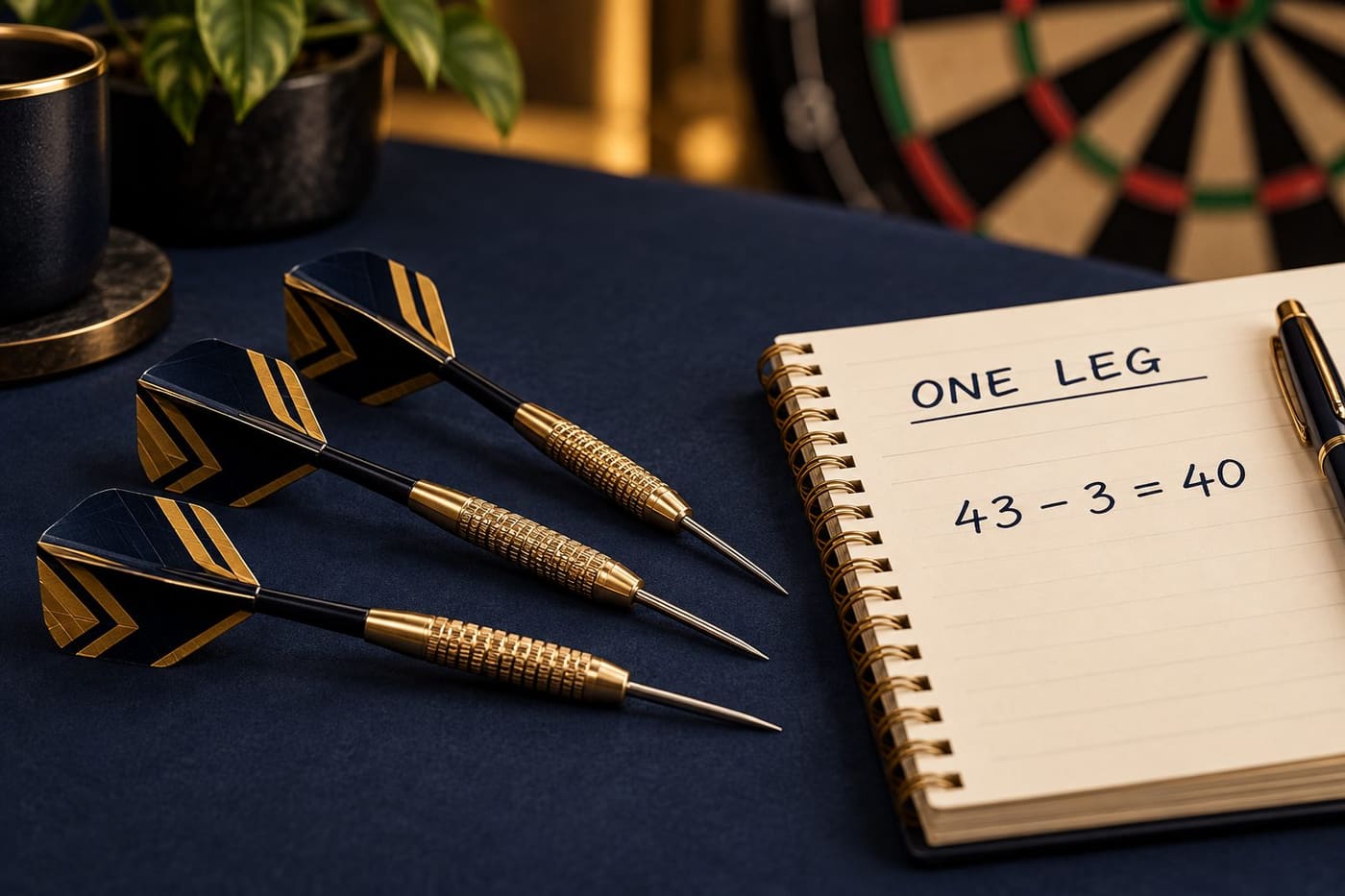
In [Darts World's post-event interview with Sherrock](https://dartsworld.com/2026/10/fallon-sherrock-exclusive-dw-interview-after-winning-beat-luke-littler/), she described a 180 leaving 43 and choosing a single three to leave double 20. The interview reports that her second attempt at that double finished the leg. This is a paraphrase of a published participant interview, not a new interview conducted for this article.
The arithmetic is simple and useful for a new viewer: 43 minus 3 leaves 40, and double 20 scores 40. The first action changes the remaining target; the successful finishing dart then supplies the required double. It is not enough merely to subtract points without considering how the leg must end.
Notice the difference between explaining the choice and claiming access to every thought behind it. The published interview supports the route Sherrock described. It does not justify inventing a private conversation, a rehearsed plan for this exact opponent or a word-for-word internal monologue.
Read the number as points still required
For the usual straight-start 501 game, the scoreboard shows a decreasing amount still needed, rather than a total that players try to increase indefinitely. The [Darts Regulation Authority's current rulebook](https://www.thedra.co.uk/dra-rulebook), section 6.3, gives the default 501 start and exact-zero finish on a double, subject to an event's stated format. It also identifies the inner bull as a possible double-25 finish.
For an original explanatory calculation, imagine a player has 100 remaining and scores 60. The new remainder is 40. That does not by itself mean the leg has ended; the player still needs a valid finish. This example is not an extra visit reconstructed from Sherrock's match.
Read “remaining” before judging who is ahead. A smaller remainder can be helpful, but it is not a completed win. The decisive change is the valid finish, not the moment a player first reaches a more attractive number on the display.
A maximum score and a finished leg are different things
The familiar 180 comes from three treble-20 scores: 60 plus 60 plus 60. It is a high-scoring visit, not automatically a checkout. Its effect depends on what the player needed before the visit and what remains afterwards.
Here is an original arithmetic example unrelated to the event. A player with 223 remaining scores 180 and is left with 43. Another player starting a visit on a different remainder would be left with a different task after the same 180. The same large score does not have one universal consequence.
That is why watching only maximum-score clips can leave part of the sporting problem out of view. Scoring creates a route towards the finish; finishing completes the leg. In this event's reported closing sequence, both the large score and the subsequent choice at 43 mattered to understanding how the result was reached.
This is an explanation of the score's structure, not a claim that one route is the correct choice for every player. Individual target preferences, the actual remainder and the contest's rules matter. No training method or performance improvement is being tested here.
Check a missed finish before assuming the score
The DRA rulebook also covers busts, including going beyond the required total, reaching zero without the required double or leaving one. The exact finishing condition therefore matters even when a dart would appear to supply enough points arithmetically.
In another invented example, a player on 40 cannot complete an ordinary double-out leg by hitting a single 20 followed by another single 20. Those two numbers total 40, but the final dart is not a double. A double-20 finish is a different scoring action despite having the same numerical value.
When following coverage, keep the referee's confirmed call and the updated display together. A camera close-up can make a wire or segment difficult to judge from your screen. Do not turn uncertainty in a clip into an accusation against a player or official.
The scoring examples here explain the default rule and basic arithmetic. They do not attempt to settle an officiating dispute or provide a frame-by-frame adjudication of the Netflix broadcast. No such dispute is alleged by this article.
Why the word “amateur” needs care
[Sky Sports' post-event report](https://www.skysports.com/darts/news/13605916/beat-luke-littler-fallon-sherrock-wins-one-off-leg-to-defeat-the-nuke-and-take-lb501-000-prize) explains that Sherrock was eligible because she did not hold a PDC Tour Card. That is a specific eligibility distinction, not a claim that she was a beginner who had never competed on a major stage.
For a directly sourced historical reference, the [PDC's published description of her December 2019 match against Ted Evetts](https://www.youtube.com/watch?v=VFc0xn7h5AA) records her 3–2 victory and first-woman-to-win-a-match milestone at its World Championship. The linked description is historical evidence; this article does not claim to have viewed the entire video during research.
Read experience and eligibility as separate questions. A person can meet the entry criteria for a special event while having substantial competitive experience. Conversely, describing a field as containing everyday players does not mean every entrant has an identical background.
For a careful discussion, use the actual criterion when it is known. Calling every entrant a novice would erase a relevant distinction. Declaring a competitor ineligible simply because you recognise their name would invent a rule the cited report does not state.
Keep the prize separate from rankings and personal finances
The advertised prize was £501,000. It is reasonable to identify that amount with the result, but a prize headline is not a complete financial statement. It does not establish the recipient's tax position, payment date, deductions or private plans for the money.
This article therefore makes no net-income calculation and does not convert the figure into a supposedly guaranteed take-home amount. An exchange-rate conversion would be another dated calculation, with its own assumptions, rather than a fixed part of the sporting result.
Similarly, do not add a special-event prize to a formal ranking table without checking the relevant competition's ranking rules. The available result establishes who won this challenge. A claim about its effect on an official order of merit would require a separate source and is not made here.
You can recognise the size of the achievement without adding unsupported consequences. Naming the event, its format, its winner and its prize gives readers a useful account while leaving unrelated financial or ranking questions open.
If you want to watch, distinguish clips from a full programme
Netflix's event guide points viewers towards the title through an active subscription on supported devices. For a replay, check the title in your own account and territory rather than assuming the original live start time remains a viewing instruction. This research did not purchase access or verify playback in every country.
A short result clip and a complete programme offer different amounts of context. If a clip shows only the finishing double, it may not explain the preceding remainder or the sequence of challengers. Use the organiser's format description alongside it rather than inventing missing play.
Our [guide to looking closely at one scene](https://monetizearticle.com/article/watch-one-scene-again-a-practical-way-to-talk-about-film-867c4e) uses a related principle of separating an observation from an interpretation. For this sports event, keep the score and confirmed result distinct from the conclusions you draw about pressure, confidence or a hypothetical rematch.
Conclusion: celebrate the result at its actual scale
Sherrock won the one-leg Beat Luke Littler challenge and its £501,000 prize. The reported closing route makes the basic drama understandable: a large score created a finish, and a valid double completed it. That result stands without being relabelled as a world-title match.
For a clear account, preserve the event's format, the points still required and the source of each detail. Those distinctions make the achievement easier to follow for both a new viewer and an experienced darts fan.
Sources and research note
Research checked 31 October 2026. Netflix supplies the organiser's preview and format; Paul Mason's Darts World reporting and participant interview supply the result and closing-route account; Sky Sports corroborates the result and entry-criterion explanation. The current DRA download was read at section 6.3 on page 14, whose footer identifies the 2026 rules in force from 31 March. The PDC's own 2019 video description supports the limited historical reference. No complete broadcast viewing, new participant interview or official ranking change is claimed.
Google Trends GB, displayed as United Kingdom, was retrieved on 31 October with Past 24 hours, All categories, All trends and search volume descending selected. “Fallon Sherrock” appeared fourth, with 50K+, 1,000% growth and Active status. The leading Traitors query was not selected because direct official result access was unavailable in this research; Tom Jones duplicated a covered event, while the broad “tax” query did not establish a sufficiently specific verified topic. This substitution is disclosed rather than claiming the selected query was first.
All unconnected score examples are original explanations, not extra match statistics. The builtin AI-generated conceptual illustration uses generic darts and a notebook calculation, not an actual event photograph or official scorecard. Limited exact-title and phrase searches found no exact matching article in the returned results; this is not an exhaustive similarity or human-authorship guarantee.