Dónal Lunny's name leads to more than a solo catalogue. It connects groups, singers, instrumentalists, arrangements and records made over many decades. For someone encountering his work through the current tributes, the most useful starting point is to follow those connections into the music itself.
The Irish Traditional Music Archive and Ireland's presidency published tributes on 23 October 2026 following his death. This guide draws on those statements, his own website and a fellow musician's recording information. It offers a manageable route for a new listener rather than attempting a complete discography or a review of recordings played during this research.
Begin with the musician, arranger and producer together
The [Irish Traditional Music Archive's tribute](https://www.itma.ie/news/donal-lunny-1947-2026/) describes Lunny as a musician, arranger and producer, connecting his influence with Planxty, The Bothy Band, Moving Hearts and a wide network of collaborators. It identifies bouzouki playing as his best-known instrumental work while also noting his range across other instruments and singing.
Those different roles explain why a search for records under his own name alone would leave out important parts of the story. A band recording can carry his work without making him the named solo artist. A production contribution can matter even when the front cover emphasises someone else.
Start with the ensemble, then follow the credit. That does not require hearing every individual contribution immediately. It asks you to keep the people and roles attached to the sound so that the next recording you choose has a clear connection to the one before it.
Read the public tributes as a map of relationships
In her [published statement on Lunny's death](https://president.ie/en/media-library/news-releases/statement-by-president-connolly-on-the-death-of-donal-lunny), President Catherine Connolly highlighted his partnerships with Christy Moore and Andy Irvine, his work in major groups and his contribution as a producer. She also referred to his role in bringing the bouzouki into Irish music and to recognition from fellow artists.
A tribute is not a substitute for every individual recording credit. It can, however, show a new reader which relationships are worth exploring. Take one name from it and find a clearly identified release, rather than turning a long list of collaborators into a claim that he performed every role on every record they made.
The point of this approach is breadth without vagueness. You can recognise a major musical legacy while still being precise about the particular piece of evidence in front of you. A careful starting route is more useful than declaring a short playlist the definitive summary of a lifetime.
First route: explore Planxty through a participant's catalogue
[Andy Irvine's Planxty discography](https://www.andyirvine.com/disc/planxty-disc-new.html) identifies the group with Irvine, Lunny, Liam O'Flynn and Christy Moore, and lists studio, live and compilation releases. Among its entries are The Well Below the Valley, Cold Blow and the Rainy Night and the reunion release Live 2004.
Choose one clearly labelled edition rather than trying to absorb the whole list. A studio release and a later live performance can both be useful, but they are not interchangeable documents. Retain the album name and edition you actually select so you can find it again and understand a later comparison.
For a first pass, ask a modest question: how does the accompanying part relate to the main melody or voice? Notice where your attention goes, then return to a short passage with another part in mind. This is an invitation to your own listening, not a description of a specific moment that this article claims to have heard.
If you cannot identify an instrument confidently, write an ordinary description such as “the plucked accompaniment” until a reliable credit or performance view resolves it. Guessing a musician's identity from a sound is less useful than keeping the uncertainty visible.
Let a group remain a group
The purpose of following Lunny's work is not to erase the musicians around him. An ensemble recording contains relationships among players, and a useful listening note leaves room for more than one contribution. Avoid turning every interesting sound into evidence that one named person alone created it.
An original note might say, “The accompanying rhythm drew my attention during the return of the melody.” That is a listening observation. “Lunny invented this exact arrangement in the studio” is a production-history claim and would need a source beyond your impression.
The same distinction applies to words such as energetic, restrained or spacious. They can help describe your response when attached to a moment you heard. They should not be borrowed from a tribute and presented as though you have independently reviewed the record.
Keeping these differences clear makes a conversation about the music more interesting. You can compare what each listener noticed without requiring everyone to give the same verdict or pretend to recognise every instrumental line.
Second route: move to Usher's Island
[Irvine's page for Usher's Island](https://www.andyirvine.com/albums/Ushers_island.html) identifies a 2017 album bringing together Irvine, Lunny, Paddy Glackin, Mike McGoldrick and John Doyle. Its musician list credits Lunny with vocals, bouzouki, baritone bouzouki, bodhrán and keyboards. The page also describes the group's connections with earlier ensembles and a later generation of players.
This provides a concrete way to move beyond a single famous band name. Keep Lunny in the picture while noticing that the surrounding musicians and recording context have changed. You are following a connection through a different ensemble rather than assuming that every collaboration reproduces the same sound.
The album page includes Bean Pháidín in its track listing and discusses Lunny revisiting it after an earlier Planxty recording. That creates a possible comparison route, provided you first establish the versions you are using. A shared title alone is not a guarantee that two tracks have identical arrangements or personnel.
Before comparing, write down each recording's performer and release. Then choose one question that can be answered by listening: how does the opening lead into the song, where do accompanying parts enter, or what changes when another voice becomes prominent? Do not try to compare everything at once.
Keep a title separate from a particular performance
Traditional repertoire can appear in more than one recording context. For a listener, this makes the full release information valuable. A title can identify what you are searching for while the performer and edition identify the particular version you are discussing.
When you send a recommendation, include that combination. “Listen to Bean Pháidín on the Usher's Island album” supplies a clearer starting point than sending only a title into a crowded search page. Check the service's own listing rather than assuming the first search result is the intended recording.
If the same title appears elsewhere, treat that as an opportunity to investigate, not permission to merge the credits. An album-level personnel list may not identify each instrument on every track. Keep its scope intact rather than converting it into a detailed session account that the page does not supply.
Our [guide to reading a concert programme](https://monetizearticle.com/article/read-a-concert-programme-follow-the-works-movements-and-performers-945cd5) uses a similar distinction between a work, its performance and the people involved. The recording route here benefits from the same attention to labels.
Third route: follow the production work
[Lunny's own website](https://www.donallunny.com/) describes his involvement in groups including Planxty, The Bothy Band, Moving Hearts, Coolfin and Mozaik. It also records his co-founding of Mulligan Records and his wider production and collaboration work. Among the projects it identifies is Common Ground, with contributors including Bono, Neil and Tim Finn and Elvis Costello.
That is a different doorway into the career. Instead of searching only for a featured instrumental performance, find a project where the credit identifies his production contribution. Read the release's own credits to establish what is actually attributed to him on that edition.
Production should not become a vague explanation for everything you like about a recording. If you hear an appealing balance or arrangement, you can describe it. Attributing the exact decision to one person requires evidence about that person's role and the particular session.
Keep the album credit beside the listening question. For example: “The site identifies this as a production project; I want to notice how the voices and instruments are presented.” That wording connects documented participation with your own curiosity without pretending that the sound reveals a complete production diary.
Notice work beyond the familiar album route
[Silverstream Music's artist page](https://www.silverstreammusic.ie/artists/donal-lunny/) records Lunny's work for film, theatre and television as well as his group and production career. It names This Is My Father among the film projects and describes theatre and broadcast work. The page is an older professional profile, not a newly announced 2026 schedule.
This context broadens the question from “Which band should I hear?” to “What kind of musical work am I following?” A screen score, an ensemble performance and an album production credit involve different settings. Their connection to one person does not make them the same kind of listening experience.
For an initial exploration, you do not need to pursue every branch. Choose the route that interests you and preserve one clear credit. You can return later to another part of the career with a more specific question than a general search for everything associated with the name.
Make a short listening session substantial
An original approach is to choose one track, keep its credits available and listen without trying to take notes continuously. Afterwards, write one moment you would like to revisit. On a second pass, attend to that moment rather than treating the whole recording as an identification exercise.
If you compare two releases, use their actual track timings. An introduction, edit or different performance can shift a timestamp, so do not assume a moment occurs at the same elapsed time in both. Identify the passage in words as well as with a number.
Leave one question unanswered if necessary. “Which instrument supplies that brief response?” is a useful next step. It is more honest than assigning a performer because their name is familiar. The exercise is designed to organise a personal exploration; it is not a tested course or a claim of measured improvement.
You can also stop with a single recording you want to hear again. A listening guide does not need to become a completion challenge. Paying attention to one well-identified performance can create a stronger connection than skimming a very long list to say you reached its end.
Use archives without treating access as ownership
An archive entry can help you locate a recording and understand its context. The ITMA tribute explicitly connects Lunny's legacy with its catalogue and with the wider community of musicians. Follow the archive's own information about the item you want to explore.
Availability to listen or read does not automatically grant permission to republish the recording, photograph, lyrics or score. This article therefore links to references and creates its own illustration rather than copying an album sleeve or an archive image into a new design.
For readers in Canada or elsewhere, check the actual service or archive page for availability and any access requirements. A research link is not a promise that every stream or edition is available in every territory. No subscription was bought, account restriction bypassed or copyrighted music downloaded for this guide.
Remember the person without inventing an encounter
The tributes describe an artist whose work connected many people. It is possible to respond with care without adding a fabricated meeting, a private recollection or a claim about what every colleague felt. Let attributed memories remain with the people who shared them.
For a new listener, a respectful response can be specific and modest: identify a recording, learn who helped make it and share a properly credited recommendation. The value lies in making the work easier for another person to find, not in presenting yourself as someone who knew its creator.
This guide does not report funeral attendance, provide private family details or assume that a planned ceremony has already taken place. Its focus is the documented musical work and a considered way to approach it.
Conclusion: follow one connection into the next recording
Begin with a clearly identified Planxty release, move towards a later collaboration such as Usher's Island, or explore a documented production project. Keep the musicians, roles and edition attached to whatever you choose. Then let your next question come from the music you actually hear.
Lunny's career rewards that approach because collaboration is part of the story, not a footnote to it. A careful listening route can acknowledge his contribution while keeping the surrounding musicians and their shared work in view.
Sources and research note
Research checked 31 October 2026. Primary references linked above include ITMA's 23 October tribute, the Irish president's dated statement, Lunny's own website, Andy Irvine's Planxty discography and Usher's Island album page, and Silverstream Music's older professional profile. The latter's relative descriptions are not treated as current event announcements. RTÉ and Arts Council pages that returned access errors were not represented as fully read sources. No complete discography audit, track-by-track playback review or private interview is claimed.
Google Trends Canada was retrieved at 04:43:37 UTC on 31 October with Past 24 hours, All categories, All trends and search volume descending selected. “Donal Lunny” was the first displayed row, showing 50K+, 1,000% growth and Active status. This records Canadian search interest, not Canadian nationality, a local concert or an exact search count. No higher-ranked topic was substituted.
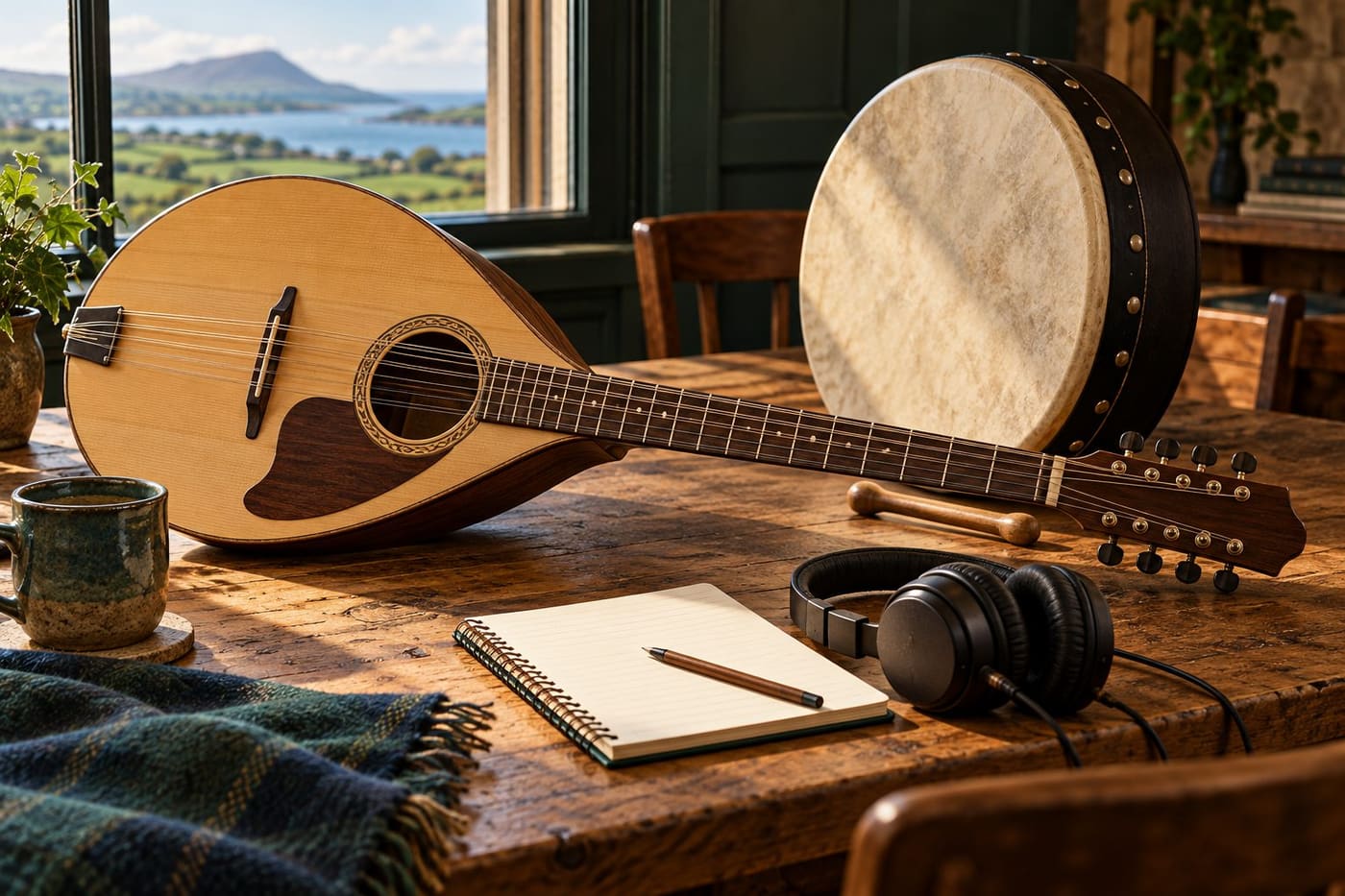
Listening questions and sample notes are original suggestions, not reports of personal listening undertaken during this research. The builtin AI-generated conceptual illustration depicts generic instruments and a notebook, not Lunny's own instrument, studio, portrait or album artwork. Limited title and phrase searches found related listening resources but no exact matching article in the returned results; no exhaustive similarity or human-authorship guarantee is made.