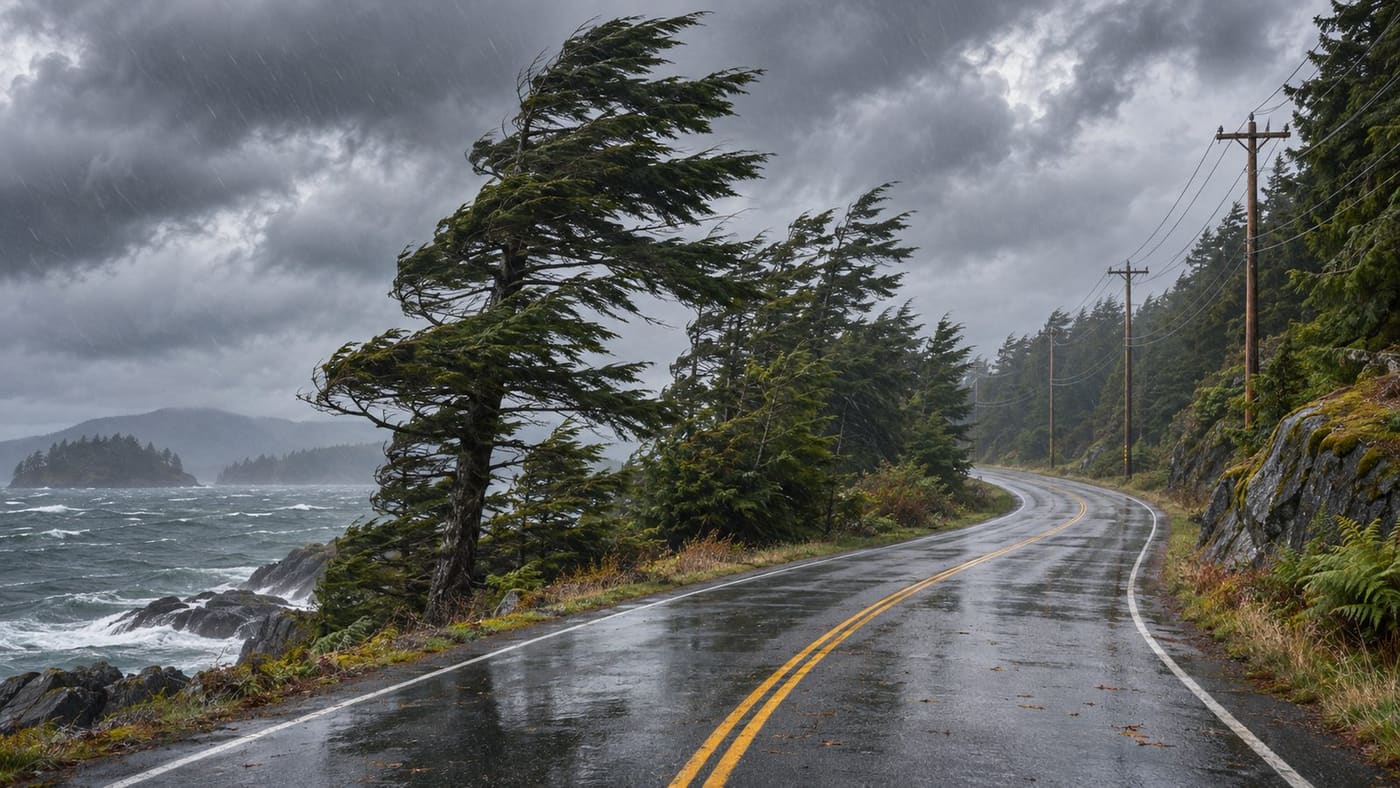
BC Hydro reported wind-related outages on several coastal islands and in parts of the Sunshine Coast in its November 7 regional alerts. The utility was also investigating a transmission outage affecting northern Vancouver Island. It said the weather was keeping helicopters from surveying the affected lines, so crews were patrolling from the ground to find the cause and see how much damage there was. Some customers in the wind-affected areas were expected to remain without electricity overnight. For an individual home or business, the latest outage entry is the place to check whether the utility has assessed the damage and posted a restoration estimate. BC Hydro regional alerts.
Which areas BC Hydro named
The Vancouver Island North alerts described two situations. The first was the transmission interruption affecting the North Island. Ground crews were still investigating, so the alert established that there was an interruption on the transmission system and that weather was limiting inspection options. The second alert named Quadra, Denman and Hornby islands, where BC Hydro attributed outages to strong winds. The two alerts appeared under the same regional label, but the utility described the transmission cause as still being investigated. A reader on one of the islands should look for the specific local entry before applying a regional description to their own outage. BC Hydro regional alerts.
The Lower Mainland alert named Bowen, Keats and Texada islands and parts of Sechelt and Powell River. The utility said crews were working in difficult weather and that some customers in the affected areas would be without power overnight. That statement gives a broad expectation. It provides neither a deadline for the last repair nor a time at which every affected home should expect its lights back. The alert uses geographic names to explain the scale of the response. The list below it and the map provide the address-level detail needed to distinguish nearby interruptions. BC Hydro regional alerts and outage map.
At 09:56 UTC on November 7, Google Trends showed “bc hydro outage” as Active in Canada's Trending Now list, with a volume bucket of 50K+ for the previous 24 hours. It appeared second when sorted by search volume, behind a federal grocery benefit query in the same bucket that we covered separately. This is a snapshot of Canadian search interest. The figure measures searches in a reported range, while the outage list's customer field concerns electricity service. For the earlier search topic, see our grocery benefit explainer. Google Trends Canada.
Start with the entry that matches your location
Go to the outage map or list and look up the part of the region where service stopped. A community can have more than one entry at once. Check the street names, block numbers or mapped area and compare the reported start time with your own observation. If two rows look plausible, use the geographic details before using the restoration estimate. The row for the next road over might describe a different group of customers, even when the roads share a postal area or the same regional alert. BC Hydro outage map and current list.
The map is useful when you're trying to place an outage boundary. The list is often easier to scan when you already know the municipality or need to compare a few nearby rows. The information shown with a row can include when service was interrupted, what area is affected, the latest crew status and when the entry was updated. If the location description fits but a field is blank, keep using the entry for subsequent updates. A blank estimate may simply mean that the crew needs more information before it can give one. BC Hydro outage map and restoration guide.
Suppose your home on a coastal island loses power in the evening and the list shows two nearby areas. One has a crew arrival estimate, while the other has an estimated time for power to come back. Before comparing the times, match the area to your own street. Then identify what the time refers to. An arrival estimate marks when the crew expects to reach the job. A restoration estimate marks when the utility thinks service might return. A timestamp under the update field tells you when the status was recorded. Read each beside its label, especially if you are sharing the information with neighbours. BC Hydro restoration guide.
What the crew statuses mean
An entry can first appear without a crew assigned. When it changes to assigned, a crew has the outage on its list. When crews are on their way, they are travelling to investigate. Once they reach the site, they can start working out what caused the interruption and what needs repairing. Those statuses describe separate points in the response. If you're deciding when to move a household activity to a different location, an on-site update is useful evidence that assessment has begun, while an actual restoration estimate gives you a more specific time to plan around. BC Hydro restoration guide.
BC Hydro says it publishes a restoration estimate after crews identify the cause and the work required. Further investigation or an urgent safety call can change priorities. Its status guide also explains that a previously assigned job can return to an unassigned status if resources have to move. For example, if a person checks at dinner and again later in the evening, the two entries may show different stages or a later time. Keep the timestamp attached to any estimate you relay so someone reading the message later can compare it with the current listing. BC Hydro restoration guide.
The North Island alert gives a concrete example of how inspection affects timing. BC Hydro said it could not conduct helicopter patrols in the prevailing weather and was looking at the lines from the ground. That means the utility's public update concerned finding the cause and establishing the extent of damage. It is reasonable to expect more detail after an assessment, but there was no basis in the alert for assigning the investigation an exact completion time. Even where the wind had caused other outages, the utility's description of those outages cannot settle the cause of the transmission interruption. BC Hydro North Island alert.
Why nearby addresses can get power back at different times
BC Hydro describes an order of work that begins with public safety and the infrastructure that carries power to larger areas. Restoring key lines and facilities can bring service back to many customers, and crews also address outages serving critical services. Then crews work through neighbourhood outages and the smaller interruptions that remain. On an outage map, a broad interruption can therefore disappear while a smaller entry remains in the same general area. A local line or a connection farther down the system may need separate attention. BC Hydro restoration guide.
Imagine two households that normally use the same town centre but live on different roads. One sees lights come back across most of the community, while the other still has no electricity. The restored view can help the second household identify which outage the utility has closed. The current view can help it look for a smaller open outage covering its road. If the household is still out and cannot find a matching entry, BC Hydro asks customers to report the interruption. This gives the utility fresh information tied to the location rather than relying on the assumption that the larger repair resolved every interruption. Restored outage list and BC Hydro reporting guidance.
A planned interruption is listed separately from the active unplanned incidents. A planned row can display maintenance details and an expected window, sometimes for streets in a community named in the wind alerts. Check its dates and whether it is still scheduled before drawing a connection. Someone taking notes for a community group should keep current, restored and planned entries in separate columns. A regional notice at the top of the screen and an old row farther down can belong to completely different events. Planned outage list and BC Hydro planned outage guide.
For a business with staff spread across town, track the premises separately from employees' homes. A regional alert can explain why several people have reported a problem, but the time in the row for the business is the one to use when deciding whether to postpone opening. Record who will check the next utility update and which location it applies to. If an estimate is revised, share the new one with its time of observation. BC Hydro's business guide recommends assigning responsibilities and keeping a list of equipment that needs attention when power returns. A written plan makes it easier to give staff an update based on the premises rather than passing along the latest time from whichever neighbourhood posted first. BC Hydro business outage preparation.
How to share an update that stays useful
Give the place and scope first. A message such as “this entry covers these blocks” is more useful to someone nearby than “the island is back on.” Add the time you checked and include the utility link so the recipient can refresh it. If you have an estimate, say whether it concerns crew arrival or power restoration. If the listing has no estimate, share the current crew status and leave the time open. For a regional alert that says some customers may be out overnight, keep the qualifier when summarising it. Readers may otherwise infer that every household in the named area faces the same wait. BC Hydro current list.
The utility's list labels times in Pacific Time. This matters when a family member is checking from another province or a workplace coordinator is reading updates in a different time zone. A clear message might say that an entry was checked at a particular local time and then quote the update time separately. Avoid attaching the time from an earlier screenshot to the current state. For people following several municipalities, BC Hydro also publishes feeds for unplanned current and restored interruptions, grouped by region or municipality. The map and regional alerts remain useful when a short feed entry needs more context. Outage list and BC Hydro outage feeds.
A dated account of an outage can explain what crews reported without freezing a changing estimate in place. The November 7 regional alerts establish the affected areas they named and the limits on North Island inspection. Some other rows on the list carry older dates. Adding their customer figures would mix events and might miss outages that opened or closed between checks. Anyone who needs a current total for a particular area should use the utility's corresponding regional view and record the time. The same distinction applies to a single address. The dated alert gives context, while a current matching row answers the more immediate question. BC Hydro regional alerts.
When to report an outage or a hazard
If the map or list has no entry matching your location, BC Hydro says you can report the outage through MyHydro or by phone at 1-800-224-9376. Its guidance says renters can also report by phone. Provide the location and when you noticed that service went off. If you are checking on someone else, distinguish a report of what you saw from a location or start time you heard secondhand. A missing outage entry and an immediate public safety hazard use different reporting routes. BC Hydro outage guidance.
BC Hydro instructs anyone who sees a fallen or low-hanging line to stay at least 10 metres away and call 911. Treat it as live even if you see no sparks. A listing marked restored describes the utility's service record and cannot establish that a particular line you encounter is safe. Keep the emergency guidance separate from the question of when electricity will come back. BC Hydro outage and safety guidance.
The next update to look for depends on where you are. On the North Island, the alert pointed to ground patrols and further assessment. For the wind-affected islands and Sunshine Coast locations, find the live entry that covers your own area and check whether a crew status or estimated time has changed. A regional headline can tell you why several places are asking about the same storm. A location, a status label and a timestamp tell you what the utility knows about your interruption.
Sources consulted 7 November 2026.