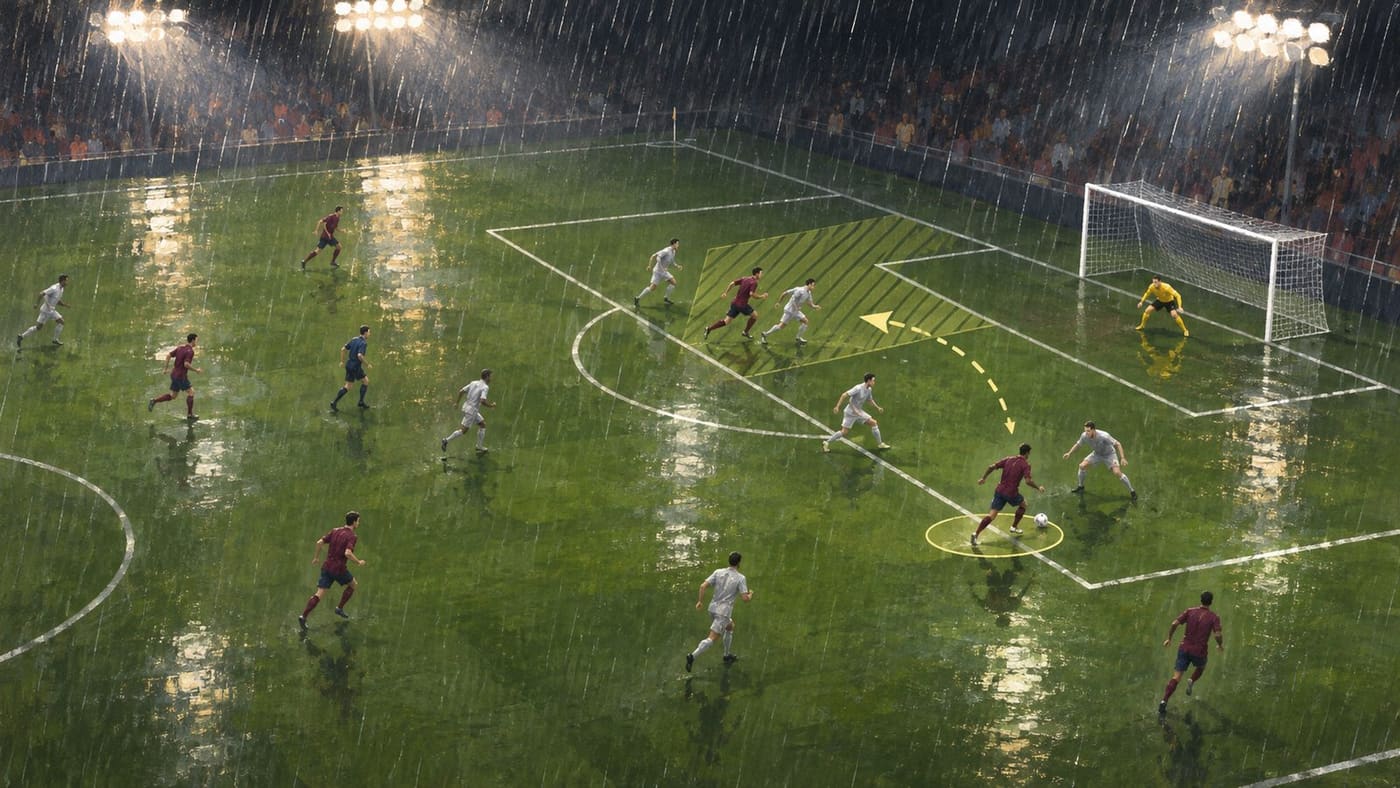
Barcelona took the lead against Aston Villa in the seventh minute, waited until the 52nd to double it and added a third in the 64th. Lamine Yamal scored first and Raphinha scored twice in the second half at Camp Nou on 3 November 2026. The Champions League result ended Villa's three-match winning start to the league phase and brought both teams to nine points after four games. The sequence matters because Barcelona's advantage meant something different at each of those three moments.
At 1–0, Villa could still make an equaliser from one good attack, and they had opportunities to do so. At 2–0, Barcelona had room to absorb an individual setback. The third goal showed another route to the penalty area, with João Cancelo creating a chance for Raphinha to finish close to goal. The UEFA matchday round-up names Raphinha player of the match and describes all three goals. Reading the goals alongside the chances Villa created makes the scoreline easier to understand.
The first goal started with an interception
Yamal's goal is easiest to understand by starting before the shot. The ball was with Villa deep in their own territory. An inaccurate pass became available inside the penalty area, Yamal read it, and his finish went across the goalkeeper into the far corner. UEFA describes the interception and finish. The Aston Villa match report places the incident in a passage after a goal kick, while Barcelona's account also describes the misdirected pass and Yamal's anticipation. The clubs differ on the identity of the player whose pass was intercepted.
A turnover that close to goal compresses the attack. In a longer possession, the defending team can retreat while the opponent moves through midfield. Here the next threat was already inside the penalty area. The passer's teammates had little time to change from offering outlets to protecting the goal, and the goalkeeper had to respond while the play was still changing direction. That is the tactical importance of the location even before you consider the finish.
There is a useful distinction between a mistake and the skill needed to convert it. A loose pass provides an opening. Yamal still had to recognise it quickly, control the ensuing action and put the shot where the goalkeeper could not reach it. When watching the replay, try following the scorer before the ball goes loose. Notice when he starts to react, where he receives or reaches the ball relative to the goal, and how much time the defenders have left to intervene. Those details explain more than the label “defensive error” on its own.
A single incident does not establish how Barcelona pressed for the entire match. To judge that, a viewer would need to compare other Villa restarts, including sequences where the visitors escaped successfully. This goal does establish that the home side converted a high-value opportunity created by a loss of possession very close to goal. Villa spent the rest of the half responding to a deficit created in a matter of seconds.
Why a one-goal lead was still vulnerable
Villa's first half gives the game an important middle section. Their report describes early efforts from Matty Cash and João Gomes, Johan Manzambi shooting wide after a Nicolas Jackson delivery, and Joan García coming out to deny Jackson. Barcelona's report also highlights Villa's counterattacks and credits García with protecting the lead. The clubs describe some individual incidents differently, but they agree that Villa threatened before the interval. The score was still only 1–0 when the teams went in.
An opening goal can give the leader more choices, but those choices depend on what the opponent can still do. Villa did not have to chase two goals in the first half. One successful break, one shot that got through traffic or one finish from close range could have changed the position. Barcelona could continue to attack while still having to judge when a move left space behind it. The documented chances make that trade-off visible without requiring a claim about the teams' precise instructions.
Consider the difference between the reported Jackson and Manzambi opportunities. A low delivery across the box asks the defence to track both the ball and the runner arriving to meet it. A goalkeeper coming out to challenge an attacker changes how much goal the attacker can see and how much time remains for the finish. Both actions can happen on counterattacks, yet the decisions that end them are different. If you are reviewing highlights, follow the final pass and the goalkeeper's starting position before judging the attempt only by whether it went in.
The same point applies to Barcelona's other first-half attacks. Villa describe goalkeeper Zion Suzuki saving from Anthony Gordon and Pau Torres intervening to prevent a Raphinha opportunity. Those moments belong in the story because they kept the score close from the other direction. At half-time the outcome still hinged on actions at both ends. The away side needed to turn an opportunity into a goal, while the home side had a chance to widen a narrow lead.
The second goal changed the value of every later chance
Seven minutes after the restart, Fermín López found Raphinha, who shifted the ball onto his left foot and shot. A deflection affected the finish on its way past Suzuki. Both clubs report the deflection, but give different accounts of who made contact. The common sequence is enough to understand the goal. A pass found Raphinha in position to shoot, he created room for the attempt, and the altered path helped beat the goalkeeper.
Watch the moment before the shot as its own action. The value of a shift across the body is that it can change the available shooting line. A defender who has stepped across to cover the first angle may have to reset. Meanwhile, a goalkeeper reading the ball through a group of players has to prepare for the initial direction and react again if it changes. None of this tells us with certainty what would have happened without the deflection. It does explain why the pass and the preparation of the shot matter alongside the final touch.
The score changed from 1–0 to 2–0. At one goal down, an equaliser could have changed the next passage immediately. At two down, the first Villa goal would only reduce the deficit. That difference can affect which risks are worth taking and how long a team has to take them. It can also give the leading side the option to choose more selectively when to commit runners. Those are consequences of the score, not proof that either coach issued a particular instruction after the goal.
The timing adds another detail. Barcelona extended the lead early in the second half, while there was still time for a Villa response. The away side introduced Leon Goretzka, Ibrahim Mbaye and Ross Barkley shortly after the hour, according to their match report. Barcelona scored again soon afterwards. The chronology is clear. It takes more evidence than the timing alone to conclude that the substitutions caused the third goal or that a different set of changes would have prevented it.
Cancelo supplied a different kind of chance for the third
The third arrived in the 64th minute. UEFA credits Cancelo with the delivery and Raphinha with the close-range finish. Barcelona describes Cancelo getting past John McGinn before putting the ball in for his teammate. The contrast with the 52nd-minute goal is useful. The second required Raphinha to find a shooting line after receiving from Fermín. For the third, much of the work that opened the finish came from the delivery into the area.
When a wide player beats the first defender, the next decision often belongs to more than one teammate. A defender near goal has to watch the ball while also tracking the attacker arriving in the area. The ball carrier has a brief window to deliver it. The runner has to arrive where it can be played and where a first touch or shot can matter. In this case the finish came from close range. That is a clue to what the cross achieved, even without claiming that the movement reflects a pattern Barcelona used all night.
For a useful replay comparison, pause shortly before each Raphinha goal and look first at the ball carrier. On the second, the key question is how the receiver sets up his own attempt. On the third, it is how the supplier gets the ball past the nearest obstacle and into a useful space. Then watch Raphinha in both clips. The same player can score twice through different attacking jobs, which is more informative than treating a brace as two copies of the same finish.
Villa still had a chance to score after the third. Goretzka's header hit the post, as both clubs report. The fact that the game ended with a clean sheet is an outcome. The chance itself shows how close that outcome came to changing. That distinction is worth keeping whenever a final score looks more settled than some of the moments that produced it.
What the result changes in the league phase
UEFA records the win as a response to Barcelona's previous defeat in Paris and places Barcelona level with Villa on nine points. Villa entered with three wins, so the defeat left their points total unchanged. Barcelona added three. In this fixture alone, the final score also adds three to Barcelona's goal difference and subtracts three from Villa's. The league table includes earlier matches as well, so those changes should be read as contributions to the overall figures.
If you check the table, note when it was updated. Matchday four ran across two days. Barcelona's club report described its position at the time of writing and specifically noted that there were matches still to play. The shared nine-point total after these teams' four fixtures is a more useful reference for the immediate effect of this game than a provisional position that can move as other results come in. For fixture dates and scores across the competition, use UEFA's official team-by-team league phase results.
A later viewer may also encounter a 3–3 score involving these clubs on the same date. Aston Villa's separate UEFA Youth League report identifies that as the youth fixture. The senior teams' 3–0 match is the Champions League result discussed here. The competition label and venue help identify which report is relevant when both appear in a search.
What the highlights can establish
The UEFA match highlights are a useful companion to the reports because they let you compare the openings directly. Keep a small record of the starting situation in each clip. The first begins with Villa trying to move the ball out. In the second, Barcelona already have an attacker receiving in position to look for a shot. In the third, a wide player has the ball and an attacker is available close to the goal. The three starts are easier to remember than an abstract verdict about which team was more clinical.
Highlights select unusual and consequential events. They may show a turnover that produces a goal and omit several similar Villa possessions that ended safely. They can reveal whether a particular chance started with a loose pass or a delivery from wide, but a claim about how often either action occurred needs a fuller record. For this match, a careful reading can explain the different paths to Barcelona's three goals while leaving broader conclusions about pressing frequency, possession quality and recurring defensive weaknesses open.
Conclusion
Yamal converted an early turnover inside Villa's area. Raphinha widened a lead that had stayed narrow through a competitive first half, then finished a delivery from Cancelo to make it three. Villa's chances before the interval explain why Barcelona still had work to do at 1–0, while Goretzka's late header shows that the clean sheet required more than simply reaching a three-goal lead. For a replay that explains the score, start each goal a few seconds earlier than the finish and look at the action that opened the chance.
This match was selected from the UK Google Trends table after skipping the previously covered Manchester United–Roma fixture and U.S. midterm results and a separate query without timely verified primary evidence.
For a related look at the same Champions League matchday, see how Manchester United versus Roma affected the table.
Sources consulted 4 November 2026 include UEFA's round-up, Aston Villa's match report and Barcelona's match report.