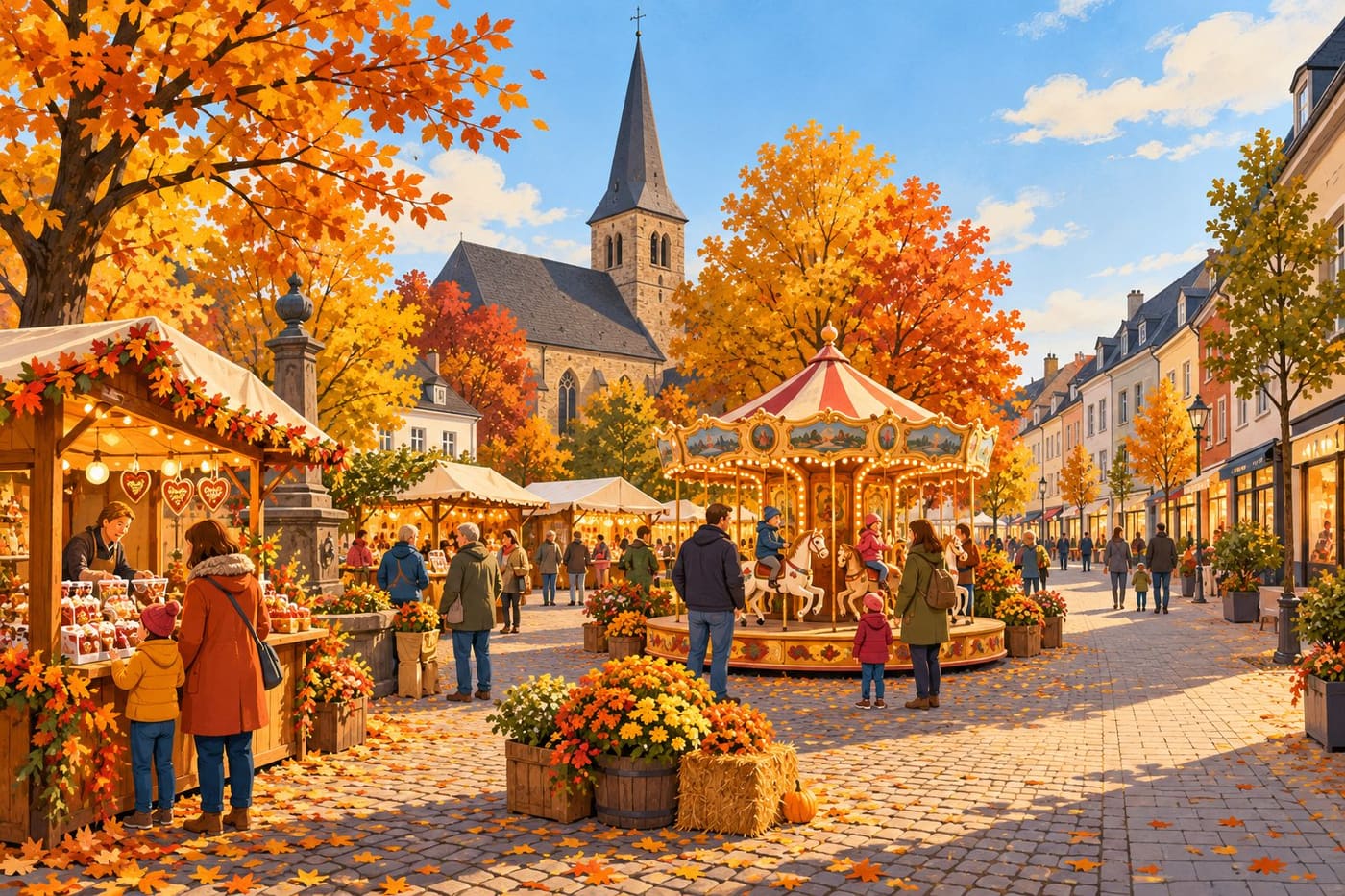
The Sunday-shopping window has ended. Visitors considering Aachen-Brand's autumn fair should now plan around the remaining Monday event and current transport information, rather than follow a Sunday itinerary. This guide updates the earlier preview and distinguishes the published programme from details that still need checking with operators.
The useful starting point is the location: Brand's market square, not an assumption that every event described as “Aachen” takes place in the old town. A precise destination, a realistic return journey and a modest plan for spending are more useful than a long list of attractions that has not been confirmed.
The confirmed programme and the elapsed shopping window
The [City of Aachen's 15 October announcement](https://www.aachen.de/services/presse/pressemitteilungen/2026/oktober/151026-brander-herbstkirmes/) places the Brander Herbstkirmes at Brander Marktplatz from 23 to 26 October 2026. Monday's published start is 11:00, with closing around 21:00. The city associates the neighbourhood fair with Saint Wendelin's patronal celebration. It also says the Tuesday 27 October weekly market moves to the parking area beside Marktschule on the street Marktplatz.
[Aachen Tourist Service](https://www.aachen-tourismus.de/en/aachen-entdecken/events/details/verkaufsoffener-sonntag-aachen-brand/) lists the separate 25 October shopping period as 13:00–18:00. That period is over. Its designated area includes Marktplatz, Marktstraße, Donatusplatz and specified sections of Trierer Straße and Freunder Landstraße; the notice does not establish city-wide opening. Monday shop hours must be checked individually.
Research checked 26 October 2026, Asia/Dhaka. All event times in this guide refer to local Aachen time. The fair hours are the published schedule, not live confirmation that every attraction is operating. Check for later changes before travelling.
Choose the purpose of the visit first
A fair visit and a shopping trip require different decisions. If a particular shop is the main reason for travelling, confirm that business's current hours before building the rest of the afternoon around it. If the fair is the purpose, treat shopping as optional rather than assuming the special Sunday arrangements extend into another day.
For a family, a useful plan begins with one or two priorities. Perhaps the aim is a short walk through the fair and one suitable attraction. Perhaps it is meeting relatives for food. Naming the main purpose helps avoid spending the entire visit searching for something that was never promised in the official announcement.
An original example is a group with three different preferences: one person wants a ride, another wants a meal and another wants to browse a shop. Write down which activity requires a confirmed opening time and which can be skipped. Agreeing beforehand is easier than negotiating every choice beside a noisy queue.
Keep an alternative small enough to be practical. If the preferred activity is unavailable, the alternative might simply be a shorter visit. This guide does not invent a nearby indoor venue, restaurant availability or a guaranteed attraction to make the itinerary appear complete.
Find the right destination without guessing a route
Enter the district and square into your journey planner, then check the resulting location before accepting the route. A familiar city name can conceal a substantial difference between the intended neighbourhood and the destination selected automatically by a search service.
Save the final destination in a form everyone in the group can recognize. A text address and a map marker are useful together: the marker gives visual orientation, while the address helps if the map fails or someone needs to ask for directions. Do not rely on a cropped screenshot that omits the district or street name.
For a meeting point, choose somewhere publicly accessible that you can identify on arrival. Agree that no one should wait inside a ride operating area or block an entrance. If the proposed landmark is crowded or unavailable, send the replacement location clearly rather than assuming others will follow the moving group.
This is general planning advice, not a surveyed walking route through the fair. Temporary barriers and on-site instructions take priority over an old map. A route that appears short on screen may not be available during an event.
Check the journey home as carefully as the outward trip
[ASEAG's official website](https://www.aseag.de/) provides journey-planning, departures and current traffic-information links. Use the actual travel date and intended return time. A route found for an ordinary weekday afternoon is not automatically a suitable route for a later departure.
A current example shows why this matters: ASEAG's [Kasinostraße closure notice](https://www.aseag.de/aktuelles/detail/kasinostrasse-gesperrt-so-fahren-die-busse-ab-26-oktober) says diversions begin on 26 October for lines 14, 14E, 34, 34E, 34V and 54. This is a network notice, not a statement that every visitor to Brand uses those lines. Check whether it affects your own planned connection.
Plan the return before deciding how long to stay. An original approach is to identify a preferred departure and one workable alternative. If the alternative is much later or requires a difficult connection, shorten the visit rather than assume a taxi or another bus will be available at a convenient price.
Keep enough battery to consult the departure information and contact your group. A saved itinerary is useful, but it is a record of a plan, not proof that a service is currently running. Recheck the relevant departure when you are ready to leave.
Accessibility is a chain of separate questions
ASEAG's [accessibility information](https://www.aseag.de/service/barrierefrei-unterwegs-in-aachen-und-der-staedteregion) describes low-floor buses with lowering functions, folding ramps and spaces for wheelchairs or pushchairs. Its page also sets conditions for mobility-scooter carriage. Those details concern the bus service; they do not certify the accessibility of a fair ride, stall, toilet or the entire route from a stop.
For a visitor with specific requirements, break the trip into stages: reaching the stop, boarding, leaving the bus, getting to the square, moving around the event and returning. A good answer for one stage does not remove uncertainty about the others.
Ask concrete questions where possible. “Is it accessible?” can produce an answer that is too general. A question about a step, surface, turning space, seating or a particular mobility device is more likely to reveal whether an arrangement meets the person's actual needs.
Do not interpret “family-friendly” as a promise of a quiet environment or universally suitable attractions. If noise, crowds or standing time are important considerations, plan a short visit with an easy option to leave. No quiet session or dedicated accessibility service has been verified for this event in this review.
Set a spending limit without inventing prices
The sources checked do not provide a complete list of ride and food prices. The tourist listing's free-admission label applies to its shopping event; it should not be expanded into a claim that fair rides, refreshments or purchases cost nothing.
An original budget example can help without pretending to quote local prices. Suppose a visitor chooses a total discretionary limit of thirty euros after setting aside transport money. They might reserve twelve for food, twelve for activities and six as a buffer. These are invented allocations, not prices charged at Brand.
If an activity costs more than the allocation, decide whether to reduce another category or skip it. The point of the plan is to make that choice consciously. A spending limit that excludes the journey home is incomplete, particularly if the return arrangement may require a different ticket.
Read the displayed terms before buying. Check whether a price covers one person, one ride or a group, and ask about accepted payment methods rather than assuming every operator accepts the same card or cash arrangement. Keep receipts where useful, especially for goods rather than immediate experiences.
Make food choices from current stall information
An event guide cannot tell you what every stall is selling or which ingredients are used on the day. If an ingredient or dietary requirement matters, ask the operator about the specific item before ordering. Do not infer an answer from the stall's name, a generic photograph or another visitor's recollection.
For a group, deciding on a pause for food can be more useful than attempting to predict the exact menu. It creates time to rest, compare choices and check the return plan. Keep the pause flexible enough that no one has to make a rushed purchase merely to preserve an imaginary timetable.
An original practical note is to separate everyone's choices before placing an order. Count portions and drinks, confirm the total and agree how the payment will be handled. This avoids confusion where several people order at once and each assumes someone else has paid for a particular item.
The guide makes no claim about stall hygiene ratings, allergen-free preparation or guaranteed dietary availability. Those would need specific evidence. A useful visitor article can identify what to ask without manufacturing reassuring answers.
Prepare for a change in conditions
Check the current local forecast before departure rather than treating “autumn fair” as a weather prediction. Choose clothing for the conditions expected during the whole outing, including the return journey. This article has not verified a forecast and does not claim that Monday will be dry, mild or free of disruption.
Leave room for changes in the plan. A queue, a temporary pause or a group member's need for a break can consume time without being a failure of the visit. A schedule with no spare time makes every small change harder to manage.
Keep a compact list of essentials instead of carrying items for every hypothetical problem. The relevant items depend on your own needs, but a charged phone, necessary personal supplies and the means to get home deserve priority over extra purchases made because the itinerary sounded ambitious.
If on-site staff stop an activity or redirect visitors, follow their instructions. Do not treat a published opening time as an entitlement to enter a restricted area. The schedule describes the event's intended operation, not permission to ignore the conditions at the location.
If something is left on the bus
ASEAG's [lost-property page](https://www.aseag.de/fundbuero) provides the relevant contact route for items lost on its buses, at stops or in its customer centre. It lists its lost-property office at Neuköllner Straße 1 and telephone 0241 1688-3021. Check the current page for opening times and collection instructions before travelling there.
A useful original lost-item note records the route, direction, approximate time, boarding and departure points, and a description of the item. Those details are more useful than saying only that something disappeared during a trip to Aachen.
Keep identifying details available for a private conversation with the service. Do not publish sensitive contents or personal document numbers in an open social post. If the item was lost at a fair stall rather than on transport, contact the relevant operator instead of assuming the bus company's office will receive it.
This is a contact route, not a guarantee that an item has been found. Ask for confirmation before making a collection trip, and follow the service's instructions for establishing ownership.
A short checklist before leaving
The final check should answer practical questions rather than repeat the whole article:
- Have I checked the correct date and the latest event notice?
- Does the destination clearly identify Aachen-Brand?
- Is the activity I care about actually confirmed?
- Have I checked outward and return transport, including disruptions?
- Are accessibility and dietary questions resolved where necessary?
- Have I kept transport money separate from optional spending?
- Does the group know where to meet if separated?
If a key answer is missing, resolve it before travelling or simplify the plan. A short, well-prepared visit can be more enjoyable than a packed itinerary built from assumptions. The published programme is a starting point; the final decisions depend on the people making the trip and the current conditions.
Conclusion
The updated plan separates a completed Sunday-shopping event from the fair's remaining published day. Use the official notice for the programme, the transport operator for the journey and individual businesses or attractions for their own arrangements. That division keeps the guide useful without promising details that the sources do not establish.
Sources and research note
City, tourist-service and ASEAG sources are linked beside the relevant information and were checked on 26 October 2026. Earlier forward-looking Sunday instructions have been replaced. The existing URL may retain the earlier Sunday title; this article's heading and update explain the current scope.
Budget examples and planning suggestions are original editorial material, not official prices or an inspected route. The generated illustration is conceptual and does not document the actual fair. AI-assisted text has been edited; limited phrase searching is not a comprehensive plagiarism scan. No personal attendance, booking, live-weather check or transport-service guarantee is claimed.